
Claude Haiku 5.5 for coding sub-agents: what the price cut changes
Anthropic's Haiku 5.5 makes high-volume subagent work cheap enough to measure. When to route there, and when Sonnet still leads.
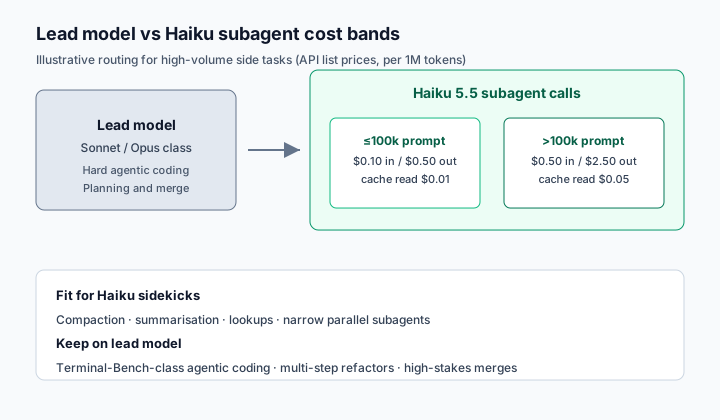
On 7 October 2026 Anthropic announced Claude Haiku 5.5, positioned for high-volume, cost-sensitive work and as a subagent beside Sonnet 5.5 and Opus 5.5 on coding tasks. The list price for short prompts is low enough that teams can finally put a number on compaction, lookups and parallel sidekicks. That does not mean Haiku replaces the lead model on hard agentic coding. This article sets out the prices, the Terminal-Bench gap, and how engineering leaders should re-price routing rather than rewrite their model stack.
Context: what shipped and who can use it
Haiku 5.5 is available on Anthropic's platforms and on Amazon Web Services, Google Cloud and Microsoft Azure. The Claude Platform model id is claude-haiku-5-5. Anthropic describes it as suited to summaries, compactions, database queries, classification and other narrow workloads, and as a pairing with larger Claude models for coding subagents.
The same announcement cut Sonnet 5.5 cache reads from $0.20 to $0.10 per million tokens, which Anthropic says makes Sonnet about 20% cheaper on most agentic work. That is a separate change from Haiku's own prices, but it matters for teams that keep Sonnet on the lead path while moving side work to Haiku.
GitHub's Copilot weekly changelog for 5 October states that Claude Haiku 5.5 is available to Copilot Pro, Pro+, Max, Business and Enterprise users. So the model is not only an API story; it is already in a widely used coding client.
Anthropic's Haiku 5.5 system card (7 October 2026) summarises pre-deployment evaluations. It reports large gains over Haiku 4.5 in many domains, usually without matching Sonnet 5.5, and notes RSP evaluations that did not cross new thresholds relative to larger Claude models.
Pricing bands: do not apply the cheap rate to long prompts
Anthropic publishes two bands. For prompts up to 100,000 tokens, Haiku 5.5 list prices are $0.10 per million input tokens, $0.50 per million output tokens and $0.01 per million cache reads (cache writes $0.125). For prompts over 100,000 tokens the figures are $0.50 / $2.50 / $0.05 (cache writes $0.625).
Anthropic says Haiku 5.5 is priced about 90% lower than Haiku 4.5 for requests up to 100,000 tokens, and about 50% lower above that. It also says that, after tokeniser and token-use changes, the model costs around 75% less on average to run than Haiku 4.5. Footnotes on the announcement stress that about 90% of Haiku 4.5 traffic fell in the ≤100k band, and that Haiku 5.5's updated tokeniser uses slightly more tokens per task.
That last point is easy to misread. A team that prices every call at $0.10/$0.50 will understate spend on long agent contexts. Measure which band your subagent prompts actually land in.
The same week Anthropic said it would roll out monthly API credits for Max and Team subscribers on the Claude Platform: Max 5x $100, Max 20x $200, and Team up to $500 pooled. Those credits are for Max and Team subscribers experimenting with agents on the Claude Platform. They are not a general API discount for every customer.
Analysis: Terminal-Bench still belongs to larger models
On Terminal-Bench 4.0, Anthropic reports Haiku 5.5 at 39.2%, Haiku 4.5 at 0.0% and Sonnet 5.5 at 70.6%. The announcement is explicit that Sonnet 5.5 and Opus 5.5 remain better choices for complex agentic coding of the kind Terminal-Bench measures, while Haiku 5.5 fits narrowly scoped work that was previously cost-prohibitive.
That is the right framing for engineering leaders. A jump from 0% to 39% on Terminal-Bench is a real capability step for a small model. It is not a reason to put Haiku on the critical path for multi-step professional CLI work when Sonnet scores roughly 30 points higher on the same vendor table.
Customer quotes on the announcement lean the same way: sidekicks for lookups while a larger model builds the deck; Fusion-style lead plus Haiku sidekick; high-volume document Q&A. Treat those as product positioning, not as independent benchmarks.
What it means for engineering and security leaders
Re-price the harness, not only the model catalogue. As the harness sets the bill and prompt caching both stress, token mix and call shape dominate spend. Haiku 5.5 changes the economics of high-call-count patterns: compaction every turn, parallel research subagents, classification before a lead call.
Keep a lead model for hard agentic coding. Route Sonnet or Opus (or your organisation's equivalent) to multi-file refactors, merge-risk changes and Terminal-Bench-class tasks. Use Haiku where failure is cheap and volume is high.
Separate Max/Team credits from API planning. Budget owners should not assume $100–$500 of monthly credits apply to every seat or every provider path.
Watch Copilot and other clients. When a vendor adds Haiku to a subscription product, usage can shift without an explicit API decision. Make the default model and subagent policy visible.
Open-weight subagents remain a parallel option. Teams that already run small open-weight models for coding side work should compare Haiku's API economics against local or private inference, as in small open-weight models for coding sub-agents.
Practical takeaways for this week
- List which agent steps are compaction, lookup, classification or narrow research, and price them at both Haiku 5.5 bands.
- Keep a written rule: lead model for merge-critical agentic coding; Haiku only for side tasks with a clear stop condition.
- Measure share of prompts over 100k tokens before celebrating the $0.10/$0.50 sticker.
- If you use Claude Max or Team, check whether Platform API credits are active and what they cover.
- In Copilot, confirm which roles can select Haiku 5.5 and whether enterprise policy pins a lead model.
- Track requested versus answered model on every proxy path so sidekick routing is auditable.
Where SpanDock fits
Through the SpanDock model proxy and budgets, the server can sit between tools and providers, record the requested model and the model that answered, and apply rules or SpanDock Mind so a cheaper model is used when it is good enough. Budgets and SpanDock Mind are on Standard and up; routing rules are on Premium and up. See also getting started for how sessions and cost show on the local dashboard, and per-person AI budgets and model advisor for the product walkthrough.