
Sol, Sonnet 5.5 or Haiku 5.5: a practical coding model map
Three coding-relevant models landed within ten days. Rather than picking one default, map task types to model tiers and check vendor benchmarks with care.
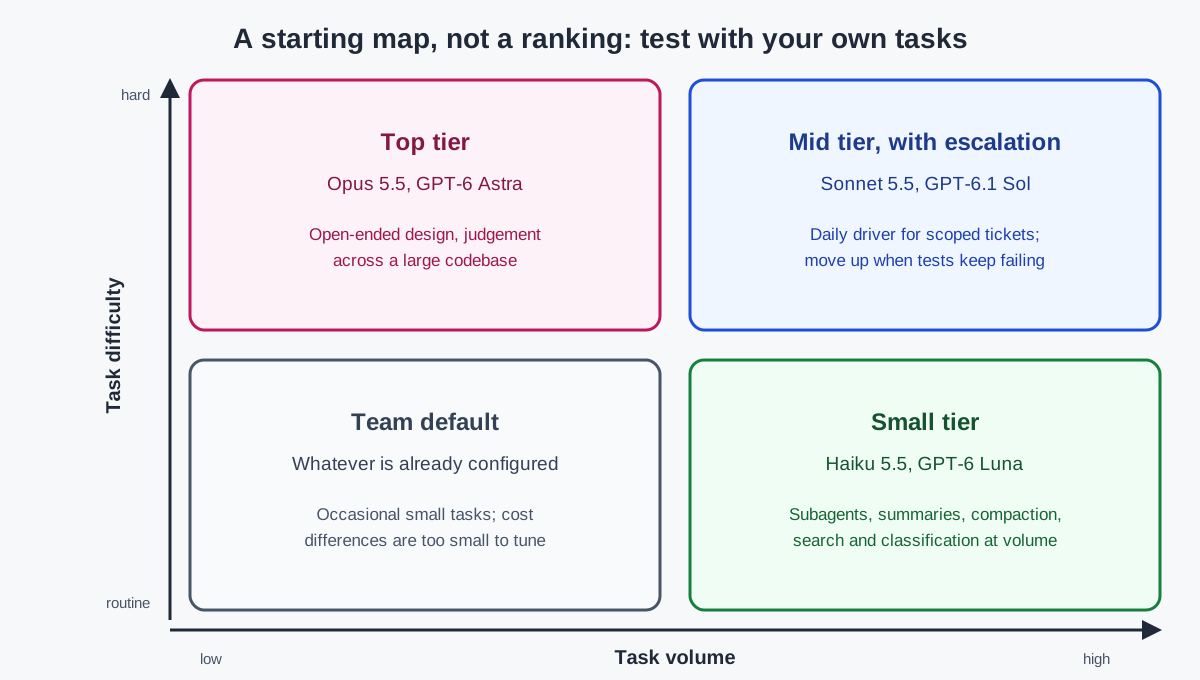
Between 28 September and 7 October 2026, Anthropic released Claude Sonnet 5.5 and Claude Haiku 5.5, and OpenAI released GPT-6.1 Sol. Each vendor published benchmarks that show its model in a good light, and each model is a reasonable choice for some coding work. The mistake would be to pick one as the default for everything and leave it there. A better approach is a short task taxonomy, with a model tier for each kind of work, and an evaluation habit that does not depend on any one vendor's charts.
The prices side by side
List prices per million tokens, from each vendor's own pages:
| Model | Input | Output | Cache reads | Cache writes |
|---|---|---|---|---|
| GPT-6 Luna | $0.10 | $0.50 | $0.01 | not listed |
| Claude Haiku 5.5, prompts up to 100k tokens | $0.10 | $0.50 | $0.01 | $0.125 |
| Claude Haiku 5.5, prompts over 100k tokens | $0.50 | $2.50 | $0.05 | $0.625 |
| GPT-6.1 Sol | $2.00 | $10.00 | $0.10 | $2.50 |
| Claude Sonnet 5.5 | $2.00 | $10.00 | $0.10 | $2.50 |
| GPT-6 Astra | $10.00 | $50.00 | $1.00 | not listed |
Sources: the GPT-6.1 Sol announcement for the OpenAI models, the GPT-6.1 Sol model page for Sol's cache writes, and the Claude Haiku 5.5 announcement for the Anthropic models, including Sonnet 5.5's cache-read price after it was halved on 7 October.
The list prices hide three differences that change real bills:
- Haiku 5.5 has a size threshold. Prompts over 100,000 tokens cost five times as much per token. Anthropic says prompts up to that size made up around 90% of requests to its previous Haiku model, but long agent sessions can cross the line.
- Sol has one too. The Sol model page says prompts with more than 272K input tokens are priced at 2x input and cache rates and 1.5x output for the whole request.
- Tokenisers differ. Anthropic says Haiku 5.5 has an updated tokeniser, similar to Sonnet 5.5's and Opus 5.5's, and uses slightly more tokens per task than Haiku 4.5. The same text does not cost the same number of tokens across vendors, so equal per-token prices do not mean equal cost per task.
What the vendors claim
OpenAI says GPT-6.1 Sol comes close to GPT-6 Astra on agentic coding, computer use and professional work at a fifth of Astra's standard token prices, and that on DeepSWE v1.1 it matches Astra at roughly one-fifth of the cost.
Anthropic's Sonnet 5.5 announcement reports 70.6% on Terminal-Bench 4.0 and positions Sonnet 5.5 for well-scoped everyday tasks and bug fixing, while saying Opus 5.5 remains clearly stronger at complex, open-ended work. Its Haiku 5.5 page compares Haiku 5.5 with GPT-6 Luna: 39.2% against 16.4% on Terminal-Bench 4.0, and 46.4% against 42.4% on FrontierCode 1.1, with Sonnet 5.5 listed at 70.6% and 52.1% respectively. Anthropic describes Haiku 5.5 as best suited to narrowly scoped tasks such as compaction, summarisation and subagent work, and pairing well with Sonnet 5.5 and Opus 5.5 as a subagent.
These figures are not directly comparable. OpenAI leads with DeepSWE and its own professional-work benchmarks; Anthropic leads with Terminal-Bench, FrontierCode and CursorBench. Each vendor ran its own evaluations in its own setup, and the comparison numbers for the other vendor's models come from that same setup.
Comparing fairly
Independent benchmark methodology shows why this matters. The Artificial Analysis Coding Agent Index methodology makes three points that apply to any internal evaluation too:
- The agent is the unit, not the model. "Each public row is an agent variant, not a model", and settings such as reasoning effort are reported as separate rows.
- Refusals cost points. Attempts blocked by a safety refusal score zero, which matters for benchmarks that include security work.
- Fallbacks are scored as normal. When an agent switches to another, often less capable, model to finish an attempt, that attempt is scored like any other.
The second and third points connect to how these models are deployed. Anthropic says higher-risk cybersecurity tasks on Sonnet 5.5 visibly fall back to Sonnet 5, so a score on a benchmark with security tasks can partly reflect a different model. The article on how the harness sets the bill covers why the same model costs different amounts in different agents.
A task map instead of a default
The vendors' own positioning suggests three tiers for coding work:
Small tier: Haiku 5.5 or GPT-6 Luna. High-volume, narrow work: subagents that search or summarise, context compaction, classification, simple database queries. Price per token matters most here, and the 100k threshold on Haiku should be watched.
Mid tier: Sonnet 5.5 or GPT-6.1 Sol. The daily driver for scoped tickets with tests: bug fixes, small features, refactors with clear acceptance criteria. Both list at the same price, so the choice between them depends on your evaluation results, your harness and what your organisation already uses. The articles on Sonnet 5.5's economics and Codex's switch to Sol go into each.
Top tier: Opus 5.5 or GPT-6 Astra. Open-ended design, changes that need judgement across a large codebase, and work where a failed attempt is expensive. Anthropic says Opus 5.5 remains clearly stronger at complex, open-ended work, and OpenAI says Astra should be used for the most difficult scientific research tasks.
Routing between tiers can be simple: start each kind of task at its tier and move up when the cheaper model repeatedly fails the tests. Effort settings add a second dial within each model, and as the article on prompt caching explains, cache hit rates often decide the bill as much as list price.
What it means for engineering and security leaders
There is no single winner. Vendors measure different things, and each model is competitive somewhere. What leaders can control is the process: a fixed set of real tasks from your own repositories, run on each candidate through the agent you actually use, with cost per completed task and pass rate recorded. Repeat it when a new model or price change lands, which on recent evidence is every few weeks.
Practical takeaways
- Write down three or four task types your teams run, and assign a starting model tier to each.
- Evaluate models through your real agent and settings, not through vendor charts.
- Measure cost per completed task, including cache reads, rather than cost per token.
- Watch the Haiku 5.5 100k-token threshold and the Sol 272K-token threshold in long sessions.
- Treat vendor-reported comparisons with other vendors' models as indicative only.
- Re-run your evaluation after each model release or price change.
Where SpanDock fits
The SpanDock model proxy can apply parts of a map like this. SpanDock Mind, on the Standard plan and up, looks at the start of each new conversation and chooses a cheaper model when it is good enough; routing rules that swap models are on the Premium plan and up; and per-person budgets, on Standard and up, limit models to cheaper ones near the limit. A conversation keeps its model for six hours, so the model does not change mid-task.