
GPT-6.1 Sol: near-Astra coding performance at one-fifth the token price
OpenAI's GPT-6.1 Sol lists at $2/$10 per million tokens against Astra's $10/$50. What that changes for default coding models, caching and harness cost.
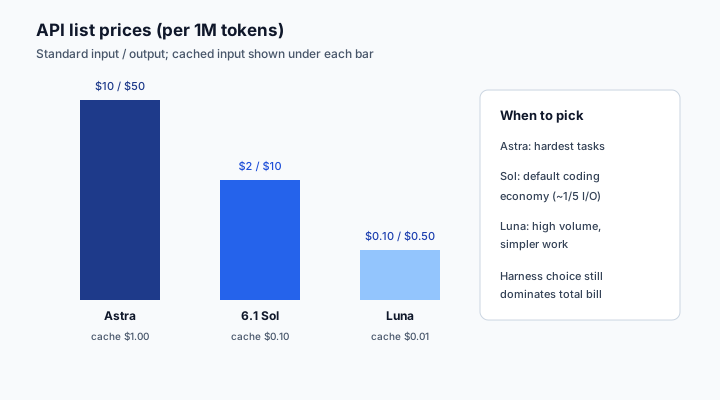
OpenAI's GPT-6.1 Sol announcement frames the model as near-Astra intelligence for agentic coding, computer use and professional work at one-fifth of Astra's standard input and output token prices. For teams that meter API usage, that is a default-model reset. It is not a claim that Sol equals Astra on every task, and it is not a license to ignore harness cost. This article compares list prices, availability caveats and what engineering leaders should change in routing policy.
Context: prices, ids and where it runs
API list prices for gpt-6.1-sol, as stated on the announcement and confirmed on the model docs page, are $2 per million input tokens, $10 per million output tokens and $0.10 per million cached input tokens. Cache writes are listed at $2.50 per million tokens on the docs page. OpenAI contrasts Astra at $10 / $50 / $1.00 cached: Sol standard I/O is about one-fifth, and Sol's cached input is 95% less than Sol's own uncached input (and half of GPT-6 Sol's prior cached input price, per the announcement).
GPT-6 Luna remains the cheap tier on the same announcement table at $0.10 / $0.50 / $0.01 cached. Treat Luna as high-volume everyday work, Sol as the new near-frontier coding default, and Astra as the model for the hardest tasks.
Availability at announcement: ChatGPT Work and Codex for Plus, Pro, Business, Enterprise and Edu users; not yet in Chat. Developers can call the API as gpt-6.1-sol. Codex rust-v0.161.0 (7 October 2026) makes GPT-6.1 Sol the default model in the bundled and Amazon Bedrock catalogues. The same release makes Daybreak opt-in, via --enable cli_daybreak or features.cli_daybreak=true.
The announcement said Ultrafast would arrive "in the coming days." The live model docs now describe Ultrafast mode (service_tier: "ultrafast") with prices at 6× Standard. Treat Ultrafast as a billed speed tier documented on the model page, not as free acceleration, and confirm your account's enablement before budgeting for it. Docs also note 2× Standard for Fast mode, and that prompts with more than 272K input tokens are priced at 2× input/cache and 1.5× output for the full request.
Analysis: near-Astra is a vendor claim you should validate
OpenAI reports Sol matching Astra on DeepSWE v1.1 at roughly one-fifth the cost, with other vendor-run comparisons on GDP.pdf, AutomationBench, OSWorld and Terminal-Bench Science. Those figures are OpenAI's evaluations. They are useful for ordering models on a shortlist; they are not a substitute for your own repository tasks.
Two cost mistakes are common after a price cut like this:
- Comparing uncached Sol to cached Astra (or the reverse). Always label cache state.
- Assuming the model is the whole bill. As the harness sets the bill argues, agent software can swing cost by several times at fixed model prices. Sol as Codex's new default will change spend only if call shape stays similar.
Subscription versus metered paths still matter (subscription vs metered AI pricing). Seats that include Codex may absorb Sol differently from raw API keys. Prompt caching economics (prompt caching and AI coding costs) become more attractive when cached input is $0.10/M on a capable coding model.
Family context from Sol and Luna
OpenAI's earlier Sol and Luna introduction set the family ladder that 6.1 Sol inherits. Luna absorbs high-volume everyday work; Sol targets agentic coding and computer use; Astra remains the top-price tier for the hardest tasks. When finance models "we moved everything to Sol," check whether Luna still covers summarisation, classification and simple refactors. Mixing Luna and Sol under routing rules usually beats a single default for cost control.
Codex's catalogue flip also interacts with Bedrock and other hosted catalogues. If some environments pin an older Codex release, they will keep answering on the previous default while others silently move to Sol. That split is a support burden as much as a cost surprise.
What it means for engineering and security leaders
Update the default coding SKU in policy. If Astra was the default "safe" choice for agentic coding on price grounds alone, revisit. Keep Astra (or equivalent) for the hardest scientific or long-horizon work where OpenAI itself still recommends it.
Instrument requested versus answered model. Defaults change under you when CLI catalogues update. Without records, finance will see a bill move and not know why.
Separate Ultrafast experiments. 6× Standard can erase the Sol price advantage quickly. Gate the tier.
Re-run a fixed internal eval pack. Vendor DeepSWE parity is not proof on your monolith.
Long-context price multipliers
The model docs price prompts above 272K input tokens at 2× input and cache rates and 1.5× output for the full request. Agent sessions that stuff large repositories into context can erase Sol's headline advantage. Prefer retrieval and compaction patterns that keep prompts under that threshold unless the task truly needs the full window.
Practical takeaways for this week
- Record Sol, Astra and Luna list prices (including cached and Ultrafast multipliers) in your model catalogue.
- Check whether Codex 0.161.0+ has flipped your default without a team decision.
- Keep Chat availability out of runbooks until OpenAI lists Sol in Chat.
- Run the same ten internal tasks on Sol and Astra; compare pass rate and $ per task.
- Cap Ultrafast to latency-critical paths with an explicit budget.
- Align cache-friendly prompt prefixes so the $0.10 cached rate is reachable.
Where SpanDock fits
The SpanDock model proxy records the requested model and the model that answered, how the choice was made, tokens, cost and savings. Budgets and SpanDock Mind are on Standard and up; routing rules are on Premium and up. That is the practical way to see whether Sol is actually answering after a catalogue default change.