
Three Copilot models retire on 16 November: what to check before then
Claude Opus 4.8, Claude Opus 5 and GPT-5.6 Terra leave GitHub Copilot on 16 November 2026. What the replacements cost, and a routine for the next retirement.
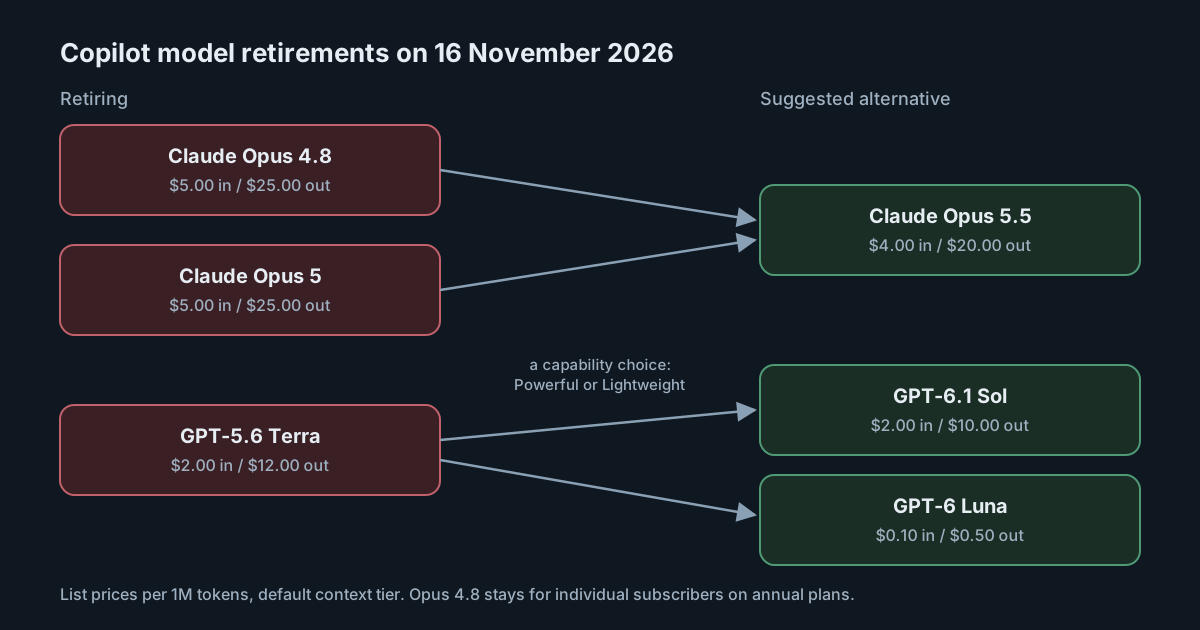
GitHub will remove three models from every Copilot experience on 16 November 2026: Claude Opus 4.8, Claude Opus 5 and GPT-5.6 Terra. For most users the change is invisible, because the suggested replacements are enabled by default and cost the same or less at list price. For teams that pinned a model in a workflow, an evaluation or a policy, it is a deadline. This article covers what changes, what the replacements cost, and a routine for the retirements that will keep coming.
What GitHub announced
The changelog entry of 15 October applies to Copilot experiences including Copilot Chat, inline edits, ask and agent modes, and code completions. It suggests one replacement for the two Claude models and two for the GPT model:
| Retiring model | Suggested alternative |
|---|---|
| Claude Opus 4.8 | Claude Opus 5.5 |
| Claude Opus 5 | Claude Opus 5.5 |
| GPT-5.6 Terra | GPT-6.1 Sol or GPT-6 Luna |
There is one exception. Claude Opus 4.8 stays available to individual Copilot subscribers on annual plans, so that they keep an Opus option. For Copilot Business and Enterprise, the alternatives are switched on automatically under default model enablement, unless an administrator has turned the global default off or disabled the model. GitHub says no action is needed to remove the old models.
Three details are less clear. The supported models page still lists all three as generally available, and its retirement history table doesn't include them yet. The changelog says "deprecate" while the documentation's table uses "retirement" for removal. And the changelog doesn't mention "Claude Opus 4.8 (fast mode) (preview)", which the docs list as a separate model. If your teams use the fast mode variant, ask GitHub before assuming it stays or goes.
What the replacements cost
Copilot bills usage above each plan's included allowance per token, in AI credits worth $0.01 each, at the rates on the models and pricing page. Per million tokens, at the default context tier:
- Claude Opus 4.8 and Claude Opus 5: $5.00 input, $0.50 cached input, $6.25 cache write, $25.00 output.
- Claude Opus 5.5: $4.00 input, $0.20 cached input, $5.00 cache write, $20.00 output.
- GPT-5.6 Terra (up to 272K input tokens): $2.00 input, $0.20 cached input, $2.50 cache write, $12.00 output.
- GPT-6.1 Sol (up to 272K): $2.00 input, $0.10 cached input, $2.50 cache write, $10.00 output.
- GPT-6 Luna (up to 272K): $0.10 input, $0.01 cached input, $0.125 cache write, $0.50 output.
So the Claude move is 20% cheaper on input and output and 60% cheaper on cached input, which matters most for long agent sessions that reread the same context. The Terra move to Sol keeps the input price, lowers output by about a sixth and halves cached input.
The two GPT alternatives are not equivalent, though. The pricing page places GPT-5.6 Terra in its "Versatile" category, GPT-6.1 Sol in "Powerful" and GPT-6 Luna in "Lightweight". Luna is roughly a twentieth of Terra's price, but it is a smaller class of model. Choosing between them is a capability decision first and a cost decision second. Per-token prices also say nothing about how many tokens a newer model spends on the same task, so measure your own work before you forecast a saving.
Retirement is now routine
The retirement history table lists 27 models retired between 17 February and 2 October 2026, on 13 separate dates. With these three, that becomes 30 in the year, although Claude Opus 4.8 stays available to individual subscribers on annual plans. The suggested alternative is often a moving target such as "Latest Claude Opus model", not a named model.
Documentation lags too. The pricing page still lists Claude Sonnet 4, which the retirement table says was retired on 1 May. None of this is unusual for a service that offers dozens of models, but it means the model you tested in spring is unlikely to be the one answering in autumn.
Many users won't notice. Auto model selection chooses the model for new sessions from a list that already includes Claude Opus 5.5 and GPT-6.1 Sol, and administrators can make it the default by setting model to "auto" in managed settings. The teams that will notice are the ones that chose a model on purpose.
What it means for engineering and security leaders
- Pinned models are configuration. The managed settings reference has a
modelkey that sets the default model for new conversations, with per-team overrides. The documentation doesn't say what a client does when that value names a retired model. Check your enterprise and team settings files now, not on 16 November. - Evaluations go stale with the model. If you approved Opus 5 or Terra for a task after testing, the replacement hasn't passed that test. Rerun the evaluation, or at least a representative sample, before the date.
- Default enablement cuts both ways. It keeps users working, but it also means new models arrive without a review unless someone turned the default off. Decide which of those you want.
- Model approvals need an owner. With a retirement every few weeks, someone has to watch the changelog and update the approved list.
Practical takeaways
- Search workflows, scripts, prompt files and managed settings for
Opus 4.8,Opus 5andGPT-5.6 Terramodel identifiers, and replace them before 16 November. - If you disabled the global default, enable Claude Opus 5.5, GPT-6.1 Sol or GPT-6 Luna explicitly through model policies.
- Pick Sol or Luna for each Terra workload deliberately, and test it.
- Ask GitHub whether the Opus 4.8 fast mode variant is included.
- Add the Copilot changelog's retirement entries to whatever process owns your approved model list.
To see how much of your teams' work still runs on a retiring model, look at usage by model. If your AI tools send telemetry to SpanDock, the Models page described in model proxy and budgets ranks the models they used by spend, tokens, calls, speed, reliability or cost per million tokens, shows how each one moved since the previous period, and lists each model's list price for comparison.