
Gemini 4 Argon is generally available: price, limits and the 1 December change
Gemini 4 Argon launched on 13 October 2026 at an introductory API price that doubles on 1 December. What it costs, what Google claims, and what to plan for.
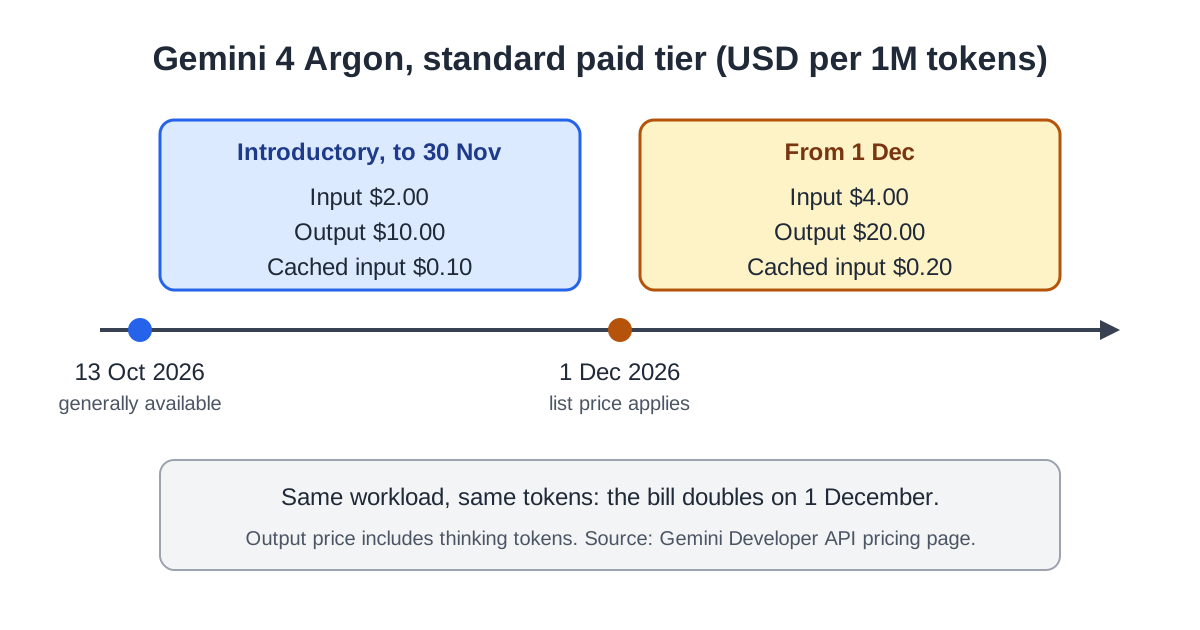
Google made Gemini 4 Argon generally available on 13 October 2026, through the Gemini API, its own coding tools and its consumer apps. For teams that pay per token, the headline is a date rather than a benchmark: Argon launched at an introductory API price that doubles on 1 December 2026. If you plan to put Argon into a coding agent, a review bot or an internal tool this quarter, the budget you set now will be wrong from December unless you plan for the change.
What Google released
In its launch post, Google describes Argon as its new frontier model for long, multi-step work in coding, finance, law, security and science. It is available to developers and enterprises through the API in AI Studio and the Gemini platform, to Google AI Ultra subscribers in Google Antigravity, and to Ultra and Pro subscribers in the Gemini app and AI Mode in Search.
Two details matter for engineering teams:
- Context. Google states a 1 million token unified input-output limit through the Gemini API, and points developers to a new continuation protocol, described in its documentation, for long tasks.
- Access by surface. The API pricing page says Argon is not available on the free tier or on the Google AI Pro plan, while the launch post lists Pro subscribers for the Gemini app. Which surface a person uses decides whether they can reach the model at all, and who pays for it.
What it costs, and when that changes
The launch post gives an introductory price of $2 per million input tokens and $10 per million output tokens, with cached input tokens at 95% off. A footnote adds that after the introductory period ends on 30 November 2026, $4 and $20 apply, and that this "applies to the Argon model intended for public access only".
The pricing page matches those numbers and fills in the rest for the standard paid tier:
| Rate, per 1M tokens | To 30 November 2026 | From 1 December 2026 |
|---|---|---|
| Input | $2.00 | $4.00 |
| Output, including thinking tokens | $10.00 | $20.00 |
| Context caching | $0.10 | $0.20 |
Every standard rate doubles. The page lists other service tiers (batch, flex and priority) with their own rates, and those also step up on 1 December. It also notes that Argon supports implicit caching only; explicit caching is not supported. That matters for agent builders who rely on explicitly marking a prefix for reuse: with implicit caching, you get the discount only when the provider recognises a repeated prefix, so prompt layout matters even more.
Output pricing includes thinking tokens. For a reasoning model working through a long agent task, thinking can be a large share of output, so the output rate is usually the one that drives the bill.
A worked example
Take a team whose Argon-backed review agent uses 100 million fresh input tokens and 10 million output tokens a month on the standard tier, ignoring caching. In October and November that costs about $200 for input plus $100 for output, $300 a month. From December, the same work costs $600. Nothing about the workload changes; only the date does.
How it compares on list price
The introductory price lands on a familiar number. OpenAI's GPT-6.1 Sol is listed at $2 per million input tokens, $10 per million output tokens and $0.10 per million cached input tokens. Until 30 November, Argon's standard list rates are the same; from 1 December, they are twice Sol's. List price is only a starting point, though: models use different tokenisers and different amounts of reasoning for the same task, so cost per completed task can differ a lot from what the per-token rates suggest. The article on how the harness sets the bill covers why the agent around the model often matters as much.
What Google claims, and how to read it
Google's launch post includes results from its own use and from early access partners. Treat these as vendor-reported, not as measurements you can reproduce:
- In Antigravity, Argon "helped teams increase agentic code submissions by more than 35% while reducing code rollbacks by nearly a third", according to Google's internal use.
- On Google's open-source Agent Development Kit, Google says overnight autonomous work produced changes that cut in-memory session preparation time by 40% in long sessions and sped up cold imports by 21%.
- On security, Google reports that Argon leads the Gray Swan indirect prompt injection benchmark, with attack success across 15 adaptive attempts cut to 0.7%, and that shortcut attempts on coding benchmarks dropped to 2%.
These are useful signals of what Google optimised for: long autonomous runs, refactoring at scale, and resistance to injected instructions. They are not evidence that Argon will do the same in your repository, with your harness, at your effort settings. Internal productivity figures in particular depend on how work is measured and which teams took part.
The security numbers deserve the same care. A 0.7% attack success rate on one benchmark is a meaningful improvement, but it is not zero, and adaptive attackers in real deployments are not limited to 15 attempts. Model-level resistance reduces risk; it does not replace controls around what an agent can reach.
Defender access is a separate track
The launch post also expands Google's Fairwind Program, which gives selected cyber defenders access to Argon without its cyber guardrails, on a rolling basis and by application. The footnote that limits the new price to the public-access model suggests Google treats these as distinct offerings. Teams should not assume the public API model and the defender programme behave the same way, or cost the same.
What it means for engineering and security leaders
Budget against the list price, not the launch price. If Argon does well in a trial during October and November, the business case should be written at $4 and $20. A pilot that only makes sense at the introductory rate is a pilot that will be cancelled in December.
Put the date in someone's calendar. Price changes on a fixed date are easy to miss when costs are reviewed monthly. Someone should own checking spend in the first week of December, and updating any internal price tables that estimate cost from tokens.
Evaluate on your own tasks. Vendor benchmarks and internal anecdotes say little about your codebase. Run Argon on a fixed set of real tickets with the harness you actually use, and record cost per completed task, not cost per token.
Watch output and thinking tokens. Because thinking is billed as output, effort settings and task length change cost more than input size does. Track output tokens per task alongside quality.
Practical takeaways
- Write any Argon business case at the 1 December rates: $4 input, $20 output and $0.20 cached input per million tokens on the standard tier.
- Set a reminder for the first week of December to compare actual spend against forecasts, and update internal price catalogues before then.
- Check which surface each team uses (API, Antigravity, Gemini app) and confirm their plan actually includes Argon.
- Keep prompt prefixes stable so implicit caching can apply; see the notes on prompt caching and AI coding costs.
- Measure cost per completed task on your own work before switching a default model.
- Treat Google's productivity and security figures as vendor claims until you have your own numbers.
Where SpanDock fits
Many tools report tokens but not cost. The SpanDock model proxy and budgets page explains that in that case SpanDock estimates cost from a price catalogue, marks it as estimated, and takes your own overrides under Settings → Model prices first, so you can enter new rates yourself when a price changes. Per-person budgets, on the Standard plan and up, keep each person's spend through the proxy within a limit: near it only cheaper models are used, and over it calls are blocked, downgraded or flagged, as you choose. For a broader view of planning AI spend, see subscription versus metered AI pricing.