
Mistral Large 4 after the launch discount: what the preview costs now
Mistral Large 4's half-price launch period has ended. Current prices, what the preview does and does not include, and how to test it before routing traffic.
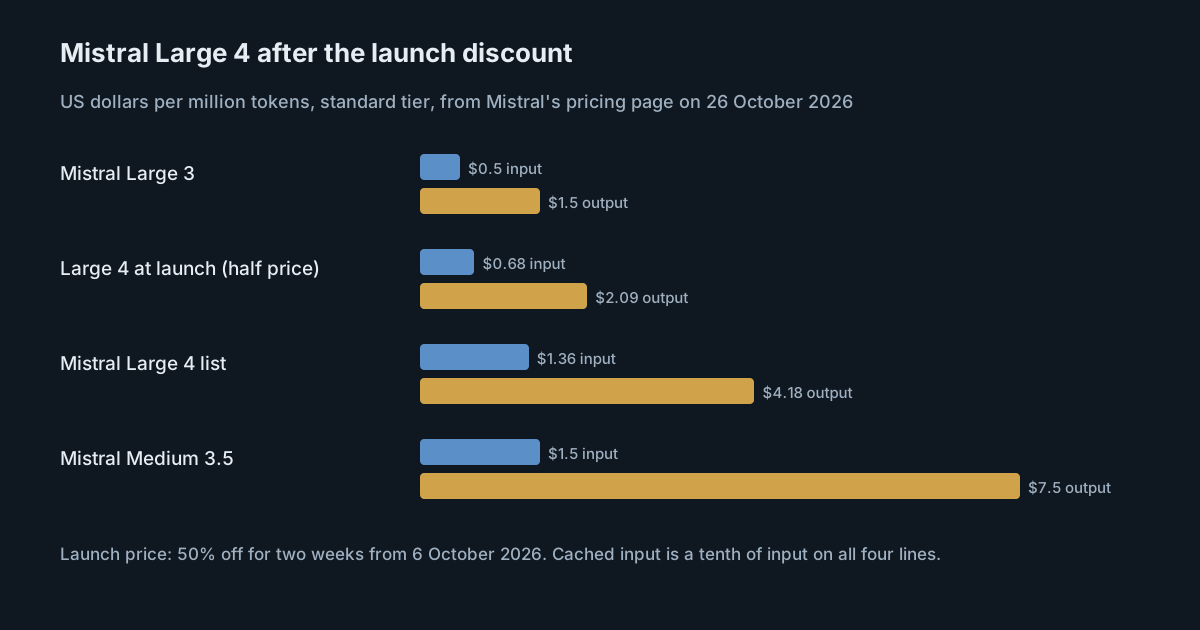
Mistral Large 4 arrived on 6 October 2026 as a public preview with a launch offer: according to Mistral's changelog, "50% off for 2 weeks". That period has now passed, and the pricing page lists the model at its full rate. Teams that tried it during the discount, or put it behind an agent, should rerun their numbers before the next bill.
This piece sets out what the preview is, what it costs now compared with Mistral's other models, and how to decide whether it earns a place in your routing.
What Mistral released
The model card describes Mistral Large 4 as an open-weight, general-purpose multimodal model with a mixture-of-experts design, listed as version 26.10 and in Public Preview from 6 October 2026. The changelog gives it a 1M-token context window.
The two Mistral sources describe its size slightly differently. The model card says 52B active parameters and 1.05T total, plus a 1.6B vision encoder. The launch post calls it "a 1 trillion-parameter" model with 52 billion active. The difference is rounding rather than a contradiction, but the model card is the more precise figure.
The weights are not out yet. The changelog says "Open weights are coming soon", and the launch post says they will be released by the end of the month. Until they are published, Mistral Large 4 is an API-only preview, and anything you plan on running it yourself is a plan, not an option. Mistral says that in the meantime it is red-teaming the model with cybersecurity leaders, vetted partners and state authorities.
What it costs now
On Mistral's pricing page on 26 October 2026, standard-tier prices in US dollars per million tokens were:
| Model | Input | Cached input | Output |
|---|---|---|---|
| Mistral Large 4 | $1.36 | $0.14 | $4.18 |
| Mistral Large 3 | $0.5 | $0.05 | $1.5 |
| Mistral Medium 3.5 | $1.5 | $0.15 | $7.5 |
| Mistral Small 4 | $0.15 | $0.015 | $0.6 |
The launch offer halved the Large 4 price for its first two weeks, so anyone who measured costs then will now see roughly double for the same traffic. The pricing page also has batch and priority tiers, which are priced separately; check those if you use them.
Two comparisons stand out. Large 4 now costs about 2.7 times as much as Large 3 for both input and output. It is still cheaper than Medium 3.5 on output, at $4.18 against $7.5 per million tokens, while input is close.
To make that concrete, take an illustrative agent workload of 10 million input tokens, of which 7 million are served from the cache, and 1 million output tokens. These are example numbers, not a measurement:
- Mistral Large 4 now: $4.08 uncached input, $0.98 cached input and $4.18 output, about $9.24.
- Mistral Large 4 during the launch offer: half of that, about $4.62.
- Mistral Large 3: about $3.35.
- Mistral Medium 3.5: about $13.05.
Agent sessions are usually input-heavy, so the cache rate matters more than the headline output price. A workload with a poor cache hit rate will see the input price dominate.
What the benchmarks do and do not tell you
Mistral's launch post makes strong claims, particularly for security work. It says Large 4 ranks among the top five models on the Artificial Analysis Cyber Index and solves 93% of the challenges in Cybench. For coding, it reports 61.7% on DeepSWE v1.1 and 28.3% on Terminal-Bench 4. These are Mistral's own published results on a preview model; we have not reproduced them, and preview models can change before general availability.
Benchmarks also say little about the things that decide an agent's real cost: how many turns it takes to finish a task, how often it calls tools needlessly, and how well it uses the cache. A model with a higher score and a lower price per token can still cost more per finished task.
What it means for engineering leaders
Three points are worth taking to a planning meeting.
Preview means unstable. A Public Preview can change behaviour, limits or price. It is a reasonable candidate for evaluation and for non-critical work, not for a default model that every developer depends on.
Open weight is a future option. The appeal of an open-weight model is the choice to run it yourself, for cost, data location or control. That choice does not exist until the weights are published, and a model of this size will need substantial hardware even then.
Launch prices distort comparisons. Any cost comparison made between 6 and roughly 20 October used half the current price. If Large 4 won a bake-off on cost during that window, the result needs checking.
Practical takeaways
- Rerun cost estimates at list price. Use $1.36, $0.14 and $4.18 per million tokens for input, cached input and output, and your own cache hit rate.
- Measure cost per completed task, not per token. Run the same set of real tasks on Large 4 and on the model you use now, and compare total spend and success rate.
- Pin the model version you tested. Record
mistral-large-4and the 26.10 version from the model card, so a later change is visible. - Keep a fallback. If Large 4 is in a routing rule, make sure another model takes the call if the preview has an outage or changes.
- Do not plan on self-hosting yet. Revisit that once the weights are actually published and their license terms are known.
- Treat the security results as a reason to test, not a conclusion. If cyber work is the use case, evaluate on your own vulnerability tasks.
If your team calls models through SpanDock's model proxy, every call is recorded with what it cost, so a trial of a new model shows up in real spend rather than in estimates. Per-person budgets, on the Standard plan and up, can switch people to cheaper models as they near their limit, and rules that swap one model for another, with backups if it fails, are on the Premium plan and up.