
Kimi K3.1 Pro: open weights, a custom license, and cyber data removed from training
Kimi K3.1 Pro: open weights on Hugging Face under a custom license, the cyber data Moonshot removed from training, and what to check first.
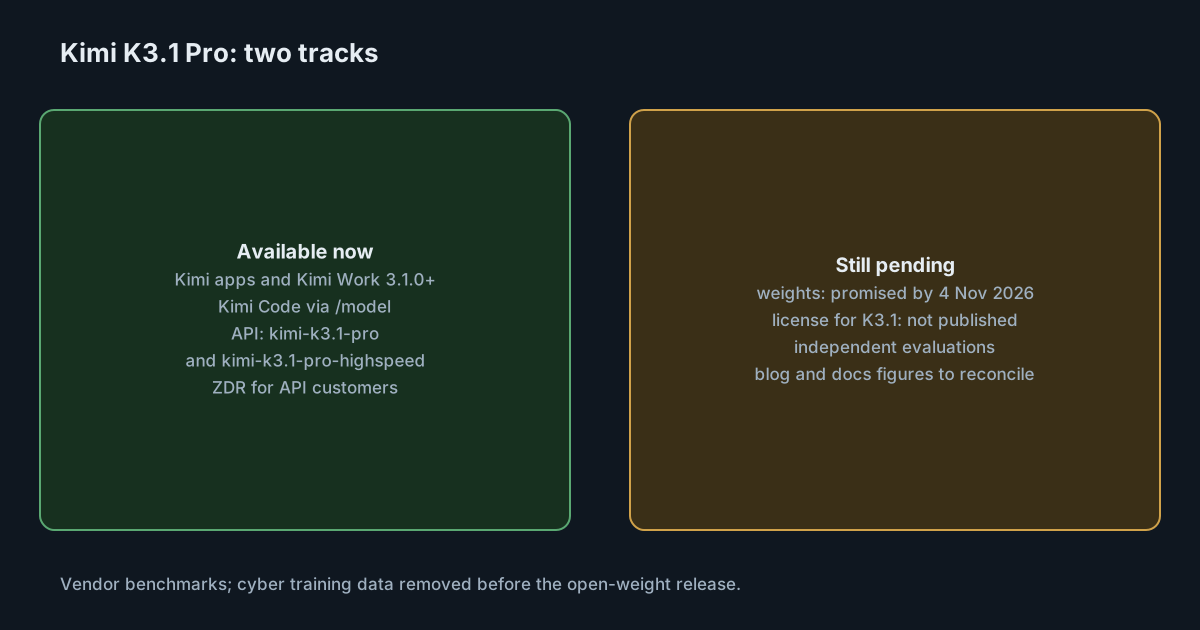
Moonshot AI's Kimi K3.1 Pro arrived in late October 2026, described as its "most capable 3T-class open-weight model to date", with a context window of about a million tokens. There is a catch in the word "open-weight". The model is available today through Moonshot's apps and API, but the announcement says "Full model weights will be released by Nov 4, 2026". The weights appeared on Hugging Face on 2 November, under a custom license listed as "other" with the name kimi-k3.1-pro.
The release is also notable for something else: a section explaining how Moonshot deliberately reduced the model's offensive cyber capability before releasing the weights.
What is available now
According to the announcement and the API quickstart:
- Where: Kimi.ai and the mobile apps, the Kimi Work desktop app (version 3.1.0 or later), Kimi Code (through the
/modelcommand) and the Kimi API, askimi-k3.1-proandkimi-k3.1-pro-highspeed. The Highspeed variant is described as 2 to 3 times faster. - For organisations: Kimi Enterprise administrators can enable it; access is off by default at launch. Zero data retention is available for API customers.
- On the API: thinking is always on, with
reasoning_effortset tolow,highormax(the default). Temperature and several sampling parameters are fixed. The model is unlocked after a minimum top-up of one dollar. - Context and batch: the pricing page gives all K3-series models a 1,048,576-token context window, and says batch inference for
kimi-k3.1-prois billed at 60% of the standard price. We couldn't read the per-token prices from the page itself, so we don't quote them here; check the page directly.
The same pricing page has a note that matters for anyone on older models: from 31 October 2026, K2-series models are no longer available to newly registered users, and Moonshot plans to retire all of them by the end of December 2026.
What the benchmarks say, and how they were run
Moonshot reports 65.7% on Terminal-Bench 4.0, against 58.2% for GPT-6 Astra and 66.4% for Claude Opus 5.5, and an improvement on its internal Kimi Code Bench 3.0 Long-horizon from 55.95% for K3 to 61.2%. The footnotes matter: Kimi K3.1 Pro was evaluated with the Claude Code harness, competitors' numbers were taken from their own reports or leaderboards, and the internal benchmark is not public. These are vendor figures, not independent results.
The two Moonshot pages also disagree with each other. On factual accuracy, the blog reports that the claim-level hallucination rate on an internal stress test fell from 23.4% for K3 to 8.3%, and that the share of responses with at least one error was 42.4% of K3's. The API quickstart reports 23.35% to 6.85%, and 46.4%. At the time of writing, the quickstart also still contained unfilled placeholders, such as "[xx.x%]", where its own Terminal-Bench scores should be. Neither page explains the difference. Treat the numbers as directional until Moonshot reconciles them or independent evaluations appear.
Removing cyber data before release
The section on cybersecurity is the most useful part of the announcement for security teams. Moonshot says vulnerability research performance rose steadily as post-training scaled, and traced it to cyber-related content in the general mid-training corpus and cyber-related tasks in the reinforcement learning mix. For the open-weight release, it removed that data from both stages while keeping general coding tasks.
It reports the effect on its in-house benchmark of vulnerability discovery and exploitation tasks. A checkpoint trained without the removal solved 90.5% of problems at pass@3; the released model solves 81.0%. Moonshot adds that the model still improves substantially over K3 on these tasks, and that its cyber capability "remains behind that of frontier proprietary models that have been publicly available for at least three months". Its stated principle is not to release open weights that would extend the frontier of cyber capability, while raising what is available in open weights over time.
Two cautions apply. The benchmark is internal, and the comparison is with Moonshot's own unreleased checkpoint, so outsiders can't reproduce it. And reduced capability is not absent capability: a model that solves 81% of a hard internal exploitation set is still a capable tool, for defenders and attackers alike. Once the weights are public, any safety behaviour that depends on the hosted service no longer applies. The guidance we summarised in open-weight model risk, model layer first is a good frame for that.
What it means for engineering and security leaders
- Evaluate the hosted model and the weights as two products. The API has zero data retention on request and Moonshot's own serving. Self-hosting has your infrastructure, your controls and a custom license.
- Read the license. K3's weights use a custom license named kimi-k3; K3.1 Pro's has its own, kimi-k3.1-pro. Don't assume the terms carried over: legal review comes before a self-hosted deployment.
- Plan for the K2 retirement. If any tool or pipeline uses K2-series models on the Kimi API, the end of December is the deadline Moonshot has given.
Practical takeaways
- Don't plan a self-hosted deployment until legal has reviewed the kimi-k3.1-pro license.
- If you test through the API, decide whether you need zero data retention before sending company code.
- Re-run your own coding tasks rather than relying on the published benchmarks, and use the harness your developers actually use.
- Treat the cyber-risk section as a vendor claim: useful context, not a substitute for your own red-teaming of anything you deploy.
- Inventory K2-series usage and plan the migration.
If your teams call hosted models through the SpanDock model proxy, a service key can be limited to named models, aliases or patterns and is refused any other, with a budget of its own (service keys are on the Premium and Enterprise plans), so a trial of a new model can be confined to the keys and teams you choose.