
Langflow 1.13.0 fixes two critical flaws: plan the upgrade around auto-login
IBM rates two Langflow flaws 9.8 and offers no workaround. What the bulletin says, why 1.12.8 is still affected, and what to prepare before upgrading.
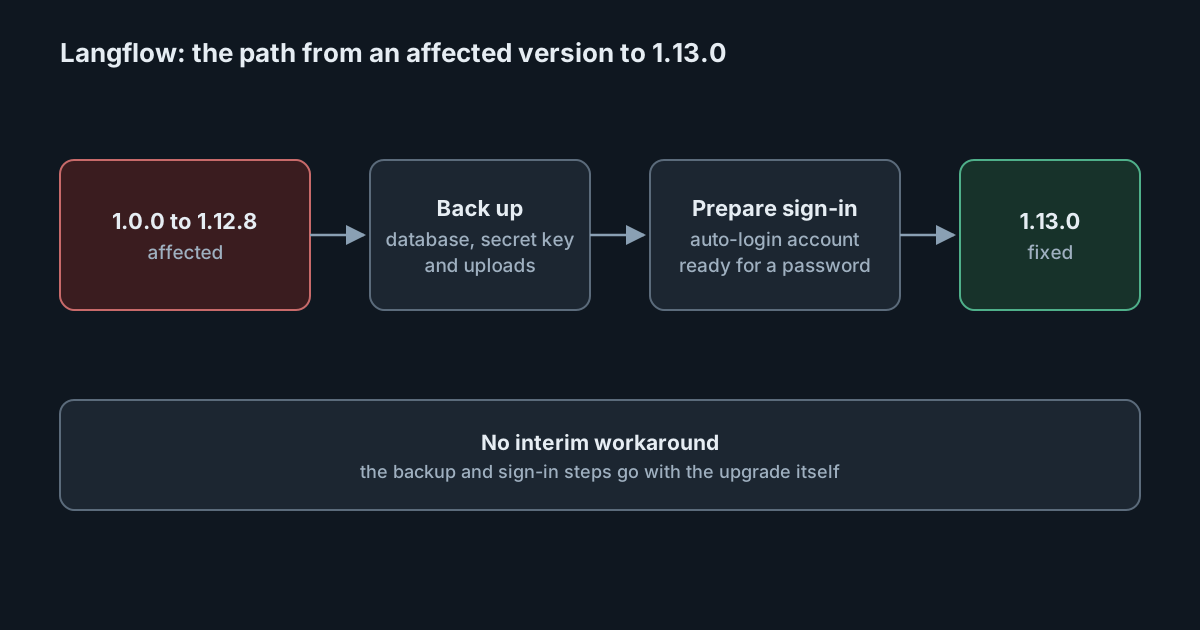
IBM published a security bulletin for Langflow OSS on 28 October 2026 covering four Langflow vulnerabilities and three in a bundled dependency. Two of the Langflow flaws carry a CVSS base score of 9.8 and need no account to exploit. Every release from 1.0.0 to 1.12.8 is affected, the fix is Langflow 1.13.0, and the bulletin's section on workarounds reads, in full, "None".
Langflow is a visual builder for agents and retrieval pipelines, and many teams run it as an internal service with access to model provider keys, vector stores and the tools its flows call. That makes an unauthenticated code execution flaw in it more serious than the same flaw in a stateless web app. This article sets out what the bulletin says, what it leaves unclear, and what to prepare before upgrading, because the upgrade changes how sign-in works.
What the bulletin lists
The four Langflow entries, with IBM's scores:
| CVE | Weakness | CVSS 3.1 | Privileges needed |
|---|---|---|---|
| CVE-2026-93680 | Improper authentication | 9.8 | None |
| CVE-2026-110186 | Code injection | 9.8 | None |
| CVE-2026-110193 | Code injection through the Agentic Assistant | 8.8 | A low-privileged account |
| CVE-2026-110192 | Insufficiently protected credentials | 6.5 | An authenticated account |
The other three entries, CVE-2026-84363, CVE-2026-84364 and CVE-2026-84365, are in Hono, a JavaScript web framework that the bulletin says is included in the product. They are fixed upstream in Hono 4.13.5 and are rated 5.3 to 6.5.
The NVD record for CVE-2026-93680 and the others were published on 29 October with the same affected range, 1.0.0 through 1.12.8. The record for CVE-2026-110193 is the most specific of the four: an attacker with a low-privileged account can cause the Agentic Assistant to generate or submit component code using patterns that were not blocked, which results in operating system command execution on the server.
What the summary adds, and what it does not
The bulletin's summary is more descriptive than the CVE entries. It mentions "an incomplete remediation of an auto-login security control", "agentic code execution via a third-party library", "operator-injected API key exposure reachable without intended authorization" and "unauthenticated remote code execution exploitable through model context protocol tool enumeration".
The bulletin does not say which of these phrases belongs to which CVE. It is tempting to pair the improper authentication flaw with auto-login and the unauthenticated code injection with MCP tool enumeration, but that is an inference, and this article does not rely on it. The practical answer does not depend on the mapping: all four are fixed in the same release, and none has a workaround.
Two other points are worth knowing before you look for more detail:
- The project's own advisory list does not show these CVEs yet. At the time of writing, Langflow's GitHub security advisories list earlier issues, the most recent fixed in 1.12.0, but nothing for 1.13.0. IBM's bulletin and the NVD records are the primary descriptions for now.
- 1.12.8 is not a fix. Version 1.12.8 was released on 22 October 2026, a few hours before 1.13.0 on the same day. Anyone who updated to the latest 1.12 patch that day is still in the affected range.
Some secondary write-ups mention public exploit tooling for these flaws. We have not found that in a primary source, so it is not part of this analysis. A 9.8 score with no privileges required is reason enough to treat the upgrade as urgent.
The upgrade changes sign-in
The 1.13.0 release notes include several changes that matter for operators, not only the security fixes:
- "docs: auto_login is false by default"
- "fix: guide recovery after upgrading from an auto-login installation"
- "fix(cli): warn when the default superuser has signed in and AUTO_LOGIN is on"
- "fix: block unsafe module reexports in assistant code scanning"
- "fix(scripts): rotate apikey and mcp_server secrets in migrate_secret_key"
Together with the bulletin's remediation text, these show that the upgrade is not a drop-in replacement for installations that rely on automatic login. IBM's instructions are to back up the database, the secret key and uploaded files first, and, if the deployment uses automatic login, to prepare the existing account for password sign-in as described in Langflow's installation and Docker upgrade instructions. IBM is explicit that these steps accompany the upgrade and that there is no separate interim workaround.
The upgrade commands in the bulletin are:
pip install --upgrade "langflow==1.13.0"
# or, for containers
docker pull langflowai/langflow:1.13.0
For containers, the bulletin asks you to preserve the deployment's persistent data across the restart. A container recreated without its volume loses the database and the stored credentials together.
Why auto-login matters for an agent builder
Auto-login exists so that a single-user install opens straight into the editor. It is convenient on a laptop. On a shared server, it means that reaching the web interface is close to being signed in as the superuser, and the superuser can edit flows that hold credentials and run code.
Langflow has had a run of advisories this year in which authenticated users could execute code, including through MCP server configuration and Python components. We covered one of them, a Smart Transform flaw where prompt injection could lead to code execution, in our article on agent frameworks running generated code. Those flaws were serious because accounts on a Langflow server tend to be broad. When authentication can also be bypassed, the distance between the network and code execution on the server shrinks to one request.
What it means for engineering and security leaders
If your organisation runs Langflow, the question is less whether to upgrade than how quickly and what to rotate afterwards. Langflow instances often hold provider keys, database credentials and tokens for the tools their flows call. If an instance was reachable by people who should not have had access, assume those secrets could have been read.
Practical takeaways:
- Find every Langflow deployment, including ones a team started for a pilot. Check versions: anything from 1.0.0 to 1.12.8 is affected.
- Take the instance off any public or broadly shared network until it is upgraded. With no workaround, network access is the only control you have in the meantime.
- Before upgrading, back up the database, the secret key and uploaded files, and prepare the auto-login account for password sign-in.
- Upgrade to 1.13.0, not to the latest 1.12 patch.
- After upgrading, confirm that automatic login is off, and rotate the provider keys and other credentials stored in flows and global variables. The release notes say the
migrate_secret_keyscript now also rotates API key and MCP server secrets, which matters if you rotate Langflow's own secret key as well. - Watch Langflow's advisory list for the project's own write-ups of these CVEs. They may clarify which flaw is which.
For organisations that keep Langflow as a Python dependency in their own repositories, repository security in SpanDock looks up dependencies from lockfiles in the OSV database and can block a commit or a CI run above a severity you choose. It is on the Enterprise plan, and it only finds what a lockfile declares, not a container someone started by hand.