
LiteLLM's Enterprise proxy could leak its master key to an unauthenticated request
A critical LiteLLM advisory affects proxies with an Enterprise license. The fixed versions, the mitigations, and why the master key and salt key both matter.
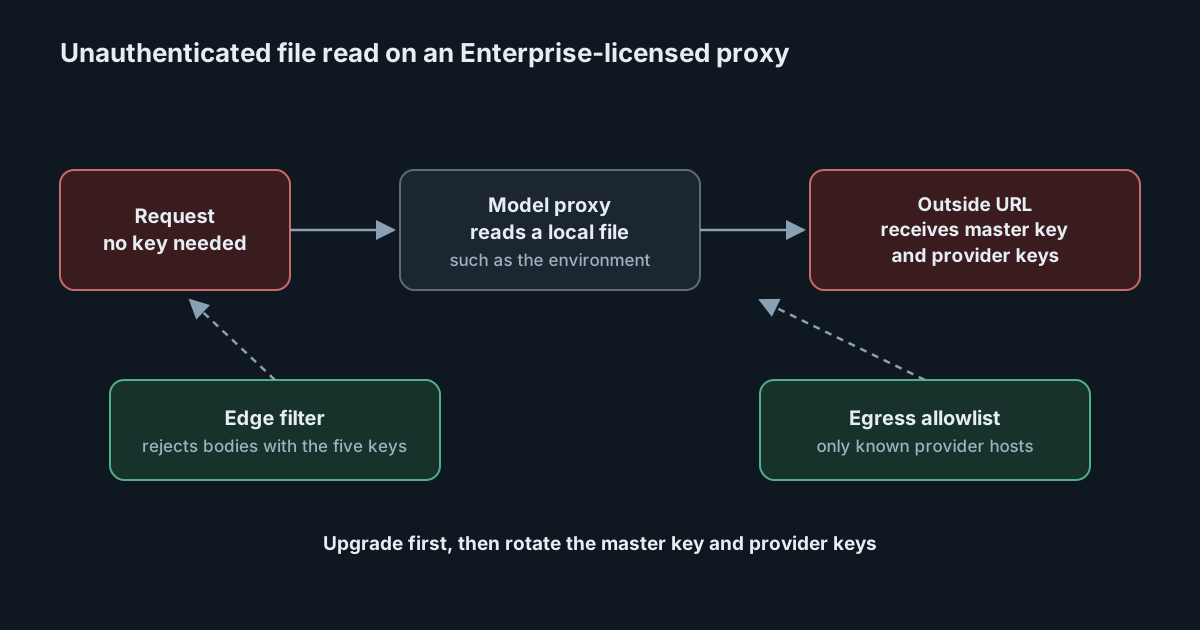
On 27 October 2026 the LiteLLM maintainers published a critical advisory, GHSA-w4c7-34wj-hqm8, for the LiteLLM proxy. An unauthenticated request to any LLM route could make the proxy read a local file and send its contents to a URL the attacker chose. Reading the process environment exposes LITELLM_MASTER_KEY and the provider API keys, which, in the advisory's words, "gives the attacker full admin access to the proxy". In some configurations the attacker could then run arbitrary Python as root.
The flaw only affects proxies running with an Enterprise license. Open-source deployments without a license are not affected, because the vulnerable code paths only load when a license is active. For teams that do run the licensed proxy, this is a priority fix, and the upgrade alone may not be the end of the work.
What the advisory says
The advisory is rated critical, with a CVSS 3.1 score of 10.0: network attack, low complexity, no privileges, no user interaction and a changed scope. It has no CVE identifier at the time of writing. Its listed weaknesses include missing authentication for a critical function, server-side request forgery and external control of a file name.
The fixed versions were released on 27 October, one per supported release line:
| Release line | Fixed in |
|---|---|
| 1.103 | 1.103.10 |
| 1.104 | 1.104.8 |
| 1.105 | 1.105.6 |
| 1.106 | 1.106.5 |
Further patch releases, 1.105.7 and 1.106.6, followed on 28 October. The advisory lists each range as "less than" the fixed version, which read literally would leave a 1.104.8 install inside the 1.106 range. The sensible reading is one fix per line, as in the table, but the advisory does not say so explicitly. It also does not mention the 1.107 and 1.108 pre-releases, so anyone testing those should check with the maintainers rather than assume.
The advisory does not describe the exploit beyond the outcome. Its mitigation section does, indirectly: it asks operators to block request bodies that contain any of five JSON keys, standard_callback_dynamic_params, gcs_path_service_account, callbacks, success_callback and failure_callback. In other words, the trigger is a request that sets logging callbacks for itself.
The release notes do not say "security"
The release notes for 1.106.5, and the matching notes for the other three lines, describe two changes: failure logs for rejected requests now keep only core request fields, tags and guardrail details, and the GCS logger now uses the bucket and credentials configured on the proxy. The notes say "No action needed to upgrade".
That is accurate as far as the upgrade itself goes. But a team that follows releases rather than advisories would have no reason to see 1.106.5 as urgent. LiteLLM's security best practices page says Enterprise customers are notified by email seven days before public disclosure, so licensed users had a separate channel. The maintainers' post on the 21 October release compromise also mentioned that a private registry for Enterprise customers was already distributing an embargoed release for a vulnerability due to be disclosed on 27 October. The lesson for everyone else is to subscribe to the repository's security advisories, not only to its releases.
A familiar pattern
This is not the first LiteLLM flaw of its kind this autumn. On 1 October the project published GHSA-g5ff-637f-6q2m, rated high: a low-privileged authenticated user could send a crafted vertex_ai_credentials value that made the proxy read a local file and send it to an attacker-controlled URL. The advisory named /proc/self/environ and the master key as the example, as the new one does. The cause there was a request-body blocklist that rejected vertex_credentials but missed its alias.
The new advisory removes the authentication requirement, but the shape is the same: a request carries configuration that the proxy treats as its own, and a blocklist of parameter names is the line of defence. Blocklists of this kind need to be complete to work, and two advisories in a month suggest that is hard to achieve. That is one more reason to rely on network controls around the proxy as well as on patches.
If you cannot upgrade today
The advisory offers two mitigations:
- Filter at the edge. Use a WAF, ingress filter or reverse proxy rule to reject or strip POST bodies that contain any of the five keys above.
- Restrict outbound traffic. Allow the proxy to reach only your configured model provider endpoints. The exploit needs the proxy to POST the file contents to an attacker-controlled endpoint, so with an egress allowlist, the exfiltration fails even if the vulnerable code is reached.
Of the two, the egress allowlist is the more robust: it does not depend on knowing every key name that reaches the code path, and it limits other server-side request forgery flaws as well. It is also the harder one to retrofit if the proxy currently calls many providers, logging services and guardrail vendors.
The advisory separately recommends keeping the proxy off the public internet, through a VPN, mTLS, an authenticating ingress or an IP allowlist. A model proxy that only internal clients call has no reason to accept requests from anywhere.
After upgrading: assume the keys may be gone
An upgrade closes the hole. It does not tell you whether someone used it. If a licensed proxy was reachable from networks you do not control while it ran an affected version, treat the master key and every provider key in its environment as exposed.
Rotating them correctly needs some care, because LiteLLM uses the master key for more than admin access. The master key rotation documentation explains that credentials stored in the database are encrypted with LITELLM_SALT_KEY if it is set, and with the master key if it is not.
- With a separate salt key, rotating the master key is a matter of replacing it and restarting. The documentation warns against using the
/key/regenerateendpoint'snew_master_keyoption in this case. - Without a salt key, stored credentials are encrypted with the master key. The documentation describes a boot-time migration, using
LITELLM_MIGRATE_FROM_MASTER_KEY, that re-encrypts them when the master key changes. - The salt key itself should not be rotated, according to the best practices page, so it has to be kept in a secret store from the start.
Changing the master key also signs everyone out of the Admin UI, which is worth announcing before you do it.
The advisory's defence-in-depth advice follows from the same point: load the master key from a secret manager rather than the process environment, and set a separate salt key. A proxy whose environment holds no master key gives a file-read flaw much less to find.
Provider keys need rotating at each provider, not in LiteLLM. Virtual keys issued to applications are a separate question: they are not in the environment, but anyone holding the master key had full admin access and could have created new ones. Review the key list for keys you do not recognise.
What it means for engineering and security leaders
This is the second serious LiteLLM incident in a week. On 21 October, version 1.107.0 was published to PyPI and the container registries with a credential stealer in it. The maintainers' incident post says the attacker reached LiteLLM's own internal deployment, which was exposed to the public internet, and suspects "a recently patched vulnerability"; it does not say which one. A model proxy is attractive to attackers because it concentrates every provider key in one process, and in both cases those keys were what was at stake.
Practical takeaways:
- Check whether your LiteLLM proxy runs with an Enterprise license. If it does not, this advisory does not affect you.
- If it does, upgrade to the fixed patch for your release line, 1.103.10, 1.104.8, 1.105.6 or 1.106.5, or later.
- Until then, filter the five JSON keys at the edge and, where you can, restrict the proxy's outbound traffic to known provider endpoints.
- If the proxy was reachable from untrusted networks, rotate the master key and provider keys, following LiteLLM's guidance on the salt key.
- Move the master key into a secret manager and set a separate salt key if you have not.
- Subscribe to the project's security advisories: the release notes for the fix did not mention security.
Teams that are reconsidering their proxy after both incidents can read the guide to moving from LiteLLM to SpanDock's model proxy. It describes running both side by side and importing the LiteLLM configuration, and it starts with rotating the keys LiteLLM held, because the importer never carries keys across.
Sources
- LiteLLM advisory GHSA-w4c7-34wj-hqm8: Unauthenticated file read leaks master key on Enterprise proxy
- LiteLLM release v1.106.5
- LiteLLM docs: Security best practices
- LiteLLM docs: Rotating master key
- LiteLLM: Contained: Oct 21, 2026 LiteLLM release v1.107.0 Compromised
- LiteLLM advisory GHSA-g5ff-637f-6q2m: internal_user_viewer arbitrary local file read via vertex_ai_credentials