
vLLM's 18 security advisories in two weeks: what 0.32.0 and 0.33.0 fix
vLLM published 18 advisories between 20 October and 2 November 2026. Which releases fix them, the few that need attention, and the defaults to change.
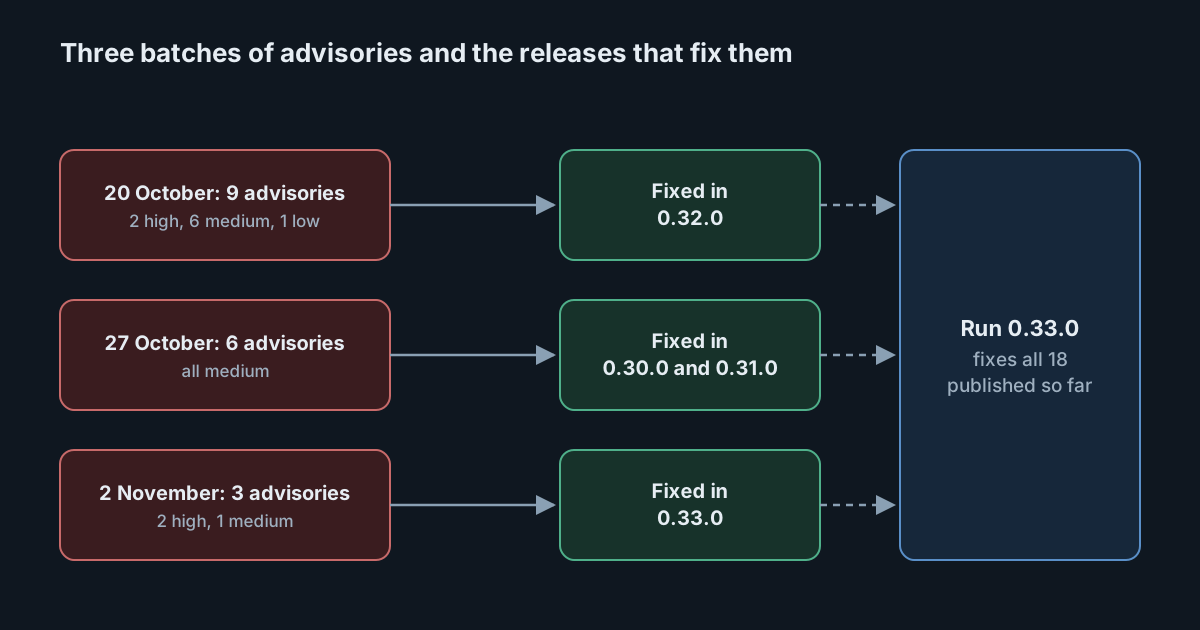
Between 20 October and 2 November 2026 the vLLM project published 18 security advisories for its inference server. They arrived in three batches. Most are denial-of-service bugs that a single request can trigger. A few are more serious, and one changes a default that browser-based tools may rely on.
The short answer for operators is to run 0.33.0, which was uploaded to PyPI on 2 November and fixes everything published so far. The rest of this article covers which release fixes what, the handful of advisories worth reading in full, and the settings that reduce exposure to the next batch.
Three batches, three releases
The advisories were published after the releases that fix them, so the fixed version is already out for each batch.
| Published | Advisories | Severities | Fixed in |
|---|---|---|---|
| 20 October | 9, all with CVE IDs | 2 high, 6 medium, 1 low | 0.32.0 (18 October) |
| 27 October | 6, no CVE IDs | all medium | 0.31.0 (five) and 0.30.0 (one) |
| 2 November | 3, no CVE IDs at the time of writing | 2 high, 1 medium | 0.33.0 (2 November) |
One detail on 0.33.0: the package is on PyPI and the v0.33.0 tag exists in the repository, but at the time of writing the project's GitHub releases page still lists 0.32.0 as the newest final release, with a release candidate, 0.33.0rc3, published the same morning. If you install from PyPI or build from the tag, this makes no difference. If your process waits for a GitHub release entry, it may hold you on 0.32.0 for a while, and 0.32.0 does not fix the 2 November batch.
The advisories worth reading in full
Image input and the host's Ghostscript (high, 8.1, GHSA-h3rc-j82p-2c3h). vLLM decoded image inputs with the Pillow library's format auto-detection, so an image request could carry EPS data. Pillow hands EPS to Ghostscript if it is installed on the host. Remote code execution needs a Ghostscript that is itself vulnerable to CVE-2024-29510, which upstream Ghostscript fixed in 10.03.1, and the reporter reproduced it on vLLM 0.30.0. The advisory also covers a separate Pillow denial-of-service bug in Pillow 12.0.0 to 12.2.0, and the fixed vLLM requires Pillow 12.3.0 or later. Two checks follow: whether your serving image contains Ghostscript at all, and which Pillow version your environment resolves.
Forged shared-memory handles (high, GHSA-6757-hggm-hp2w). On deployments that use shared-memory caching for multimodal inputs, an ordinary authenticated caller could forge a cache handle that reached Python's pickle.loads in the worker and ran code there. The advisory says this works without the insecure serialisation flag. It applies only when the server runs with --mm-processor-cache-type shm. The scores disagree: GitHub shows 7.5, while the text of the advisory gives 8.8 with a lower attack complexity. Its affected range is also stated as up to 0.25.1, while the patched version is 0.32.0. Treat every release before 0.32.0 as affected if you use shared-memory caching.
Any web page could call your server (low, 3.4, GHSA-vvpg-rrww-wpmh). The OpenAI-compatible server allowed every CORS origin by default and has no authentication unless --api-key is set. A web page in a developer's browser could therefore list models, run completions and read the output from a vLLM server on localhost or an internal address. The score is low, but this is the advisory most likely to affect people running vLLM on a workstation. The fix in 0.32.0 changes the default: browser origins are no longer allowed unless named with --allowed-origins. A browser-based chat interface that talks to vLLM directly will stop working after the upgrade until its origin is added.
Model repositories as an attack surface (medium, 5.4, GHSA-qrj2-j723-m6w8). A crafted model repository could use a path in its speculative decoding configuration to make vLLM load files from another directory, and an unauthenticated tokenizer endpoint then exposed the loaded vocabulary. The advisory notes that remote code loading stays off. The lesson is broader than the bug: a model repository is input from its publisher, whether it comes from a public hub, a vendor or a shared mount.
Two high-rated crashes fixed in 0.33.0. GHSA-q9v9-qpjp-fc24 lets a request crash the engine on servers started with --skip-tokenizer-init, and is described as an incomplete fix of an earlier advisory. It affects 0.28.0 up to 0.33.0. GHSA-5r3c-5x4v-8gjh reports that there was no limit on the total media in one request, so a single request could exhaust memory. Its affected range goes back to 0.6.0.
The rest are medium-rated denial-of-service bugs: oversized audio and video inputs, assertions that crash a worker, unbounded chat template rendering that ties up the renderer's threads, a way around the Responses API's restrictions on template arguments, and a leak of live heap addresses to unauthenticated clients. Each is a reason to upgrade, and none changes the plan.
Settings that reduce exposure
Upgrading fixes these 18. The vLLM security guide describes settings that limit what the next batch can do, and several are easy to miss.
- The API key does not cover every route.
--api-keyprotects paths under/v1,/v2,/inferenceand/cohere. The guide says other endpoints, including/invocations, stay unauthenticated even with a key set. Put a reverse proxy in front that forwards only the routes you use. - Restrict media sources.
--allowed-media-domainslimits where image, audio and video URLs can be fetched from, and settingVLLM_MEDIA_URL_ALLOW_REDIRECTS=0stops redirects to other hosts. - Set media limits that fit your workload. The guide documents per-download and per-request size limits, a pixel limit for images and a per-request decode budget. Several of this month's advisories were about exactly these resources.
- Keep the multi-node network private. The guide says communication between nodes is insecure by default and should run on an isolated network.
- Never use development mode in production.
VLLM_SERVER_DEV_MODE=1enables endpoints meant for debugging, which the guide says include arbitrary remote procedure calls through/collective_rpc. - Name browser origins explicitly. After 0.32.0 this is required for browser clients anyway. Keep the list short.
Two further habits help. Load models only from repositories you have reviewed or mirrored, and pin them to a revision rather than following a branch. And rebuild serving images from a minimal base, so that libraries such as Ghostscript are not present unless something needs them.
What to do this week
- Find every vLLM deployment, including the ones on developer workstations and in research clusters, and record the version.
- Upgrade to 0.33.0 from PyPI or the
v0.33.0tag. If you cannot, 0.32.0 fixes the 20 October batch, but not the three published on 2 November. - If a browser interface talks to vLLM directly, add its origin with
--allowed-originsbefore the upgrade. - Check whether your images contain Ghostscript and which Pillow version they resolve.
- Put an endpoint allowlist in front of any server reachable by more than one person, and set media domain and size limits.
The volume of advisories is a sign of more people looking at the code, which is good in the long run. In the short run it means vLLM needs the same upgrade routine as any other internet-facing service: a known owner, a version inventory and a way to roll out a release within days.
Sources
- vLLM security advisories
- vLLM advisory GHSA-h3rc-j82p-2c3h (CVE-2026-115915): EPS image input reaches the host's Ghostscript
- vLLM advisory GHSA-6757-hggm-hp2w (CVE-2026-115912): forged shared-memory cache handle reaches pickle
- vLLM advisory GHSA-vvpg-rrww-wpmh (CVE-2026-115917): default CORS allows any origin
- vLLM advisory GHSA-q9v9-qpjp-fc24: EngineCore crash with --skip-tokenizer-init
- vLLM advisory GHSA-5r3c-5x4v-8gjh: no request-wide media budget
- vLLM advisory GHSA-qrj2-j723-m6w8: speculators config path traversal from a model repository
- vLLM on PyPI
- vLLM docs: Security