
Ads in MCP tool results: what a census of 100,000 servers found
Researchers found paid ads and affiliate links inside MCP tool results, mostly unlabelled and behind hidden redirects. What it means for teams that use MCP.
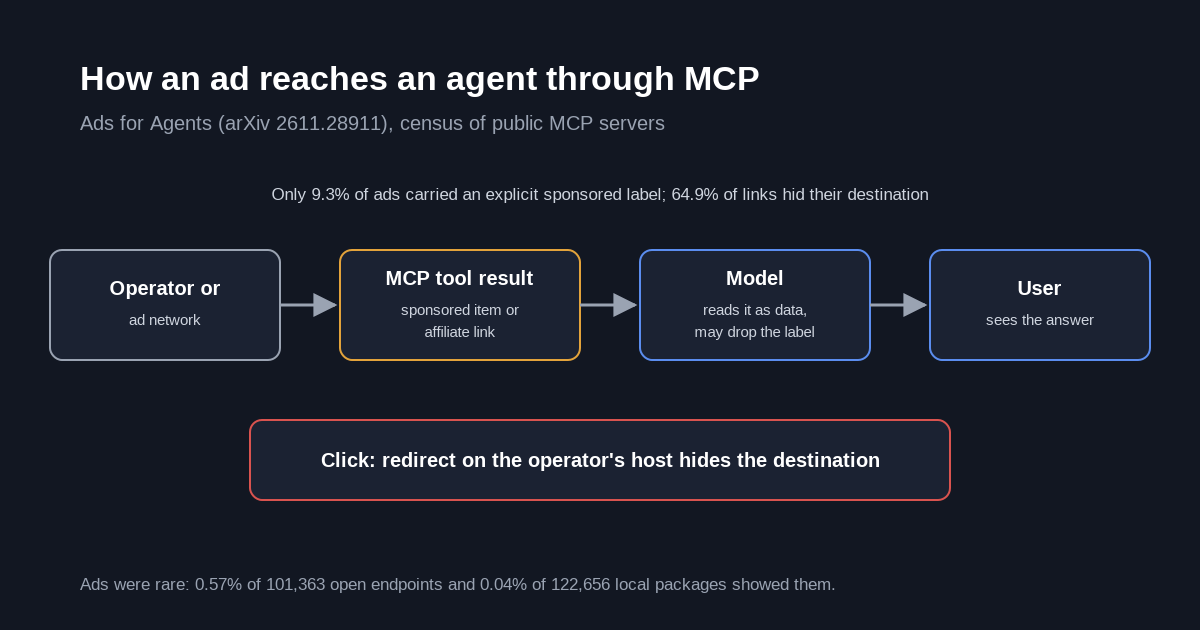
When an AI agent calls an MCP tool, the result goes straight into the model's context. A paper published on 21 November 2026, Ads for Agents, measured how often those results contain paid advertising. Ads are rare across public MCP servers, but where they appear they are mostly unlabelled affiliate links inserted by the server's own operator, often behind redirects that hide where they lead. For teams that let agents use third-party MCP servers, it is a reminder that a tool result is content someone else controls.
What the researchers measured
The authors, from Chalmers University of Technology and the University of Gothenburg, Stockholm University and Google, looked for MCP servers through every public trace they could find: ad networks, package registries, certificate logs, host names, MCP directories and configuration files on GitHub. They then sent read-only, in-domain queries to the servers that showed signs of advertising and inspected the links in the results without opening them.
The headline numbers, from the paper:
- Ads are rare. Of 101,363 open remote MCP endpoints, 579 (0.57%) showed evidence of ads, and 226 returned ads in the researchers' query results. Among 122,656 local MCP packages, 52 (0.04%) serve ads.
- Operators insert most of them. The authors identified 173 ad networks that target agents, but only 10 servers referenced one in their metadata. Operators placed the ads themselves on about half of the ad-returning servers, and 48 of the 52 ad-serving packages carry the operator's own affiliate identifier.
- Ads follow the query; labels don't. Ads changed with the topic and intent of a query, but each tool's disclosure stayed the same whatever the query.
- Disclosure is thin. Checked against five disclosure elements drawn from EU Digital Services Act and US Federal Trade Commission guidance, 42.2% of ads showed none, and only 9.3% carried an explicit sponsored label.
- Destinations are hidden. 64.9% of ad links conceal where they lead, most often behind a redirect on the operator's own host (41.0%).
Some counts in the paper don't line up exactly, and it helps to know why. The disclosure and link analysis covers 6,499 ads found in the census responses, while the attribution analysis, after removing duplicates by destination, covers 5,163. The summary says operators place ads on 117 of the 226 servers; the attribution section says operators are the best-supported inserter on 116. Neither difference changes the conclusions, but quote the figures with their context.
The authors are clear that this is a lower bound. Servers behind sign-in, 159,724 endpoints in their census, show ads only to their users, and the probes used fixed queries from one location on a few dates.
Why ad blockers don't help
Web ad blocklists caught almost none of it. Matched against the EasyList and EasyPrivacy lists of 11 November 2026, EasyList recognised 292 of the 6,499 ad links (4.5%). The reason is structural: nearly half the links start on the operator's own host, and many others are ordinary merchant addresses with an affiliate parameter. A host-based list can't block them without blocking the server's normal content.
That leaves the server as the only party that knows which items are paid, and the model as the party that decides whether the user ever finds out. The paper points to earlier work showing that models instructed to favour a sponsor can hide the sponsorship. An ad label that arrives as text in a tool result can be dropped or rewritten in the model's answer.
What the protocol says today
The MCP specification's tools page has no notion of advertising. It does set the right expectations about trust. Clients "MUST consider tool annotations to be untrusted unless they come from trusted servers", and under security considerations, clients should "Validate tool results before passing to LLM". Results can carry structured content, a JSON value that can follow a declared output schema.
The paper builds on that. It found that ads delivered in structured fields disclosed far more than ads marked inline in text (3.00 of the five elements on average, against 1.17). It proposes a per-item ad annotation in the structured result, carrying a sponsored flag, the advertiser, why the item was selected, the commercial relationship and the link's real destination, so that a client can show it to the user regardless of what the model says. That is a research proposal, not part of the specification.
What it means for engineering and security leaders
For most engineering teams, the immediate risk is small: the MCP servers that matter at work, such as code hosts, issue trackers and internal APIs, are not the shopping and search servers where ads cluster. But the finding generalises. A tool result is third-party content that steers what the model says and does next, and the operator's incentives are not always yours. The same reasoning applies to the MCP servers that trust the wrong URLs and to poisoned tool descriptions.
Affiliate links are also a data question. The paper notes that an agent fills tool arguments from the conversation, so it can pass a user's location or preferences to a server before any answer exists. And, as the paper notes, an agent that follows an ad link does so without the defences browsers have against redirect tracking.
Practical takeaways
- Inventory the MCP servers in use, especially public search, shopping and recommendation servers, and ask what their operators earn from.
- Prefer servers whose operators you know for anything that informs a purchase, a dependency choice or a recommendation to customers.
- Treat links in tool results as untrusted. Don't let agents follow them automatically in sensitive sessions.
- Look for affiliate parameters and redirects when you review a server's output; a link on the operator's own host that hides its destination is a signal.
- Watch the specification discussion. If an ad annotation is proposed for MCP, client support is what will make it useful.
If you want that inventory to be complete, SpanDock's MCP gateway, on the Premium and Enterprise plans, gives each computer's AI tools one governed MCP server. In Enforced mode it also reports, or moves aside, the tools' other MCP servers, and every call through it is recorded with the connector, tool, person and outcome. Deciding whether a server's results can be trusted is still a judgement you make.