
When the MCP tool skips the API's checks: two November advisories
Two MCP advisories show the same gap: an agent-facing path that didn't apply the rules the normal API enforces. What happened, and how to test your own.
Adding an MCP server to an application gives it a second way in. Two advisories published on 2 and 3 November 2026 show what goes wrong when that second way doesn't apply the rules the first one does. In a self-hosted CMS, MCP read tools returned other users' drafts that the normal HTTP API refused to show. In an MCP hub, a server's configuration could forward the calling user's own credentials to an upstream API. Both are fixed, and both fixes shipped weeks before the advisories appeared. If you build or run MCP servers in front of existing systems, the lesson is the same: test the agent path with the same authorisation cases as the API.
Instatic: MCP read tools without row-level checks
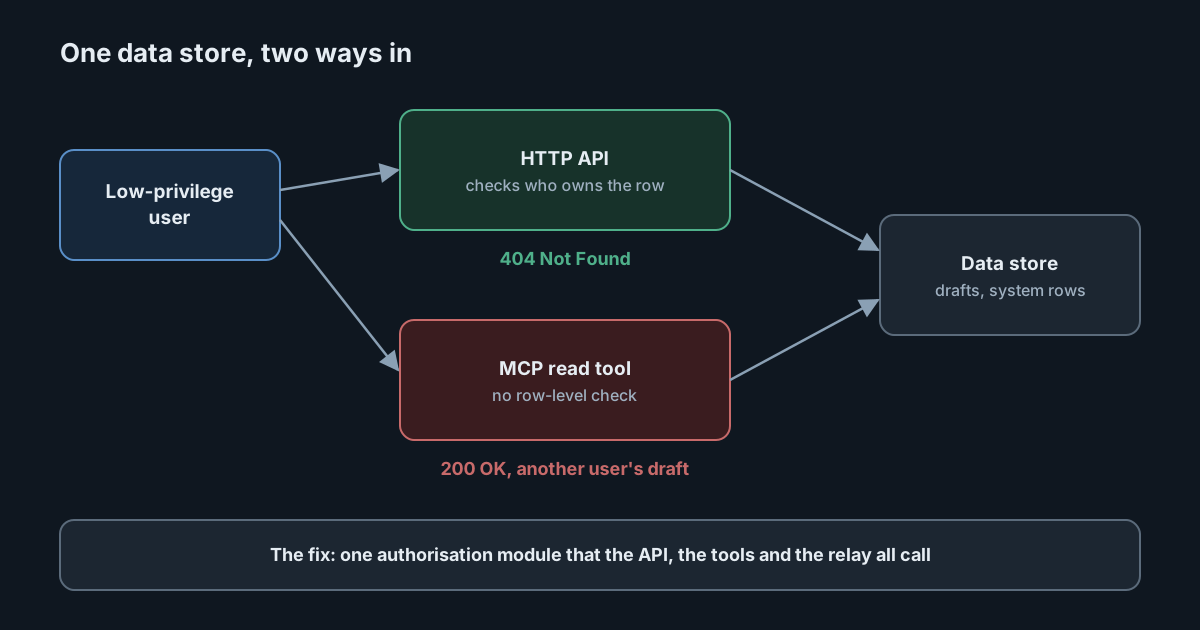
Instatic is an open-source, self-hosted visual CMS with built-in AI features. According to its advisory, GHSA-x5cc-8486-8qqx, three AI and MCP content read tools, content_get_document, content_list_documents and content_search_documents, didn't apply the object-level authorisation that the HTTP data endpoint enforces. A user holding only the ai.chat and content.edit.own capabilities could ask for another user's draft. Over HTTP the answer was 404; through the MCP tools it was the draft.
Two details matter. First, no model was needed: the advisory notes the tools can be called directly through the MCP endpoint, so this isn't prompt injection, just a missing check. Second, it reached beyond drafts to rows in system tables such as posts.
The fix, pull request #626, merged on 12 October, is the instructive part. Its description says the MCP relay "had its own copy of the ownership rule". The fix moves the table and ownership rules into one module that the HTTP handlers, the read tools and the relay all call, and adds an architecture test that fails any direct row read in the AI code that bypasses it. Version 0.0.21, released the same day, contains it.
What the ratings and ranges say
The sources agree on the fixed version but not on everything else:
- Severity. The project's advisory gives CVSS 3.1 6.5 (low privileges, high confidentiality impact). The GitHub Advisory Database entry, GHSA-wq53-554h-vq3f, published later the same day as CVE-2026-121458, labels it high, with the same 3.1 score and a CVSS 4.0 score of 7.1.
- Affected versions. The advisory's package range is everything before 0.0.21. The report text says the flaw dates from 0.0.5, while another database lists 0.0.12 to 0.0.20. The safe reading is: if you run anything before 0.0.21, upgrade.
MCPHub: headers that carried the caller's credentials
MCPHub is a self-hosted MCP gateway that connects users to many MCP servers, including servers generated from an OpenAPI definition. Such a server can list passthroughHeaders, request headers from the caller that are forwarded to the upstream API.
The GitHub Advisory Database entry, GHSA-c48q-fjwh-j7gg (CVE-2026-120323, published 2 November, rated medium) describes it briefly as information disclosure in the header passthrough code, affecting versions up to 1.0.45 and 1.1.7, fixed in 1.1.8. The fix commit, 040f7b9, merged on 20 October, explains more than the advisory does. A code comment states the rule: "Server owners must never forward the invoking user's platform credentials." The fix drops Authorization, Proxy-Authorization, Cookie, X-Auth-Token, X-Api-Key and the hub's own configured bearer header from any passthrough list, and makes header forwarding an administrator-only setting, alongside servers that run local commands.
Read that way, the risk was that whoever configured a server could receive the hub credentials of everyone who called it. Release 1.1.8 came out on 21 October; its notes don't mention the security fix, so you couldn't have known to prioritise it from the release page alone.
The common pattern
Both flaws come from the same design gap. An MCP path was added next to an existing system, and it reimplemented, or skipped, a rule the existing system already enforced:
- in Instatic, row ownership was checked in the HTTP handlers and copied, incompletely, into the MCP relay;
- in MCPHub, the boundary between a server owner's configuration and a caller's credentials wasn't enforced where headers were forwarded.
This pattern is likely to repeat. Many products are adding MCP servers to existing APIs quickly, and an MCP tool is often written as a thin wrapper over the database rather than over the API, which is where the authorisation lives. The advisories also arrived three weeks after their fixes, so tracking only advisories leaves a gap.
What it means for engineering and security leaders
Treat every MCP server attached to an internal system as a new API. It needs the same authorisation review, the same tests for "user A reads user B's object" and the same logging as the API it sits next to. It also deserves a credential review: which credentials does the tool hold, and could any caller's credentials end up somewhere else?
For third-party MCP servers, ask vendors whether their tools call the same authorisation code as their API, or their own copy. The Instatic fix, one module and a test that fails on any bypass, is a good answer to look for.
Practical takeaways
- Upgrade. Instatic to 0.0.21 or later; MCPHub to 1.1.8 or later.
- Run your API's authorisation tests through MCP. For each tool that reads or writes data, repeat the cross-user cases from your API tests by calling the tool directly, without a model.
- Route tools through the API's checks. Prefer tools that call the same authorisation function as the HTTP handlers, and add a test that fails on direct data access.
- Audit header and credential forwarding. List every place an MCP server forwards caller headers or tokens upstream, and block credential headers by default.
- Watch commits and releases, not only advisories, for MCP components you depend on.
SpanDock's MCP gateway applies permissions on your server before any connector is called: each connector starts read-only for everyone, overrides can be set by person, group, tag or user type, and connector credentials stay in the server's credential store, never sent to computers. It is on the Premium and Enterprise plans. It decides which tools a person may call, but it doesn't add the row-level checks a connector itself is missing, so the tests above still apply. For related advice, see step-up authorisation in MCP.
Sources
- Instatic advisory GHSA-x5cc-8486-8qqx: AI/MCP content read tools miss object-level authorization
- GitHub Advisory Database: GHSA-wq53-554h-vq3f (CVE-2026-121458)
- Instatic pull request #626: read tools and the MCP relay decide row access with the HTTP rules
- GitHub Advisory Database: GHSA-c48q-fjwh-j7gg (CVE-2026-120323), MCPHub
- MCPHub fix commit 040f7b9: caller credential isolation for passthrough headers