
n8n MCP: open redirect and owner-account takeover
Two MCP-related advisories in n8n: an unauthenticated OAuth open redirect and a high-severity workflow-validation path to owner takeover. What to patch.
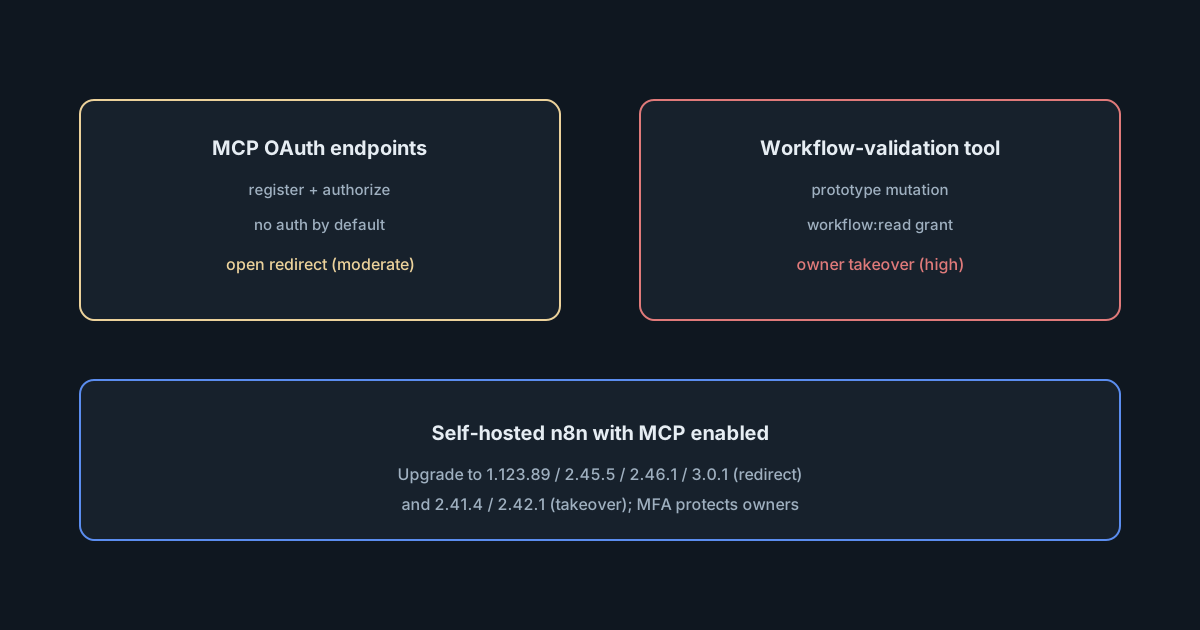
Self-hosted n8n can speak Model Context Protocol (MCP). In late October 2026 the project published an MCP OAuth open-redirect advisory as part of a larger security update, and an earlier high-severity advisory showed how the MCP workflow-validation tool could be turned into an owner-account takeover. Neither issue is a coding-agent sandbox story. They sit on the automation platform that many teams already put on the network so agents and operators can drive workflows. If that instance is still below the patched versions, the MCP surface is part of the patch priority, not an optional add-on.
Open redirect on MCP OAuth registration
On 28 October 2026 n8n published GHSA-rc3w-8jc8-7x3w, rated moderate (CVSS 4.0 score 5.1 on the advisory). The MCP OAuth registration and authorisation endpoints were enabled by default and required no authentication. Any caller could register an OAuth client with an arbitrary redirect_uri. A crafted authorisation URL then redirected the visitor to that URI before the instance's checks ran, turning the n8n host into an open redirector.
Important limits from the advisory:
- No tokens or session data were included in the redirect.
- A victim had to open the crafted URL (user interaction is active in the CVSS vector).
- Integrity impact is scored on the subsequent system as low; confidentiality and availability on the vulnerable system are none.
Patched versions for this issue: 1.123.89, 2.45.5, 2.46.1 and 3.0.1 (and later on those lines). Workarounds if you cannot upgrade immediately: restrict instance access to trusted users, block unauthenticated access to /mcp-oauth/register and /mcp-oauth/authorize at the reverse proxy, and tell users not to follow unsolicited OAuth links to your instance. The advisory says those workarounds do not fully remediate the risk.
The 28 October community security update lists this open redirect among a dozen advisories fixed in the same release trains. Cloud n8n is described there as patched automatically; self-hosted operators must upgrade.
Owner takeover through workflow validation
A separate advisory, GHSA-5jr4-xmvf-frmj, is rated high (CVSS 4.0 score 7.7). It was published 30 September 2026 and fixed in 2.41.4 and 2.42.1. The MCP workflow-validation tool evaluated caller-supplied code in the main process through an interpreter that read inherited properties and allowed assignment onto shared prototypes. A member holding only a workflow:read grant could replace a built-in method so a server-side permission check accepted a scope they did not hold. The reporter drove that to a full takeover of the instance owner's account. Accounts protected by MFA were not affected.
Workarounds listed there: disable the instance-level MCP server if it is not required, restrict who can reach the instance, enable MFA on owner and admin accounts, and revoke workflow:read MCP OAuth grants from people who do not need them.
The two advisories are not the same bug. One is an unauthenticated phishing aid on OAuth endpoints. The other is an authenticated privilege escalation through an MCP tool. Together they show that "we turned on MCP for agents" expands n8n's attack surface in more than one place: discovery and client registration, and the tools the server exposes to holders of MCP grants.
How this differs from coding-agent MCP bugs
Many recent MCP advisories concern a developer laptop: a hostile server, a poisoned tool description, a local stdio process. Here the vulnerable component is the workflow host. Agents and MCP clients connect outward to n8n; a compromised or careless grant on that host becomes an automation and credential problem for the whole team.
Open redirects are often dismissed because they do not leak tokens by themselves. On an internal automation URL that employees already trust, they still help phishing. The advisory is careful not to claim token theft; security leaders should be equally careful not to ignore a moderate finding that lives on a high-trust hostname.
The takeover advisory is the higher operational priority wherever owners lack MFA. A workflow:read grant sounds harmless. In this design it was enough to reach owner takeover on non-MFA accounts.
What it means for engineering and security leaders
Patch self-hosted n8n on a schedule that includes MCP. If MCP is enabled, the October release trains are not optional cosmetics. Align with the fixed versions above for your release branch.
Treat MCP OAuth grants as standing access. Inventory who holds them, especially workflow:read, and revoke what is unused. MFA on owner accounts is a hard requirement after GHSA-5jr4-xmvf-frmj, not a nice-to-have.
Decide whether instance-level MCP should be on at all. Both advisories list disabling MCP as a temporary mitigation. Some teams only need n8n's UI and webhooks; leaving MCP on "for later" keeps the endpoints and tools live.
Separate agent credentials from human owner accounts. If an agent needs to drive workflows, give it a dedicated identity with the smallest grant set, and keep owner accounts behind MFA and human login paths.
Practical takeaways
- Upgrade self-hosted n8n to at least 1.123.89, 2.45.5, 2.46.1 or 3.0.1 for the open redirect, and ensure you are also past 2.41.4 / 2.42.1 for the takeover fix on the 2.x lines you run.
- Enable MFA on every owner and admin account before expanding MCP use.
- Audit MCP OAuth grants, especially
workflow:read, and revoke unused ones. - If MCP is unused, turn the instance-level MCP server off until there is a named use case.
- Proxy-block
/mcp-oauth/registerand/mcp-oauth/authorizefrom the public internet if the instance must stay on an older build for a short time. - Record both GHSA IDs in your vulnerability tracker so scanners and humans share the same identifiers.
Where a gateway fits
The SpanDock MCP gateway documentation describes one governed MCP server for AI tools on each computer, with permissions, approvals and a recorded call trail, on the Premium and Enterprise plans. It does not replace patching n8n or managing n8n's own MCP OAuth grants. If agents reach n8n only through an approved connector behind the gateway, you still need the n8n instance itself on a fixed version; the gateway does not absorb these server-side bugs.