
Stripe MCP: migrate off full secret keys by 30 November
Stripe's MCP docs set a hard cutoff: from December, full secret keys and untagged restricted keys get 401. What to use instead, and how to inventory clients.
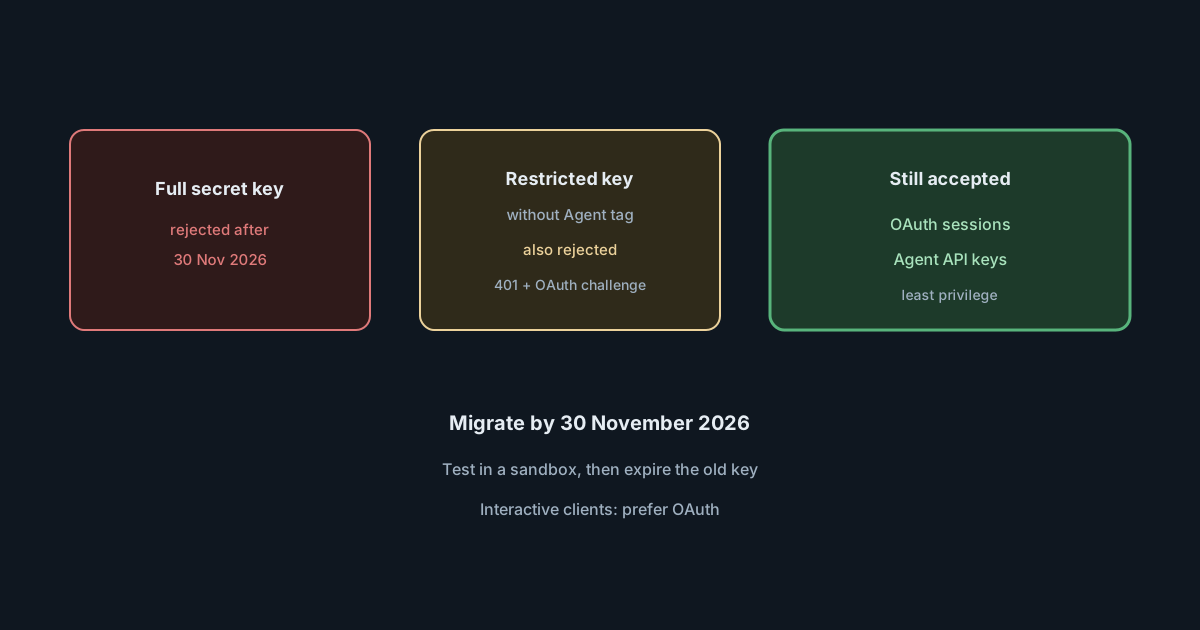
Stripe's Model Context Protocol server is telling customers to finish a credential migration before the end of November 2026. The MCP documentation states that teams should migrate by 30 November 2026, and that starting in December Stripe MCP will stop accepting full-access secret keys and restricted API keys without the Agent tag. Those requests receive a 401 with an OAuth discovery challenge. Interactive clients should prefer OAuth; autonomous clients should use an agent API key. The change is operational, not a vulnerability disclosure, but missed deadlines look like outages when an agent can no longer refund, invoice or read customers.
What Stripe documents
Under "Authenticate Stripe MCP", Stripe describes two supported methods:
- OAuth — when a client accesses Stripe on behalf of a Stripe user account. The client opens Stripe's consent page; administrators can manage and revoke sessions.
- Agent API keys — when an AI application needs independent, persistent access. Agent keys are identifiable in the Dashboard by an Agent badge. Pass the key as a bearer token in the
Authorizationheader.
The callout that matters for planning:
Migrate by 30 November 2026. Starting in December, Stripe MCP will stop accepting full-access secret keys and restricted API keys without the Agent tag. Replace these keys with newly created agent API keys or reconnect with OAuth. Requests using an unsupported key receive a
401response with an OAuth discovery challenge.
Stripe also advises turning on the MCP client's tool-approval setting, using caution when combining Stripe MCP with other servers (prompt injection), and noting that some write actions require a separate human confirmation flow in the Dashboard before the agent can retry.
The API keys documentation is the general reference for creating and scoping keys in the Dashboard. Agent-tagged keys are the MCP-oriented path when OAuth is not available.
Why the deadline is a security improvement
Full secret keys in an MCP client config are a classic blast-radius problem: one laptop backup, one committed .mcp.json, one log line, and the key can do everything the account can do. Restricted keys without an Agent tag were already narrower, but Stripe is now drawing a bright line for the MCP entry point: either a user-delegated OAuth session or a key that is explicitly marked for agent use.
The December cutover forces inventories that many teams have postponed. Coding agents accumulate Stripe MCP entries quietly—Cursor, Claude Code, Codex, VS Code Copilot and custom clients all appear in Stripe's setup examples. Each entry may still hold a sk_live_… or an old restricted key in an environment variable. After the cutover those entries fail closed with 401, which is better than silent over-privilege, but only if someone is watching agent error rates.
OAuth is the better default for interactive use because revocation is a session list, not a key rotation fire drill. Agent API keys remain for unattended processes; they should be created with only the permissions the agent needs, tested in a sandbox, then swapped in before the old key is expired.
Who is affected
Anyone connecting to https://mcp.stripe.com with:
- a standard secret key, or
- a restricted key that lacks the Agent tag,
in MCP client configuration, secrets managers or CI. OAuth-connected clients and clients already on agent API keys are on the supported path. Administrators who can disable MCP access for the team in the Dashboard should confirm whether live mode and sandboxes are configured separately, as the MCP docs describe.
Managed devices may also block outbound MCP hosts; Stripe notes that IT may need to allow mcp.stripe.com when connections fail in corporate environments.
What it means for engineering and security leaders
Put the date on a calendar with an owner. 30 November 2026 is a hard customer-facing deadline, not a soft recommendation. Assign someone to inventory MCP clients that talk to Stripe.
Prefer OAuth for humans, agent keys for bots. Document that split so developers do not paste live secret keys into MCP JSON "just to test".
Rotate, do not only add. After a sandbox test of the new agent key or OAuth session, expire the old key. Leaving both valid preserves the failure mode Stripe is trying to retire.
Watch for confirmation and approval gaps. Stripe's human-confirmation flow for some actions is separate from the MCP client's own tool approval. Security review should understand both layers so finance actions are not approved only by a model.
Practical takeaways
- Inventory every MCP client config and secret that targets
mcp.stripe.com. - Classify each as interactive (move to OAuth) or autonomous (create an agent API key with least privilege).
- Test in a sandbox first, including a write path that requires human confirmation if you use those tools.
- Cut over before 30 November 2026, then expire full secret keys and untagged restricted keys used for MCP.
- Verify a deliberate request with an old key type receives
401, so monitoring knows what failure looks like. - Review team MCP access toggles in the Stripe Dashboard for live and sandbox environments.
- Keep tool approval on in MCP clients that call Stripe, and train operators on Stripe's confirmation links.
Where a gateway fits
The SpanDock MCP gateway documentation says connector tokens and sign-ins stay in the server's credential store, are never shown again, never logged, and never sent to computers, and that every connector starts read-only until write access is granted. The MCP gateway is on the Premium and Enterprise plans. The page does not mention Stripe's November deadline or agent API keys; if Stripe is added as an organisation connector, server-held credentials and read-only defaults help keep keys off laptops, but someone still has to create the right Stripe credential type before December.