
The OCC's framework for bank AI agents: risk tiers, real approvals and kill switches
The OCC's 4 November examiner framework rates AI use by consequence and autonomy, not sophistication. What it asks of teams running coding agents in banks.
A rules-based agent that can move money can be riskier than a frontier model that only drafts memos. That is the core idea of the supervisory framework the US Office of the Comptroller of the Currency (OCC) issued on 4 November 2026 in Bulletin 2026-54. It tells national bank examiners how to evaluate banks' use of what the OCC now calls "super intelligence", including agents. It is written for examiners, not as new rules, but it shows what a bank's AI controls will be measured against. Coding agents appear in it by name.
What the OCC published
The framework is a guide for the OCC's examination workforce. The bulletin is explicit about its status: it "does not establish supervisory expectations for banks", banks are not expected to use it to assess themselves, and nothing in it sets "enforceable standards or prescriptive requirements". Examiners are told to tailor their work to the materiality of each use case and, for community banks, to the bank's size and risk profile.
Two clarifications in the news release matter for anyone designing a control programme. Examiners "should not treat SI as a separate and distinct risk category", and banks "should not be required to define a separate SI risk appetite". AI risk is to be managed inside existing operational, compliance, credit and model risk practices.
A note on the vocabulary
The bulletin defines "super intelligence" as the technologies previously covered by the statutory term "artificial intelligence", with a reference to a 2 October 2026 executive order. In practice, read "SI" as AI and "agentic SI" as agents. The framework document also states that it "was prepared with the assistance of SI" and was reviewed and approved by a human.
How the framework is built
The document groups sixteen components into six pillars: purpose, risk, control, oversight, resilience and assurance. Its overarching principle is that "control intensity could increase with the potential consequences of an SI agent's failure or misuse", and that risk classification may rest on "potential consequences, transfer of agency, and the degree of human oversight, rather than the technical sophistication" of the system.
Purpose stated in testable terms
The first component asks banks to document, before deployment and after material changes, what an agent is designed to do and not do, who may invoke it, the data and systems it may access, and the actions it could take. The framework wants authorised data sources, tools, accounts and actions "stated in terms that can be tested rather than as a general capability description". Activity outside the approved purpose "may be treated as a control failure even when the resulting output or action appears reasonable".
Human approval that is more than a click
The section on human oversight separates human-in-the-loop (review and approval before an action runs) from human-on-the-loop (active monitoring with the authority and practical ability to intervene). It asks that approval be "more than a nominal click", warns that "high volumes or bulk approval could reduce review quality and contribute to alert fatigue", and asks how many agents, accounts or alerts one person can credibly monitor. Overrides and their reasons may be logged and reviewed.
Containing an agent that is running but wrong
The resilience section makes a point that is easy to miss: an agentic system "could remain available while taking inappropriate or harmful actions". The listed containment tools are monitoring, deterministic rules, circuit breakers, rate limits, least-privilege permissions and kill switches. The cybersecurity section adds that "the breadth of agent permissions and tool access may be treated as part of the attack surface", and that agent identities, credentials and logs may be governed "comparable to privileged users".
Provider agents and silent model changes
The third-party section covers vendors adding AI features or changing models in products a bank already uses. Banks "may require notice and transparency of new SI functionality" and may retest before or when changes happen. It also suggests defining an incident vocabulary for events such as hallucination, misfire, drift and manipulation.
Where coding agents sit
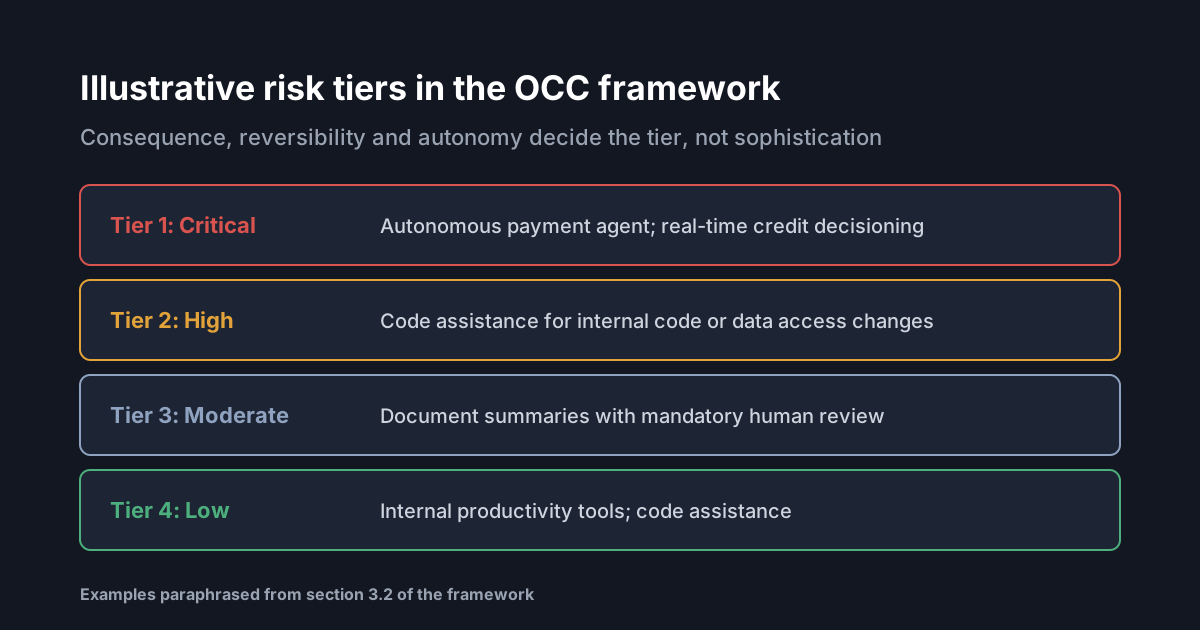
The framework closes with an illustrative tiering method. Each use case is scored on decision consequence, reversibility, customer and financial impact, autonomy, data sensitivity, explainability and provenance, then placed in one of four composite tiers. The examples are telling:
- Tier 4 (low) lists "code assistance" alongside internal productivity tools and general Q&A.
- Tier 2 (high) lists "code assistance for internal code or data access changes", next to AI-assisted underwriting and anti-money-laundering alert disposition.
- Tier 1 (critical) is reserved for direct, hard-to-reverse actions with high impact, such as an autonomous payment agent.
So the same coding agent can sit at either end, depending on what it is allowed to touch. An assistant suggesting code in an editor is low risk. An agent that can change code governing data access, or change access itself, is placed with high-weight decisions.
Analysis
The framework is careful not to create obligations, and that restraint is worth respecting: it is not a checklist banks must pass. But examiners will read a bank's controls through it, and its emphasis is clear. It rewards scoping agents by what they can do, recording that scope in an inventory, and showing that human checkpoints actually work.
Two parts are more demanding than they look. Testable purpose statements require a bank to know which tools and accounts each agent holds, which is hard when developers configure their own agents and MCP servers. And "more than a nominal click" is a design requirement for approval prompts: a reviewer needs the evidence, the time and the authority to say no. A coding agent that asks for approval forty times an hour does not meet that bar, however many prompts it shows.
Our earlier articles on the FSB's sound practices and the Bank of England's view of autonomous AI risk cover related ground from other regulators. The OCC's contribution is the explicit tiering, with code assistance placed on it.
What it means for engineering and security leaders
If you build or run software at a US national bank, expect examiners to ask which tier your coding agents sit in and why. The defensible answer depends on permissions, not on the model: what can the agent change, how reversible is it, and who approves.
Practical takeaways
- Inventory your agents by capability. For each coding agent and MCP server, record owner, provider, tools, accounts and data it can reach.
- Split use cases by tier. Keep editor assistance separate from agents that can change access-control code, infrastructure or data.
- Make approvals meaningful. Route consequential actions to a named reviewer with context, and measure approval volume per person.
- Plan containment. Decide how you would stop a misbehaving agent: rate limits, revoked credentials, a kill switch.
- Ask vendors for change notice when they add AI features or switch models.
- Define incident categories for agent misfires so they are recorded consistently.
For approvals and access, SpanDock's MCP gateway (Premium and Enterprise) starts every connector read-only, holds tools that need approval until an administrator approves that one call, and on Enterprise supports just-in-time write access with every request, grant and use recorded. The change management report, on Enterprise, shows who approved what, with the ticket.