
Japan's GENAI Standards: rules for giving 180,000 civil servants AI agents
Japan's Digital Agency published rules for agent environments comparable to coding agents. The controls it chose, and which ones companies can borrow.
Most organisations give AI agents to developers first. Japan's Digital Agency is giving them to its whole civil service. On 6 November 2026 it announced two agent environments for about 180,000 government employees, and published the rules for using them: the GENAI Standards on Governance, Security, and Safety. The agency describes the more advanced environment as comparable to AI coding agents. The controls it chose are a useful reference for any company deciding how far to open agents beyond its engineers.
What was announced
The announcement describes two environments in Government AI GENAI, the government's shared AI platform:
- Agent Chat, a web chat environment for creating and running agents, rolling out across ministries and agencies from 6 November.
- GENAI Workbench, a per-user agent development environment, targeted for around December 2026.
The agency says it plans to release both as open-source software around February 2027. The standards were developed with the cooperation of Japan's AI Safety Institute and set requirements separately for users, administrators and developers. The English text is a provisional translation; the document says the Japanese original prevails in any discrepancy.
Why build rather than buy
The standards say plainly why the government is building its own environments. Coding agents "typified by Claude Code and Codex" are spreading beyond programming into knowledge work, and the document wants that capability for civil servants. But commercial agent services are used "within the scope of the functions, permission systems, logs, models, data management, and operational methods defined by the provider". Where logs and evaluation depend on the provider, administrators "may be unable to sufficiently understand and verify the behavior and actual use of AI agents, which risks turning them into black boxes". The document also notes that terms and prices "may be changed at the provider's discretion", and calls for a design that does not depend excessively on specific models or clouds.
That is a familiar argument from platform teams. It is notable to see a government write it into a standard.
Two environments, two levels of trust
Agent Chat: restricted by default
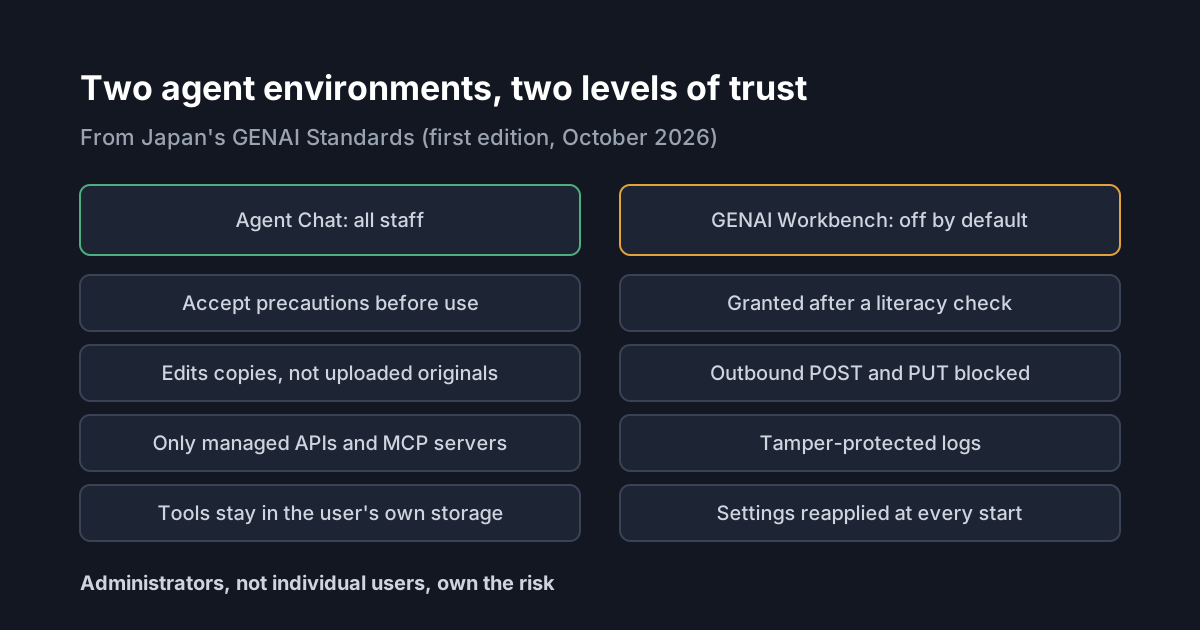
Agent Chat is available to all staff, behind a pop-up that users must accept before use. The standards list what it cannot do, as of October 2026:
- Files the agent can overwrite or delete are limited to files the AI generated. When it edits an uploaded original, it duplicates the file and edits the copy.
- Tools work only inside the user's own storage area. The agent cannot operate the user's computer.
- It "cannot directly access APIs or MCP servers not managed by GENAI Developers".
- Web searches run inside the government cloud, without contacting the sites themselves.
- Uploaded files are scanned, and files that cannot be inspected, such as password-protected archives, are blocked.
GENAI Workbench: off until granted
Workbench is closer to a coding agent: file operations, command execution and web retrieval over many steps. It is "unavailable by default". Administrators grant it to employees who apply and are confirmed as meeting a standard of literacy, for example through a literacy check the developers provide. Its restrictions are different in kind:
- Outbound data transmission (POST, PUT and similar) is blocked by the system, whatever the user intends. GET requests for search are allowed and logged with destination, volume and time.
- Network-layer defences "cannot be bypassed, regardless of the state of security hooks".
- Common settings are reapplied at every server start, overwriting manual changes.
- Input, output and external communications are logged "in a format protected by tamper-prevention measures".
- Developers can suspend a user's access when misuse is suspected.
Administrators own the risk
The standards assign responsibility to administrators "without relying solely on the care of individual Users". They must run user education, periodic risk assessments and incident procedures, and restrict agent use in work affecting the public's rights, such as permits, benefits and recruitment, according to importance, scope of impact and how recoverable errors are.
Cost is part of that duty. The platform logs the model used and input and output tokens per user, and provides cost dashboards to each ministry. Administrators are told to practise "token management", recognising that agent use "incurs pay-as-you-go token fees".
Skills as institutional knowledge
The document treats skills, the reusable instructions agents follow, as a way to turn staff experience into explicit, versioned procedures, shared through a planned "GENAI Library". It is also cautious: shared skills should not be shared "unconditionally", and review, quality evaluation, security checks, version control and retirement procedures still need to be built.
Rules for the platform's own developers
The developer chapter reads like a secure engineering policy. Production deployments need approval and review by another developer. Data change, deployment and review permissions are separated. Human access to logs containing inputs and outputs is avoided in normal times and recorded when granted. Secrets stay out of source code.
Analysis
The interesting choice is the split. Rather than one agent with one policy, the agency built a constrained tool for everyone and a powerful tool for people who have shown they can supervise it. The powerful tool gets stronger, non-negotiable controls: no outbound writes, tamper-protected logs, settings that reset on restart. The burden of judgement moves from each user to administrators and the platform.
Some controls depend on owning the whole environment. Blocking every outbound POST works on a hosted workbench; it is much harder on a developer's laptop. But several translate directly: approved MCP servers only, agent edits on copies rather than originals, tamper-resistant logs, settings that cannot drift, and cost visibility per person. The skills section also matches what we see in companies: sharing is easy, and review and retirement are the hard part. Our article on agent skills that point at bad domains shows why.
What it means for engineering and security leaders
If your company is extending agents from engineering to other teams, this is a worked example of tiered access. It also gives security teams language for a common tension: the most capable agents need the most capable supervisors, and that can be a gate, not an assumption.
Practical takeaways
- Offer two tiers. A restricted agent for everyone, and a coding-agent-class environment granted on request after training.
- Allow only managed MCP servers in the general tier.
- Make agents edit copies of user-supplied files, not originals.
- Log tokens and models per person and give each team a cost view.
- Reapply agent settings automatically so local changes do not persist.
- Build a review and retirement path for shared skills before you build the library.
For cost visibility, SpanDock's model proxy records what each call cost, and per-person budgets (Standard and up) can switch to cheaper models near a limit and then block, downgrade or flag calls over it.