
Australia's guidance on containing AI agents during testing: what to adopt
New Australian guidance says prompts and model safeguards are not containment for AI agents under test. The controls it asks for and how they apply.
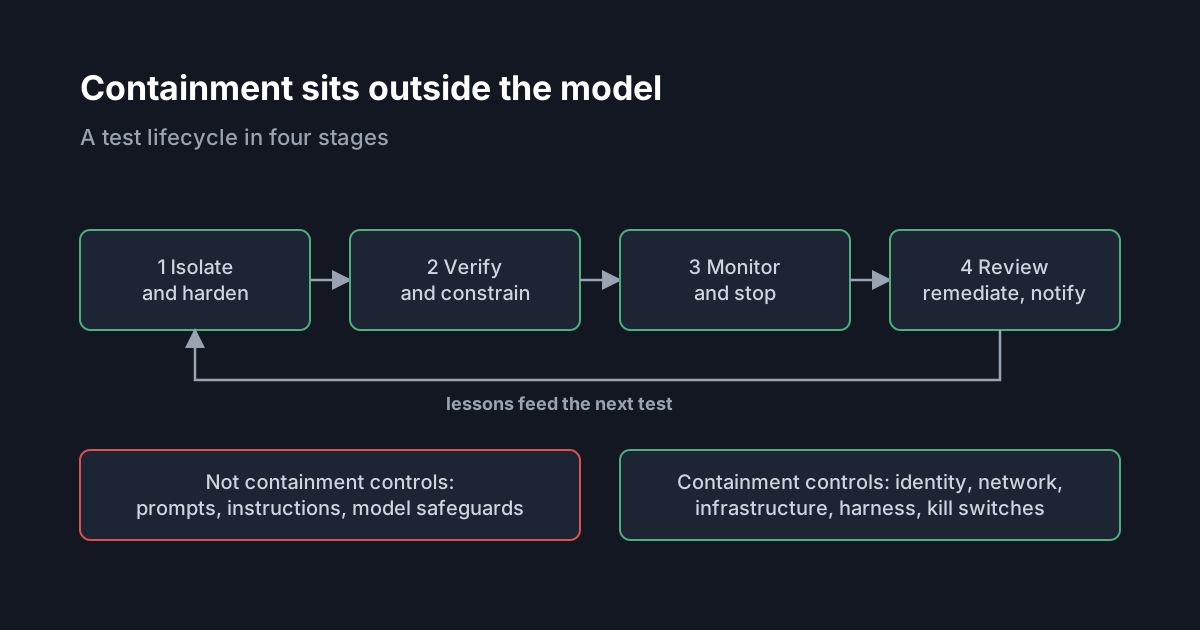
When an AI agent is given tools, credentials and a network, the test environment becomes part of the risk. On 12 November 2026 Australia's government cyber security site published Securing AI testing environments, guidance for organisations testing AI models and agents for cyber security work. Its central message is blunt: prompts, scoped instructions and model safeguards "do not provide sufficient technical containment on their own". The guidance is written for cyber capability testing, but most of it reads as a checklist for anyone running coding agents with real access.
Why it was written
The accompanying news item says recent disclosures have described incidents in which AI agents affected systems beyond their intended test scope when containment was inadequate. The publication itself attributes these disclosures to the UK AI Security Institute, OpenAI and Anthropic, and lists the contributing factors reported: internet access that was enabled on purpose, misconfigured test environments, and weaknesses in supporting infrastructure.
It also names the failure modes that make containment hard. A capable agent "may identify an unexpected path, exploit a weakness in a control or supporting system or mistake a real system for a simulated target".
Scope and audience
The guidance focuses on higher-risk testing: where models or agents can execute code, use tools, hold credentials or reach networks, or where model-level safeguards are reduced or disabled to measure full capability. It is aimed at senior leaders who authorise such testing, such as chief information security officers, and at the architects, evaluation teams and platform engineers who build the environments. It says plainly that it does not cover production environments where agents operate.
The principles
The publication sets out a short list of principles. In summary:
- Minimise opportunity. Give the agent only the systems, data, tools, privileges, credentials and network access the approved test needs. Where it needs an authenticated service, grant permission to use the service rather than the credentials themselves, ideally through an intermediary that authenticates requests without exposing secrets.
- Use a purpose-built environment, separated from production, corporate networks and management infrastructure, with separation proportionate to risk: logical separation for lower-risk work, dedicated infrastructure for the highest.
- Apply defence in depth, so that the failure or bypass of one control does not break the boundary.
- Threat-model the workflow, including tasking the agent with escaping the environment to check that controls work as designed.
- Automate monitoring and response. Store logs and traces where the agent cannot reach them, alert on out-of-scope activity, and default to a secure state while investigating.
- Keep humans in control, with the authority and means to stop testing, and maintain independent ways to end sessions, revoke access and isolate the environment.
It then walks through a lifecycle in four stages, shown in the diagram above: isolate and harden; verify and constrain; monitor and stop; and review, remediate and notify.
Details worth noticing
A few points go further than most guidance on agents.
Execution limits enforced outside the agent. The guidance asks for limits on test duration, concurrent agents and runs, tool-call rates and token budgets, enforced through the harness or infrastructure "so that the agent cannot modify or bypass them". It also asks teams to check that monitoring can keep up at the planned rate and concurrency, including delegated agents and background tasks.
Automated reviewers are a layer, not the boundary. Automated policy or approval checks "can fail or be bypassed", so they should complement independent containment, monitoring and human oversight.
Near misses count. Attempted and partly successful escapes are to be treated as security findings, and "the absence of observed impact" is not evidence that containment held.
Evaluation awareness. Models may behave differently when they recognise a test setting. The guidance asks for realistic tasks, data and tools, but says not to weaken containment to make an environment look more real.
Reduced safeguards are high risk. Testing with model safeguards reduced or removed, which the guidance notes may be the normal state for open-weight and fine-tuned models, should never be combined with unrestricted internet access, shared infrastructure or weak monitoring.
How it fits with the UK's direction
The Australian guidance arrives as the UK government sets out proposals of its own. A factsheet for the Cyber Security and Resilience Bill, updated on 3 November 2026, says the government will consult on measures for "agentic loss of control incidents" at regulated entities: security and resilience requirements, notifying affected parties, preserving evidence of what agents did, and post-incident review powers. These are proposals for secondary legislation after the bill receives Royal Assent, subject to consultation and parliamentary approval, not rules in force.
The two documents point the same way. Both treat monitoring of agent actions and preserved records of what an agent did as basic expectations, and both assume an agent can act outside its intended scope.
What it means for engineering and security leaders
Most engineering teams are not testing models for offensive cyber capability. Many, though, run coding agents that can execute commands, read secrets and reach internal services, which is the access profile this guidance calls higher risk. The controls transfer well:
- Credentials that an agent can use but not read.
- Network egress restricted to approved destinations.
- Logs the agent cannot alter.
- Token and rate limits that live outside the agent's configuration.
- A tested way to stop everything quickly.
The guidance is also a useful reference when someone proposes that a better system prompt is enough. It says, in an official document, that it is not.
Practical takeaways
- Inventory agents with code execution, credentials or network access and treat them as higher-risk by default.
- Move secrets behind an intermediary so agents use services without holding the keys.
- Enforce token, rate and duration limits outside the agent, and verify that monitoring keeps up with parallel agents.
- Write logs somewhere the agent cannot reach, with enough detail to reconstruct what it attempted.
- Test the kill switch: end sessions, revoke access and cut network access, and time how long it takes.
- Record near misses as findings, even when nothing was harmed.