
Gemini 4 Carbon: Argon's token price, more thinking, and a 1 December rise
Gemini 4 Carbon is generally available at the same per-token price as Argon, doubling on 1 December. Why thinking tokens and long decodes decide the real bill.
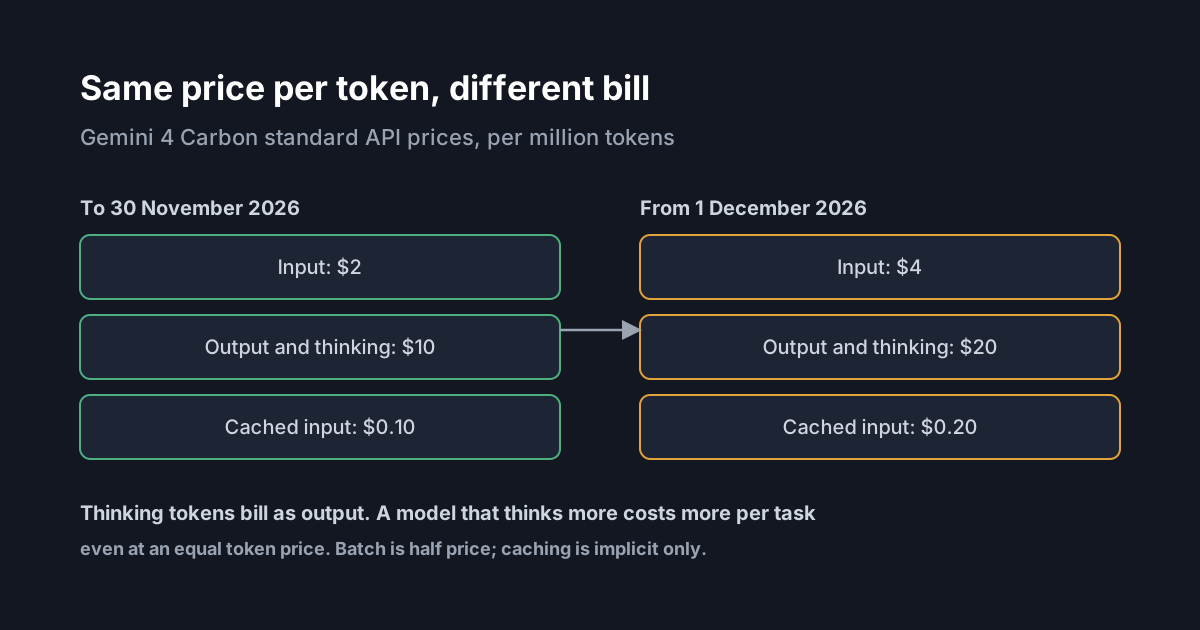
Google made Gemini 4 Carbon generally available on 10 November 2026, two weeks after announcing it. For teams paying per token, the headline price looks familiar: Carbon costs the same per token as Gemini 4 Argon, and like Argon its introductory price doubles on 1 December. The per-token price is not the whole story, though. Google's own guidance says Carbon spends more thinking tokens than Argon, and thinking is billed as output. If you plan to route coding agents or review bots to Carbon, budget for tasks, not tokens.
What Google released
In its availability post, Google calls Carbon its strongest model, with frontier performance in cyber security and long-horizon agentic work. It was first released to cyber security defenders through Google's Fairwind programme, and is now available:
- through the Gemini API on the paid tier, in Google AI Studio and Gemini for business;
- to Google AI Ultra subscribers in Google Antigravity, the Gemini app and AI Mode in Search.
On the same day, the GitHub Changelog announced Carbon as generally available in GitHub Copilot for Pro+, Max, Business and Enterprise users, billed at provider list pricing under usage-based billing, with a gradual rollout.
What it costs, and when that changes
The Gemini API pricing page gives the standard paid-tier prices per million tokens:
| To 30 November 2026 | From 1 December 2026 | |
|---|---|---|
| Input | $2.00 | $4.00 |
| Output, including thinking tokens | $10.00 | $20.00 |
| Context caching | $0.10 | $0.20 |
Batch input and output prices are half the standard rate in both periods. Several details on the same page affect real bills:
- No free tier. Carbon is not available on the free tier of the API.
- Implicit caching only. Explicit caching is not supported, so you cannot pin a long shared prefix yourself; you benefit only when the service reuses it.
- Everything is counted. The page says every token the model processes is billed, "including thinking tokens", and internal tool instructions and function declarations when grounding is used.
- Grounding costs extra. Grounding with Google Search has 5,000 free requests a month, shared across Gemini 3 and newer models, then $14 per 1,000.
Google's availability post adds that the post-introductory price "applies to the Carbon model intended for public access only".
Same price as Argon, different bill
The developer guide is unusually direct about how to choose between the two models. It says Carbon "spends more thinking tokens" exploring codebases and running build-and-verify loops, and recommends Argon for "the majority of software engineering and knowledge work", with "tighter token usage and faster turnaround". It even suggests pairing them: Carbon for planning, coordination and final verification, Argon or Gemini 3.8 Flash for parallel implementation.
Read that as a cost statement. At equal per-token prices, the model that thinks more costs more per task. How much more depends on your workload, and Google does not publish a ratio. The only reliable number is the one you measure on your own tasks.
Carbon's default thinking level is medium, with low and high available. The guide describes low as minimising latency and cost for classification, routing and extraction. Setting the level per job, rather than accepting the default everywhere, is the simplest lever teams have.
Long decodes raise the ceiling
Carbon, like Argon, shares a unified 1 million token window between input, thinking and output in the Gemini API. The guide says the default output limit is 65,536 tokens, and that requests can generate past that, up to 1 million tokens minus the input, by running in the background with a higher max_output_tokens. Google's own advice is to set it high enough that thinking doesn't cut the answer short, and "low enough to limit spend".
The arithmetic is worth doing once. A single request that used 900,000 output tokens would cost $9 at the introductory output price and $18 from 1 December, before input. That is not a typical request, but agents retry, and a loop that keeps hitting a generous ceiling adds up quickly. The guide also says a more advanced client-side continuation option "will soon come" to the Interactions API; for now, client-side continuation is only available through the legacy GenerateContent API.
What it means for engineering and security leaders
The earlier article on Gemini 4 Argon's pricing made the point that a price with an end date is a budgeting problem. Carbon adds a second one: a stronger model at the same token price invites people to switch everything to it. That is the expensive default.
A better pattern is to decide where Carbon earns its cost. Google's own split, Carbon for hard planning and verification and cheaper models for bulk implementation, is a reasonable starting hypothesis. Test it on your own repositories, with your own success criteria, before making it policy.
Two governance points also matter. In Copilot, Carbon is billed under usage-based billing, so seats alone no longer bound spend. And on the API, the 1 December change applies automatically; nothing in your code will tell you it happened.
Where SpanDock fits
With SpanDock's model proxy, each person can have a daily, weekly or monthly budget, and an administrator chooses what happens over the limit: calls are blocked, sent to the cheapest model, or flagged. Where a tool reports tokens but not cost, SpanDock estimates the cost, using your own price overrides under Settings → Model prices ahead of its built-in prices. Budgets are on the Standard plan and up.
Practical takeaways
- Put 1 December 2026 in your budget: Carbon's input, output and cached prices double that day.
- Measure cost per completed task, not per token, on a handful of real jobs for Carbon and Argon.
- Set
thinking_levelper job and uselowfor routing and classification. - Cap
max_output_tokenson long-decode requests, and alert on requests that hit the cap. - Use batch for work that can wait; it is half price.
- Check Copilot model policies if you don't want Carbon available to everyone under usage-based billing.