
AWS API MCP Server: a deny list that missed some operation names
CVE-2026-125271 let some AWS operations skip the AWS API MCP Server's deny and consent lists. Who was affected, the August fix and what to check.
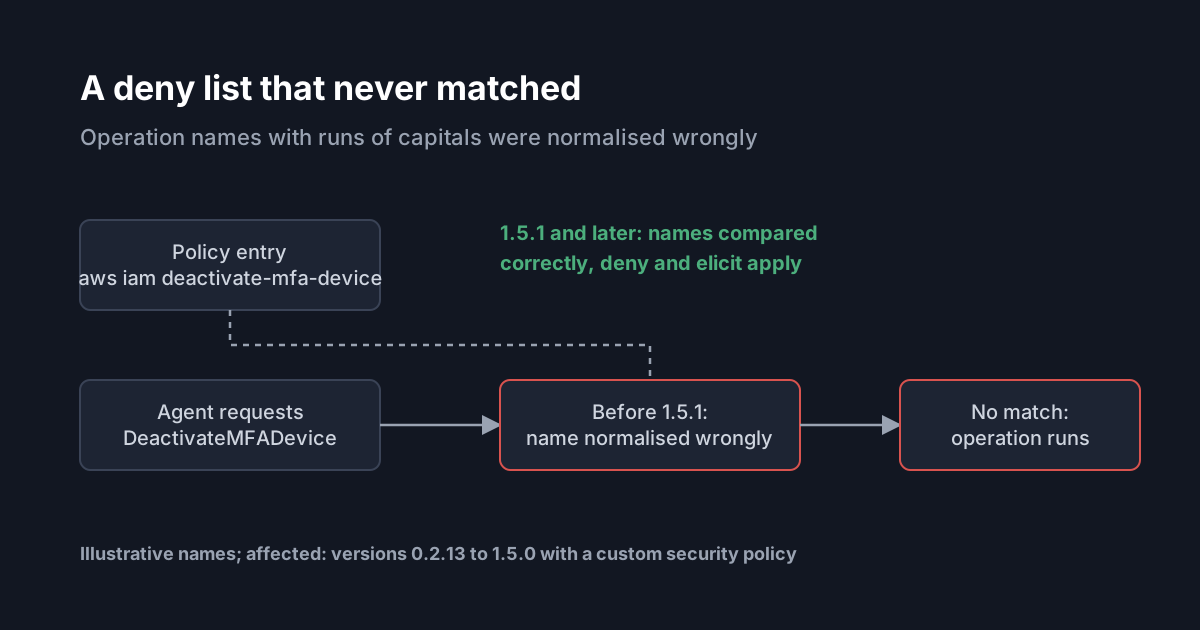
A deny list is only as good as its string matching. On 10 November 2026 AWS published security bulletin 2026-176-AWS for the AWS API MCP Server, the open-source MCP server that lets an AI assistant run AWS API calls. In affected versions, a custom security policy could fail to block or ask about some operations it explicitly listed. The cause was how the server rewrote operation names before comparing them. The fix has been on PyPI since August.
What the AWS API MCP Server's policy does
Besides IAM, the server supports an optional policy file. The project's README says it looks for it at ~/.aws/aws-api-mcp/mcp-security-policy.json, with two lists:
denyList: commands that are always blocked.elicitList: commands that need explicit user consent first, through MCP elicitation in clients that support it.
Entries are written the way the AWS CLI writes commands, with kebab-case operation names, such as aws iam delete-user. The README is explicit that matching is exact: wildcards such as iam:delete-* are not supported, so every command has to be listed individually.
What went wrong
The GitHub advisory GHSA-4wq9-grf3-qg2p, assigned CVE-2026-125271, explains the flaw. For AWS API operations whose names contain consecutive capital letters, the server normalised the name incorrectly before comparing it with the policy. In the bulletin's words, those operations "never matched a correctly written denyList or elicitList entry".
AWS operation names are written in PascalCase, and acronyms produce runs of capitals. The advisory's examples of what could slip through are creating a federated identity provider, deactivating an MFA device and deleting database clusters. These are exactly the operations a cautious team would put on a deny list. The diagram above uses an illustrative MFA operation; the advisory does not list every affected name.
The preconditions narrow the exposure:
- Versions: 0.2.13 up to, but not including, 1.5.1.
- A locally run server with a custom security policy that lists affected operations. Without a policy file, there was nothing to bypass.
- User interaction with the AI assistant.
The advisory says the remote AWS API MCP Server offering is not affected, and neither are the READ_OPERATIONS_ONLY and REQUIRE_MUTATION_CONSENT settings. There is no workaround other than upgrading.
Severity
GitHub rates the advisory high, with a CVSS 4.0 score of 8.5 and a local attack vector. AWS's bulletin labels it "Important (requires attention)". These are different scales and not a disagreement, but teams that triage only on "critical" will not see it.
The fix shipped three months before the advisory
The fixed version is 1.5.1. According to the PyPI release history, 1.5.1 was uploaded on 10 August 2026, and the current release, 1.6.0, on 27 October. The advisory followed on 10 November.
That gap has two consequences. Anyone who updated in the last three months is already protected. Anyone who pinned a version during the summer and relies on advisories to tell them when to move had no signal until this week. If your installs are pinned, the advisory date is not the date you became safe; the upload date of the version you run is.
Version 1.6.0 also fixes an unrelated issue covered in the earlier article on the server's token audience bypass. Moving straight to 1.6.0 or later deals with both.
Analysis: string policies around an agent
The policy file is a client-side safety net for a server that, by design, can call almost any AWS API. Three lessons carry beyond this one bug.
- Normalisation is part of the security boundary. When a policy is written in one format (CLI kebab-case) and enforced against another (API PascalCase), the conversion between them decides what the policy means. A bug there silently empties the list, and nothing in normal use reveals it.
- Exact matching cuts both ways. No wildcards means no surprising matches, but also no safety margin. One spelling difference is enough to miss.
- IAM stays the primary control. The README says so, and the bulletin's own wording, "might allow an actor to execute AWS API operations that the operator's security policy was configured to deny", is a reminder that the policy is an extra layer. An IAM role that cannot deactivate MFA devices could not have been talked into doing it, whatever the policy file said.
What it means for engineering and security leaders
If developers run the AWS API MCP Server locally, ask two questions: which version, and which credentials. The version question is quick. The credentials question matters more: the server runs with the permissions of the person who started it, and the README warns it is intended for local use with a single user's credentials.
For operations you never want an assistant to perform, rely on IAM first, then on consent prompts, then on deny lists, and test each layer with the exact operations you care about.
Where SpanDock fits
When MCP servers are reached through SpanDock's MCP gateway, including your own servers added over HTTPS or run on the server, every connector starts read-only for everyone, read-only access hides write and destructive tools completely, and destructive tools still need an administrator's approval when write access is granted. Every call is recorded. The MCP gateway is on the Premium and Enterprise plans.
Practical takeaways
- Check installed versions of
awslabs.aws-api-mcp-serverand move to 1.6.0 or later. - Test your deny list with the operations you care most about, including ones with acronyms in their names, and confirm they are refused.
- Scope the IAM role the server uses so the riskiest operations are impossible, not just discouraged.
- Turn on
READ_OPERATIONS_ONLYorREQUIRE_MUTATION_CONSENTwhere they fit; the advisory says they were not affected. - Track release dates, not only advisory dates, for pinned MCP servers.