
Muse Ember's pricing: cheap per token, with a 200K cliff for agent loops
Meta's Muse Ember costs $0.10 and $0.50 per million tokens, but a request over 200K input tokens is billed at triple rates in full. What that means for agents.
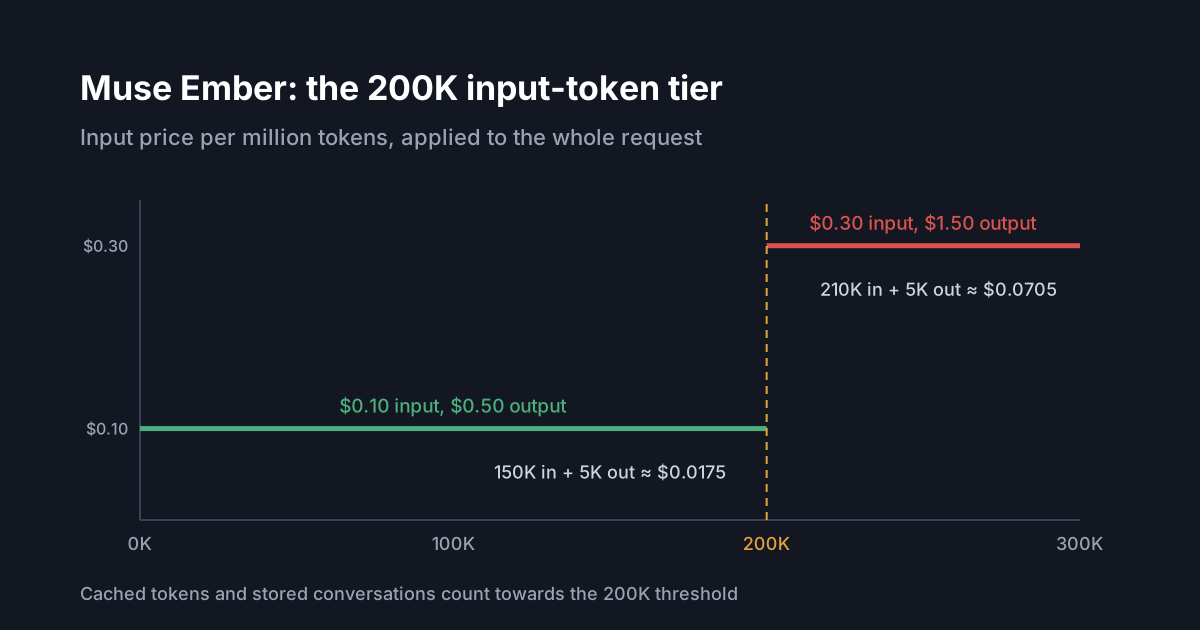
Meta released Muse Ember on 9 November 2026, a small model it positions for the work agents repeat all day: sub-agent tasks, tool calls, routing and extraction. The headline price is low, at $0.10 per million input tokens and $0.50 per million output tokens. The detail that matters more for agent workloads is in the pricing documentation: a request with more than 200K input tokens is billed at three times those rates, for the whole request. Agent loops that carry their history forward cross that line without anyone deciding to. Here is how the pricing works, what Meta's cost comparisons do and don't show, and how to keep the cheap tier cheap.
What Meta released
According to Meta's announcement, Muse Ember (muse-ember-1.0) is the company's "smallest and most efficient model", designed for "tool calls, coding subtasks, routing, extraction, and long document parsing". The model page lists text, image, video, audio and PDF input, text output, a context window of 1,048,576 tokens and a maximum output of 524,288 tokens. It works through the Responses, Chat Completions and Messages endpoints.
Meta suggests pairing it with a larger model: Muse Wonder or Muse Spark plans, and Muse Ember "handles the volume". For hard single-shot coding problems, knowledge-heavy questions or visual coding, the model page points to the larger models instead.
Two more details from the model page affect cost. Reasoning effort runs from "minimal" to "max", and the default is "max". And on Meta Model API, Muse Ember runs in Standard mode only: there is no Contributor mode, the discounted option in which Meta may use your prompts and responses to train future models.
How the price tiers work
The pricing page lists two tiers, per million tokens:
| Usage | Up to 200K input tokens | Over 200K input tokens |
|---|---|---|
| Input | $0.10 | $0.30 |
| Cached input | $0.004 | $0.012 |
| Output | $0.50 | $1.50 |
Three rules decide which tier applies:
- Input tokens set the tier, cached tokens included. A long prompt that is mostly served from cache still counts in full towards the 200K threshold.
- Stored conversations count. When a request continues a conversation with
previous_response_id, its input includes that conversation. - The whole request moves. A request over 200K is "billed at the long-context rates in full, not only for the tokens past 200K".
This is different from Meta's own larger models. The same page says Muse Wonder and Muse Spark have no long-context premium. Web search grounding adds $2.50 per 1,000 queries on all three.
A worked example
Take an agent that sends Muse Ember 150,000 uncached input tokens and gets 5,000 output tokens back. At list prices, that call costs about $0.0175 ($0.015 input, $0.0025 output). Now let its history grow to 210,000 input tokens with the same 5,000 output tokens. The whole call moves to the long-context tier and costs about $0.0705 ($0.063 input, $0.0075 output). That is 40% more input for roughly four times the price. These are our calculations from the published rates, not figures from Meta.
The jump is not a reason to avoid the model. It is a reason to know where your requests sit relative to 200K.
What Meta's cost comparisons show
Meta's announcement says Muse Ember "matches Haiku's best score at about a third of the cost" and compares it with Claude Haiku 5.5 and GPT-6 Luna on the Artificial Analysis Intelligence Index, where it scores 36. The figures deserve a careful read.
- The cost per task varies with rounding and source. Meta's developer blog gives "about $0.13" per Intelligence Index task at max effort; a comparison table in the announcement gives $0.14; the chart data shows $0.136. These are consistent, but quote one and say which.
- The basis of the estimate is described two ways. One chart caption says Muse Ember's costs are "estimates at proposed pricing"; the chart's footnote says "Muse Ember cost at list pricing". The published list prices match those used, so the difference is probably wording, but it is there.
- Some benchmarks compare harnesses as well as models. Meta's footnote says its Terminal-Bench 4.0 figures use each model's best published harness: mini-swe-agent for Muse Ember, Claude Code for Claude Haiku 5.5 and Codex for GPT-6 Luna. That is a fair way to report best results, but it is not a like-for-like model comparison.
- The results are at max effort, which is also the default. A workload that runs at lower effort will see a different cost and quality balance.
What it means for engineering and security leaders
The model is aimed squarely at the sub-agent layer, where many small calls add up and price per token matters most. That makes it a natural candidate for routing: send bounded, repetitive work to a cheap model and keep planning on a stronger one. The pricing structure, though, rewards a particular architecture. Short, focused calls with trimmed context stay in the cheap tier. Long-running loops that keep appending history, especially through stored conversations, drift into the expensive one, and prompt caching doesn't stop the drift because cached tokens count towards the threshold.
There is also a data question. Meta's Contributor mode, which trades your content for lower prices, is not offered for Muse Ember on the Model API, but it exists for Muse Spark there. In Muse Code, subscriptions default to Contributor mode, which can be turned off in settings, according to the pricing page. Anyone evaluating Meta's models across products should check which mode each one runs in before sending company code.
Practical takeaways
- Measure input tokens per call for any agent you consider moving to Muse Ember, and look at the distribution, not the average. The calls just above 200K are the expensive ones.
- Keep sub-agent context short. Hand sub-agents the files and instructions they need rather than the whole conversation, and compact or restart long loops before they pass 200K.
- Watch
previous_response_idchains. Stored conversations count towards the tier even though you don't send the text again. - Set reasoning effort deliberately. The default is max; test whether lower settings are good enough for routing, classification and extraction tasks.
- Check the two tiers on the invoice. Meta lists them separately, which makes it easy to see how much traffic crossed the line.
- Confirm the mode (Standard or Contributor) for each Meta product your teams use.
If your AI tools call models through SpanDock's model proxy, every call records the requested model, the model that answered, tokens and cost, and per-person budgets (Standard plan and up) can steer people to cheaper models near their limit. Prices from your own overrides, under Settings → Model prices, take priority over the built-in catalogue when costs are estimated. See model proxy and budgets.
For a related cost lever, see prompt caching for AI coding costs, and for another small model for sub-agents, Claude Haiku 5.5 for coding sub-agents.