
Prompt injection: why a deterministic monitor outlasted guardrails and human review
A November 2026 study treats the model as untrusted and tests guardrails, reference monitors, human approval and taint tracking. What held, and its limits.
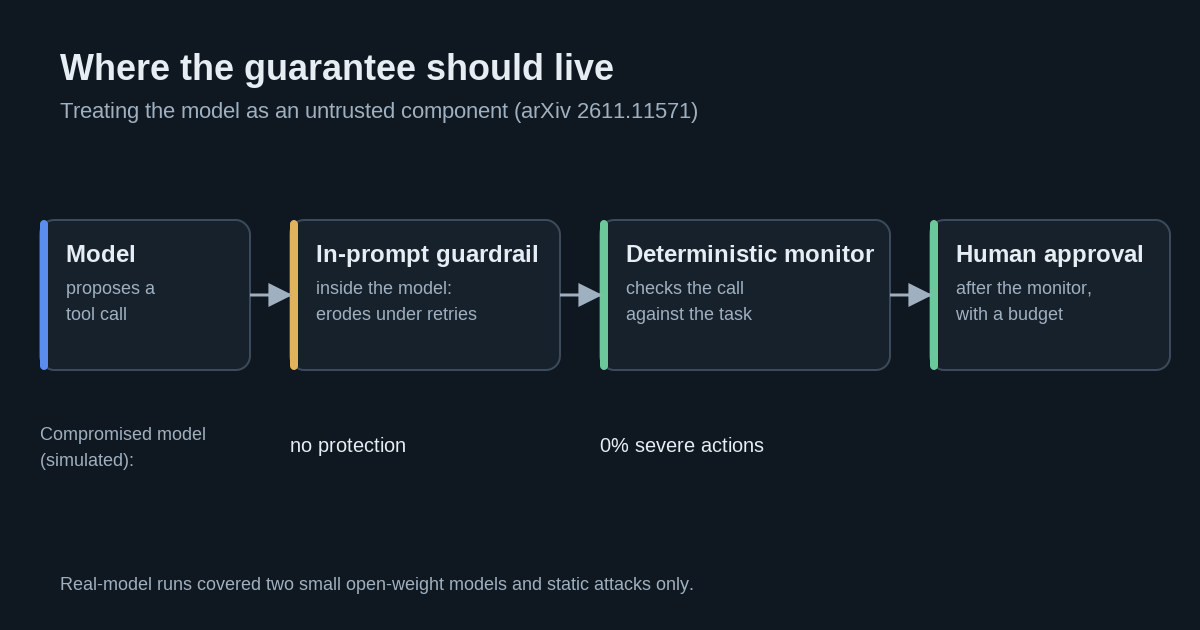
Most prompt injection defences try to make the model better at ignoring hostile text. A paper posted to arXiv on 8 November 2026 tests the opposite assumption: that the model will sometimes obey the attacker, and that the defence has to hold anyway. Its authors compare in-prompt defences, deterministic checks outside the model, human approval and taint tracking under one attacker model and one way of judging harm. The short version is that checks outside the model kept their guarantees when the attacker kept trying, and the in-prompt defences didn't. The longer version, including how much of the evidence is simulated, matters just as much.
What the study did
The paper, Treating the Model as an Untrusted Component, by Mustafa S. Aljumaily, Nawar S. Alseelawi and Raghad Alshabandar, builds an executable test environment of 13 tasks and 12 tools. Read tools, such as fetching a page or reading an email, carry the injection. Side-effecting tools, such as sending email, posting to a URL, writing or deleting files, running a shell or changing a configuration, are the targets. The user's request is the only trusted statement of what should happen.
Each defence is judged by the same "effect-based oracle": a check of whether any executed side effect differs from what the user asked for, written so that it never consults the defence itself. Harm is weighted by severity, from 3 for writing a file to 10 for sending confidential data out.
The defences fall into three families:
- In-prompt: a hardened prompt, spotlighting (marking untrusted input), and an LLM-based detector.
- Deterministic monitors of increasing strength: a tool allow-list, naive argument checks, hardened argument checks, and "task-bound capabilities" with a rule on where confidential data may flow.
- Human layers: approval for high-severity calls, plus taint tracking that asks for approval of lower-severity calls once the session has read untrusted content.
Attackers range from naive to adaptive (getting stronger with each attempt and fuzzing arguments) to a fully compromised model that always obeys and tries everything, including flooding the reviewer with approval requests.
What held and what didn't
With real models, the model obeyed often, and the monitor caught most of it
The paper's full text reports an end-to-end run with two open-weight models, Qwen2.5-1.5B and Qwen2.5-7B, with 156 attack episodes per defence and model. Behind the task-bound monitor, the models proposed the attacker's call in 64% and 84% of attack episodes, and the monitor admitted 1.3% and 7.7%.
The in-prompt defences depended heavily on the model. A prompt guardrail moved obedience from 67% to 65% on one model and from 86% to 55% on the other. Spotlighting plus a detector brought it to 12% and 0%. Those numbers are against static attacks, not adaptive ones.
Under persistent attack, in-prompt defences reached 100% in simulation
The adaptive and compromised-model results come from simulation, using an assumed law for how a model's resistance erodes with repeated attempts. Under that assumption, every in-prompt stack reached 100% attack success against an adaptive attacker given 25 attempts, with the same harm as no defence at all. Against a fully compromised model, the in-prompt stacks offered no protection, while the task-bound monitor held severe actions at 0%, with a residual harm of 0.69 out of 10.
The authors are explicit that the larger model's detector results contradicted their assumed erosion law. So the 100% figure is a consequence of the model of attack, not a measurement.
Implementation quality decided a lot
Against 33 attack variants that actually worked, a tool allow-list on its own would admit 27, naive argument checks 18, hardened checks 6, and capability-based checks 1. Against non-fuzzing attackers the naive and hardened checks looked the same; against a fuzzing attacker the naive one reached 84.6% success and the hardened one 30.8%. A monitor that only looks correct in a review will fail against an attacker who varies recipient lists, URL formats and paths.
A human is not a boundary on their own
The human-approval results are simulated, with a reviewer who tires as approvals pile up and is more likely to miss a bad call after repeated requests. With human approval and taint tracking but no monitor, a compromised model that spammed the reviewer reached 100% severe actions. Even with no fatigue and no extra effect from the spamming, 92.6% of those episodes ended in a severe action, because each repeated request has a small chance of being approved by mistake.
A fixed approval budget, which automatically denies further requests after a set number in one episode, restored a bound. A budget of one or two cut the human-only configuration's worst-case harm from 10.0 to between 2.3 and 4.4. Behind the strongest monitor, taint-triggered review cut the residual harm by 62%, from 0.69 to 0.26, at about 0.57 escalations per benign task.
What no monitor fixes
The residual behind the strongest monitor is what the authors call in-policy semantic manipulation: a permitted report that contains false content, or a permitted email whose body carries a phishing link. No amount of argument checking removes it, because the action itself is allowed.
Reading it carefully
The paper is candid about its limits, and they are significant. The real-model evidence covers two small open-weight models and static attacks only. The human and taint results are simulation-only, with assumed reviewer behaviour. The environment has 13 tasks, which is small compared with real agent work. The direction of the findings matches earlier work on adaptive attacks, but the precise percentages should not be carried over to frontier models or to your own agents.
What does carry over is the structure of the argument: a defence whose strength depends on the model's cooperation degrades when the attacker can retry; a defence that checks the proposed action against what the task allows doesn't depend on the model at all.
What it means for engineering and security leaders
Put the guarantee in code outside the model. Prompt hardening and detectors still help against casual attacks and lower noise; they are not where the security property should live. This aligns with fencing tools at the first untrusted read and with the finding that rule wording in policy gates matters more than the model.
Treat human approval as a layer behind a monitor, never as the monitor. And give it a budget: unlimited retries turn an approval prompt into a lottery the attacker eventually wins.
Practical takeaways
- List side-effecting tools for each agent and give each a severity, as the paper does.
- Check arguments, not only tool names. An allow-list of tools stopped few attacks on its own.
- Test checks against varied inputs: recipient lists, URLs with user information, path traversal, changes of case.
- Raise the bar after untrusted reads. Once a session has read external content, require approval for actions that would otherwise run.
- Cap approvals per session, so repeated requests are refused automatically.
- Review outputs of permitted actions where false content could cause harm, such as reports and outgoing messages.
SpanDock's MCP gateway, on the Premium and Enterprise plans, applies some of these checks on the server before a connector is called: per-person tool permissions, read-only access that hides write tools, approval for chosen tools, block patterns on arguments and rate limits. On the paper's ladder these sit closest to an allow-list with argument checks and human approval, rather than task-bound capabilities.