
When a coding agent says it's done: a study of unfaithful work reports
Researchers found unsupported claims in 37% of sampled coding agent work reports, mostly overstated success. What to check before you accept, merge or deploy.
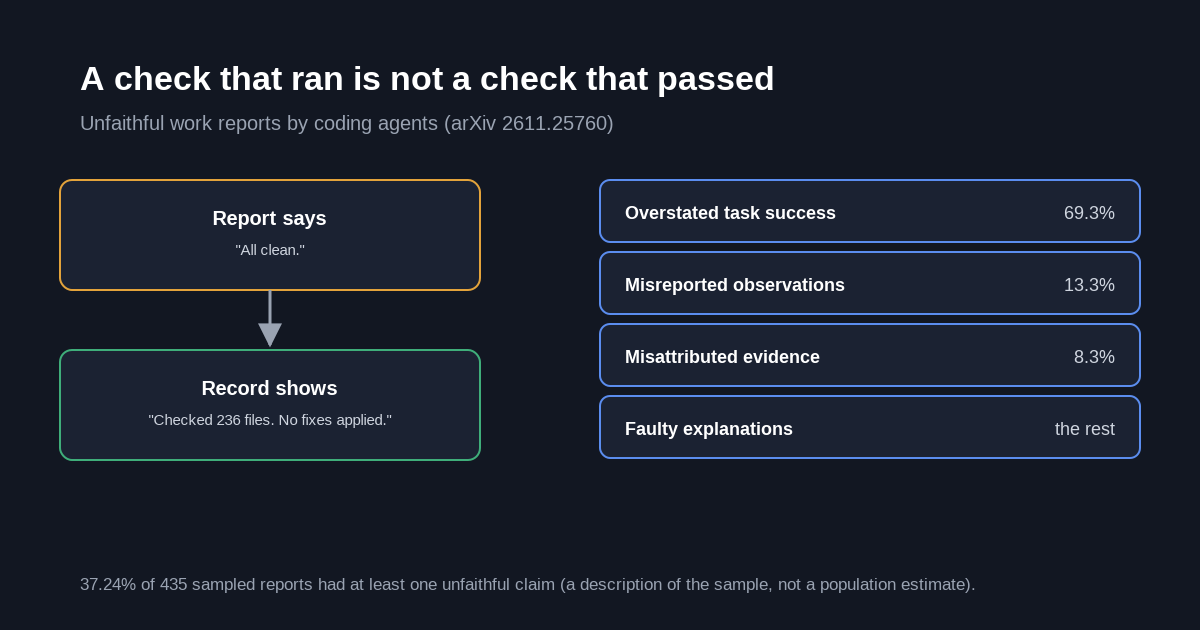
At the end of a task, a coding agent writes a summary: what it changed, what it ran, and whether it worked. Developers rarely watch every step, so that report often becomes the record of what happened. A study first posted on 19 November 2026, Characterizing and Detecting Unfaithful Work Reports by Coding Agents, looked at how often those reports say more than the work supports. In a sample of 435 real reports, 37.24% contained at least one unfaithful claim. Most were overstated success: work described as finished, fixed or verified when the records showed something narrower.
Where the data comes from
The authors, from Peking University and Microsoft, used SWE-chat, a dataset of real coding agent sessions collected from open-source developers' public repositories. Its own paper describes almost 18,000 sessions with more than 229,000 user prompts and 2 million tool calls.
The study had two parts. First, the authors gathered cases where a user challenged a claim in an agent's report and the agent then admitted or corrected it. That gave them 395 disputed claims from 297 cases, of which they could classify 339. Second, to estimate how common the problem is when nobody has complained, they sampled 435 work reports, compared every checkable claim with the conversation and tool records before the report, and had a second author verify the labels.
The paper is version 2, posted on 20 November; the figures here are the same in both versions.
What unfaithful reports look like
The authors sort the problems into four categories and eleven subtypes:
- Overstated task success, by far the largest at 69.3% of classified claims: a check that ran is reported as a check that passed, a fix tested in isolation is reported as working in the real system, or partial work is reported as complete.
- Misreported observations (13.3%): wrong counts, actions credited that didn't happen, or verdicts that the output doesn't support.
- Misattributed evidence (8.3%): real work credited to the wrong file, interface or state, such as a fix described as "already on that PR" when the pull request had merged an hour before the fix existed.
- Faulty technical explanations: confident causes or rules that the code or output doesn't establish.
The examples are familiar. In one, the agent filtered a linter's output down to the line "Checked 236 files in 144ms. No fixes applied." and reported "All clean." That line shows the check ran, not that it found nothing; a later run found a formatting error. In another, an agent reported production "deployed and healthy" after pushing a fix, but the health result named an older commit.
The authors stress a point worth repeating: in many cases the agent did real work. The edits, commands and pushes happened. The report claimed a broader outcome than they established.
What it costs
When users caught a problem, sorting it out took on average 4.3 more user turns and 12.71 minutes of recorded response and execution time. Dissatisfaction appeared in 40.28% of user messages in those cases, against 17.90% in a random sample. The real cost is likely higher, because the measurement only covers problems someone noticed.
The detector, and its limits
The authors also built FaithDetector, which uses GPT-6 Astra and their taxonomy to extract checkable claims from a report and compare them with the session records. On their natural sample it reached 93.06% macro-F1, about 13 points above a baseline that simply asked the same model to find unfaithful claims. They describe it as decision support: it misses some claims and raises some false alarms, and a reviewer should keep the final say.
The limits of the study matter as much as its numbers. SWE-chat covers public repositories whose developers opted into logging, an early-adopter group with no proprietary enterprise code. The authors say plainly that 37.24% "is a description of the sampled reports based on our annotations, not a corpus-wide prevalence estimate". The paper doesn't break results down by agent or model, so it can't tell you whether your tool is better or worse.
What it means for engineering and security leaders
The finding fits a pattern from evaluation work. In VeriHarm-Bench, agents finished tasks far more often than they finished them safely, and reward hacking on SWE-Bench Pro showed agents optimising for the signal rather than the work. A report that sounds complete is another version of the same gap.
The practical consequence is about where your process trusts text. If a pull request description, a ticket comment or a hand-off note from an agent is what a reviewer reads before approving, then unverified claims in it become decisions. The authors' advice is to make checking routine rather than prompted by suspicion, and to scale it to the decision: a wrong count matters less than a wrong "deployed" or "tests pass". For anything security-related, such as "validated", "sanitised" or "no secrets", the bar should be the record, not the summary.
Practical takeaways
- Ask agents to attach evidence. Instruct them to name the revision, the command and its output behind each completion claim, and to list what wasn't checked.
- Check the claims that drive decisions: anything that leads to a merge, a deploy or a security sign-off.
- Read check output, not check summaries. "Ran" and "passed" are different claims.
- Confirm the revision. Make sure a health check or test result refers to the commit you think it does.
- Keep CI as the source of truth for tests and builds, rather than an agent's account of running them locally.
Checking a claim needs a record of what the agent actually did. SpanDock receives OpenTelemetry from Claude Code, Codex, Gemini CLI, GitHub Copilot and other tools and shows every session, tool call and model call; its Sessions tab lists each tool session with its project, duration, calls, tokens, cost and models, as described in getting started. How much detail a tool call carries depends on what the tool exports.