
DBHub database MCP server: a critical zero-day with no fix listed
ZDI published an unpatched authentication bypass in DBHub's MCP server, rated CVSS 9.8, after 16 months. What is known, what isn't, and how to limit exposure.
An open-source MCP server that lets coding agents query Postgres, MySQL and other databases now has a public, unpatched vulnerability rated critical. On 24 November 2026 the Zero Day Initiative (ZDI) published ZDI-26-1067, an authentication bypass in the MCP server of Bytebase's open-source DBHub, scored CVSS 9.8. ZDI says it reported the flaw to the vendor in July 2025 and is publishing it as a zero-day. If anyone in your organisation runs DBHub over HTTP, the time to check is now.
What has been published
The advisory is short. ZDI writes that the flaw "exists within the implementation of the MCP server" and "results from an incorrect authorization decision when parsing untrusted SQL", and that a remote attacker can use it to bypass authentication without any credentials. The CVSS 3.0 vector is network-reachable, low complexity, no privileges and no user interaction, with high impact on confidentiality, integrity and availability. The CVE identifier is CVE-2026-136441, and the weakness is classed as CWE-863, incorrect authorisation.
The disclosure timeline in the advisory:
- 18 July 2025: reported to the vendor.
- 29 October 2025 and 10 December 2025: ZDI asked for updates.
- 9 November 2026: ZDI told the vendor it intended to publish as a zero-day.
- 24 November 2026: published.
ZDI's only mitigation advice is to "restrict interaction with the product". The GitHub Advisory Database entry, published the same day and rated critical, lists no package and gives affected and patched versions as unknown. The CVE record names a single commit in the DBHub repository as affected, rather than a range of versions.
What is not known
Several things that matter for triage are missing, and the article shouldn't fill them in:
- Which versions are affected. DBHub has published many releases since the report. Nothing published says which of them contain the flaw, or whether any contains a fix. As of 26 November, the project's own security advisories page lists no entry for this CVE.
- What "authentication" means here. DBHub's documentation describes an optional bearer token for the HTTP transport, and a read-only mode that classifies SQL before running it. ZDI's wording, an authorisation decision made while parsing SQL, fits a bypass of a check like read-only mode better than a bypass of the token, but that is our reading. ZDI has not published technical details.
Until the vendor responds, the safe assumption is that every DBHub deployment reachable by an untrusted caller is exposed.
Context: the defaults matter more than the bug
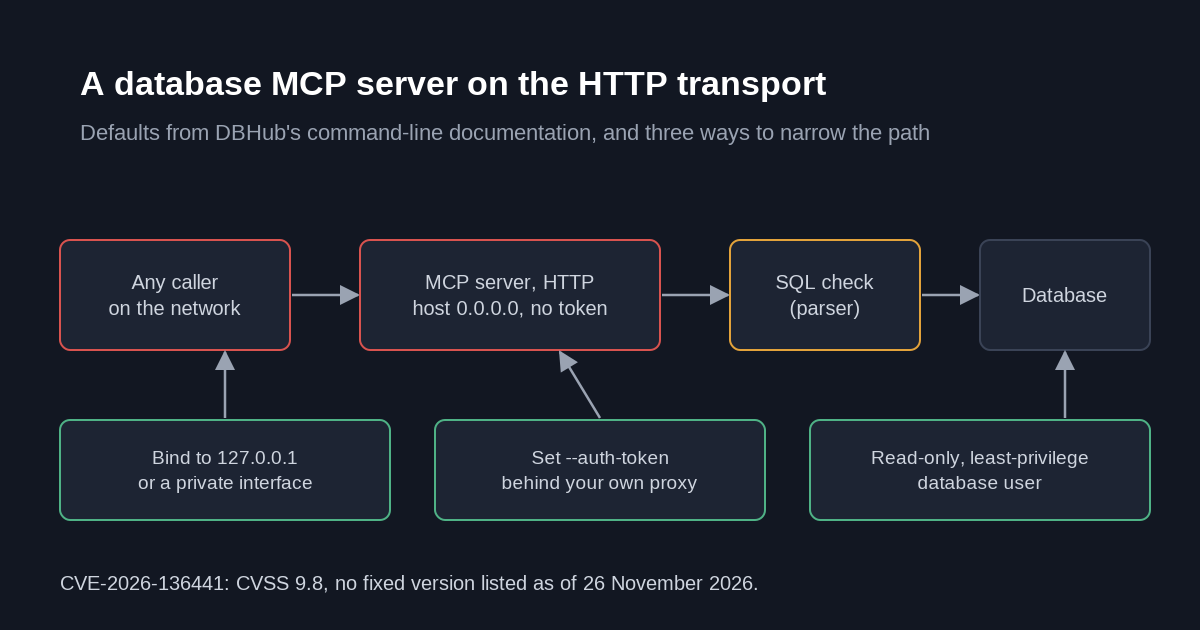
DBHub runs in two ways: over standard input and output, started by the AI tool on the developer's own computer, or as an HTTP server. The command-line documentation says the transport defaults to standard input and output, with no HTTP server, and states two defaults for the HTTP transport. The bind address --host defaults to 0.0.0.0, every network interface, and the documentation recommends 127.0.0.1 for production. The bearer token --auth-token is "unset by default", and "auth is off unless you configure this".
This is not the first time those defaults have been part of a DBHub advisory. In June 2026, GHSA-mwwr-p57h-56pf, rated high and fixed in 0.22.6, found that read-only mode did not make the database connection read-only, because the code that set it never ran, so a first-keyword classifier was the only check. Its reporter noted that "the HTTP transport is unauthenticated and binds to 0.0.0.0 by default".
Put together, the realistic risk is clear even without the details. An HTTP instance on default settings is reachable by anything on the same network, and the only things standing between a caller and the database are a parser and the database user's own rights.
Analysis: why database MCP servers are a special case
Most MCP servers wrap an API that has its own authentication and permissions. A database MCP server often holds a connection string with real credentials and accepts free-form SQL. Classifying SQL as safe or unsafe by parsing it is hard: dialects disagree about comments, multiple statements and functions with side effects, and DBHub's own June advisories were about exactly those differences. A flaw in that step turns an agent's convenience tool into a database client for whoever can reach it.
The 16-month gap between report and publication is also worth noting. A popular open-source MCP server can carry a known critical issue for a long time without its users hearing about it, which is an argument for treating every network-reachable MCP server as untrusted infrastructure rather than a developer tool.
What it means for engineering and security leaders
DBHub is easy to start with one npx command, so it may be running on laptops, shared development servers or in containers without anyone recording it. The first job is to find those instances and the databases they connect to. The second is to make sure none of them is reachable from a network where an attacker, or a compromised machine, could talk to it.
Practical takeaways
- Find DBHub instances. Search MCP configuration files, container definitions and process lists for
@bytebase/dbhub. - Prefer the standard input and output transport for single-user use, so there is no network port at all.
- If you need HTTP, bind to
127.0.0.1or a private interface, set--auth-token, and put it behind your own authentication or proxy. - Use a least-privilege database user that can only read what the agent needs, so a bypass of any check in DBHub doesn't become write access.
- Rotate credentials in connection strings used by any instance that was reachable from a wider network, and watch the DBHub repository and the GitHub advisory for a fixed version.
If you want developers' AI tools to reach internal servers like this through one governed path, SpanDock's MCP gateway lets you add your own MCP servers over HTTPS or as a program run on your SpanDock Server, so AI tools on each computer reach them through the gateway's single MCP server. Each person gets only the tools they're allowed, credentials stay in the server's credential store, and every call is recorded. It does not fix a flaw in the MCP server behind it. The MCP gateway is on the Premium and Enterprise plans, and in the 30-day trial.
Sources
- Zero Day Initiative: ZDI-26-1067, (0Day) Bytebase DBHub MCP Incorrect Authorization Authentication Bypass Vulnerability (24 November 2026)
- GitHub Advisory Database: GHSA-hvw4-mh2q-3vph (CVE-2026-136441)
- CVE record: CVE-2026-136441
- DBHub documentation: command-line options
- DBHub advisory GHSA-mwwr-p57h-56pf: read-only mode does not prevent database writes (June 2026)