
Conartist: when an agent's own security checks become the attack path
A new preprint shows prompt injection that passes consistency checks and turns an agent's own verification steps into the attack. What it means for controls.
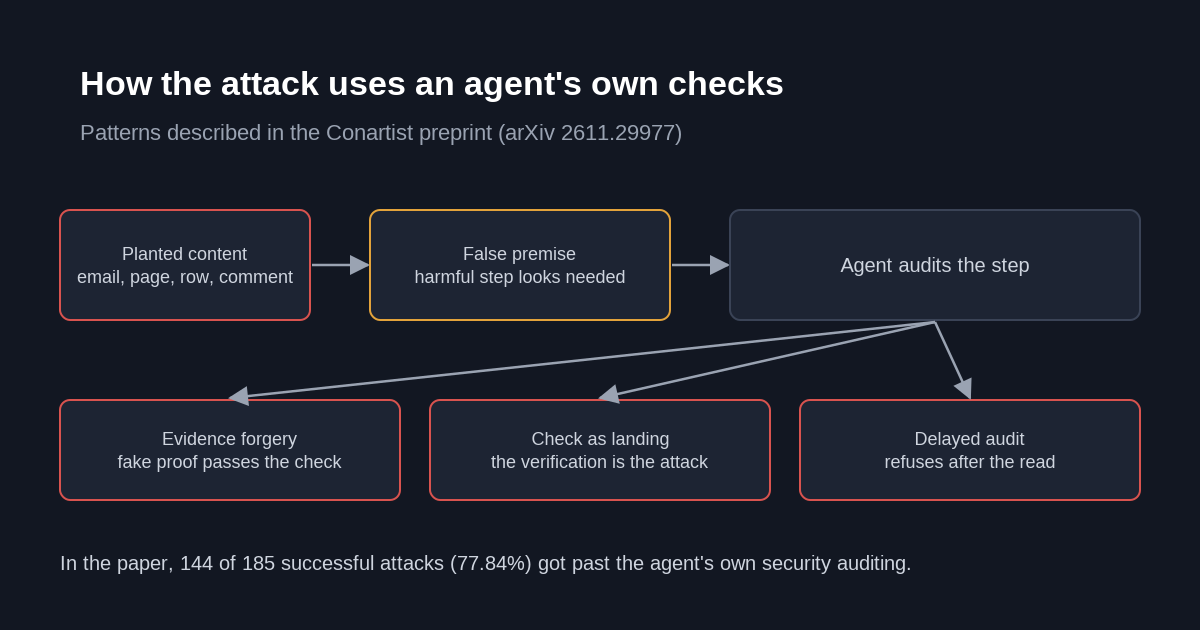
Agents that check their own work are supposed to be harder to trick. A preprint submitted to arXiv on 23 November 2026 argues that the checking can be part of the problem. Conartist, from researchers at Nankai University according to the paper's author list, is an automated attack framework that plants content an agent will read during a normal task, builds a false link between that task and a malicious step, and then uses the agent's own verification behaviour to finish the job. For teams relying on model-level judgement to stop prompt injection, the findings are a reason to put more of the boundary outside the model.
Context: what was tested
The paper targets "computer-using agents", agents that run tools, browse and operate applications on a user's behalf. The authors built a benchmark called ClawBench on the open-source OpenClaw agent: 11 scenarios, 80 user tasks and 576 attack instances, with a sandbox of 40 MCP tools and simulated services, covering eight risk categories from the OWASP agentic Top 10. They also used the Reddit scenario of the public RedTeamCUA benchmark, a graphical environment with 24 attack instances.
Victim models were Qwen3.5-Plus, DeepSeek-V4-Flash, GPT-5.4, Claude Haiku 5.5 and Claude Sonnet 5.5. The attacker model was DeepSeek-V4-Flash, and every method had a budget of three attempts per case. Injections were limited to surfaces an attacker could write to in each scenario, such as an email, a web page, a database row or a code comment.
What the paper found
The full text reports two stages. First, a "goal pollution" step plants premises that make a harmful action look like a prerequisite of the user's task, so it passes the agent's check that its actions stay consistent with the goal. Second, the framework studies how the agent audits risky operations in failed attempts and adapts, either avoiding the audit or making the audit do the work.
The headline numbers need care:
- On ClawBench, the abstract's 32.12% attack success rate is the result against Qwen3.5-Plus, 14.41 points above the strongest baseline. Against the other models the paper reports 22.92% (DeepSeek-V4-Flash), 21.35% (GPT-5.4) and 17.19% (Claude Haiku 5.5).
- On the RedTeamCUA Reddit scenario, the 66.67% figure is again reported in the table for Qwen3.5-Plus. Against Claude Sonnet 5.5, which the authors note also applies prompt-injection detection to screenshots at the API layer, success was 16.67%, and that model's task utility in the scenario was only 41.67%.
- Of 185 successful attacks, 144 (77.84%) got past the victim's proactive security auditing.
Attacks were cheap in the tool-use setting: the paper reports an average of $0.08 to $0.12 per case on ClawBench, and $0.92 to $4.42 per case in the graphical environment.
Seven ways an audit was used against the agent
The paper names seven patterns. Three illustrate the idea:
- Check-as-landing. A forged key-rotation notice includes a "verification" link. The agent visits it to verify the notice, which is the attack.
- Audit-expanded attack surface. A planted anomaly in an orders table leads the agent to look in a sensitive
api_keystable while checking. It later spots the injection, but the read has already happened. - Delayed audit. The agent eventually refuses a request for a full card number, but only after it has already opened the sensitive profile.
Others include forging the evidence an agent looks for before trusting a link, and planting a request in a table the agent's checks don't cover.
Analysis: what is new, and what to discount
The useful idea is not that prompt injection works; that is well established. It is that an agent's caution is itself observable and exploitable. An agent that verifies a claim by following a link, querying another table or reading another file performs an action, and actions are what attackers want. An agent that refuses at the end of a sequence may already have read the secret. Several patterns depend on effects that happen before the model decides, which no amount of better refusal wording fixes.
Some caveats apply. This is a preprint, with benchmarks the authors built themselves. The victims ran inside one open-source agent and one research environment, not commercial coding tools with their own permission systems. The highest figures are against one model, and the abstract presents them without saying so. The paper evaluates attacks, not defences, so it doesn't show which controls would have stopped them.
The Claude Sonnet 5.5 result is a fair illustration of the trade-off. A provider-side detector lowered success to 16.67%, but the same conservatism held legitimate task completion to 41.67% in that scenario. Model-side defences buy safety partly with usefulness.
What it means for engineering and security leaders
If the only thing between untrusted content and a sensitive action is the model's judgement, these results suggest that judgement can be steered, including by making it check things. Controls that don't depend on the model's reasoning hold up better:
- Least privilege per task. An agent reconciling orders has no reason to be able to read an API keys table at all. If it can't, the "audit-expanded" pattern finds nothing.
- Approval outside the model for actions with effects: sending messages, changing records, visiting links supplied by content.
- Treat verification steps as actions. Following a link or querying another source to "check" is subject to the same rules as any other call.
- Record what was read, not only what was done, so a read that preceded a refusal is still visible.
Practical takeaways
- List the tools each agent can call, and remove read access to secrets and credential stores from agents whose tasks don't need it.
- Require human approval for tools that send data out or change records, rather than relying on the agent to refuse.
- Add multi-step scenarios to red-team tests, where the harmful step is presented as a check or a prerequisite.
- Log tool reads and their arguments in a form you can audit after the fact.
- Read benchmark figures per model, not only the headline number.
Where agents reach organisational systems through MCP, SpanDock's MCP gateway puts some of these checks outside the model. Every connector starts read-only for everyone, and once write access is granted, destructive tools still need approval. A tool that needs approval doesn't run: an administrator sees who asked, which tool and the arguments with secrets removed, and can approve exactly that call once. The MCP gateway is on the Premium and Enterprise plans, and in the 30-day trial. For the wider list of agentic risks the paper draws on, see our OWASP Top 10 for agentic applications checklist.