
Claude Enterprise Frontier Safeguards: zero retention, with sealed copies in your bucket
Anthropic's new beta lets eligible organisations use its top models without Anthropic retaining prompts. What it covers, what it excludes, and the trade-offs.
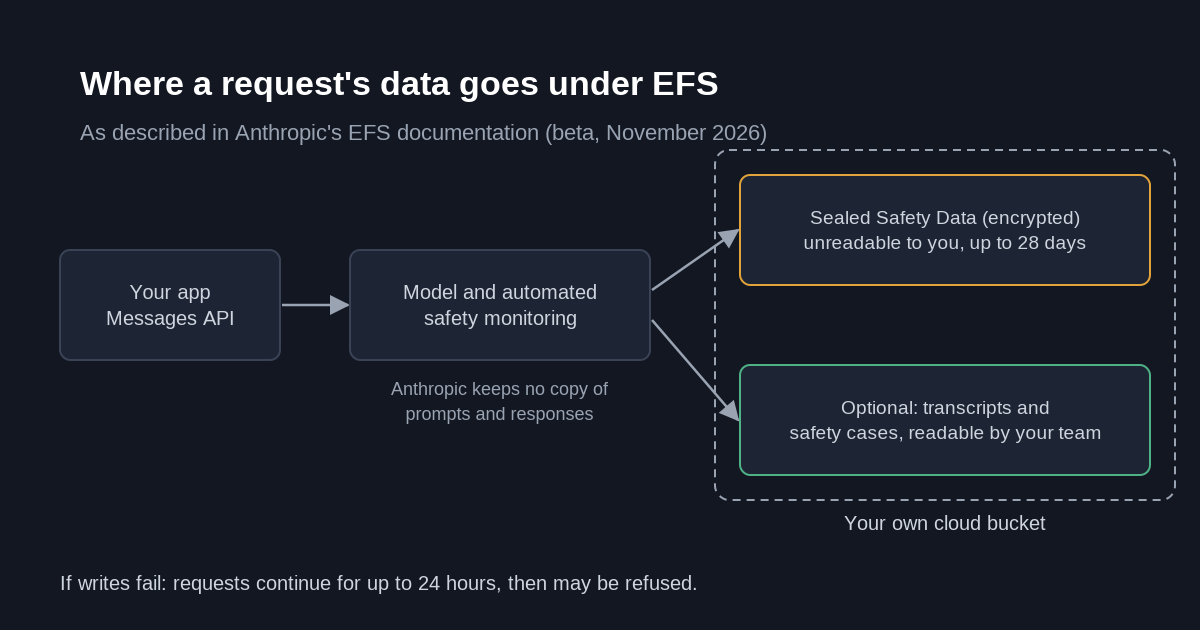
Anthropic has given enterprises a way to use its most capable models without Anthropic keeping their prompts. On 23 November 2026 the Claude Platform release notes announced Enterprise Frontier Safeguards (EFS) in beta: zero data retention for eligible organisations, where encrypted copies of prompts and responses, called Sealed Safety Data, are written to a bucket in the customer's own cloud account instead. For teams that paused on models which require 30-day retention, this changes the conversation, but "zero retention" here has a specific meaning worth reading closely.
Context: why this exists
Some of Anthropic's newest models come with a retention requirement. As we wrote when Claude Fable 5.2 arrived in GitHub Copilot, Anthropic retains prompts and outputs of those models for 30 days to run safety classifiers, and GitHub said eligible enterprises could use them under zero retention only until the end of 2026, while Anthropic rolled out what it called Enterprise Frontier Safeguards. That programme is now documented.
The EFS overview describes it as zero data retention "for eligible organizations that use Claude's most capable models", giving Claude Fable 5.1 as an example. It is available on Claude Platform, Claude Platform on AWS and Claude Models on Google Cloud (Anthropic managed); on Amazon Bedrock, access goes through AWS. Access starts with an Anthropic account team or a request form, and an organisation admin accepts the terms once Anthropic confirms eligibility.
How it works
EFS combines two things, according to the overview:
- Customer-owned storage. A bucket in your cloud account receives the Sealed Safety Data: prompts, responses and model reasoning, encrypted in Anthropic's format. Your team can't read it, even in your own bucket. It exists for Anthropic's automated safety monitoring.
- Your team reviews Safety Cases. Anthropic Human Review is always off. When automated monitoring flags something, people at your organisation review it, not reviewers at Anthropic.
The customer-owned storage page adds the mechanics. You create the bucket, the encryption key and the roles that give Anthropic access, on Amazon S3 or Google Cloud Storage depending on platform. On AWS, your account's logs record each time Anthropic assumes one of your roles, and you can remove that access, though requests may then be refused. Sealed Safety Data stays for a retention period of up to 28 days after the request. Optionally, a readable Transcript of each prompt and response, and the Safety Cases themselves, can go to the same bucket. Safety Cases never contain prompts or responses.
Anthropic doesn't charge for EFS, and the overview says it doesn't change model behaviour, pricing or rate limits. Your cloud provider bills storage, requests, key operations and data transfer as usual.
What it covers, and what it doesn't
The scope rules are where most of the planning will go:
- It applies to a whole workspace. On Claude Platform, once EFS takes effect for a workspace, it covers every request to every model in it, including models that don't require retention. To use it for some traffic only, the docs say to use separate workspaces.
- It covers the Messages API. The FAQ says EFS does not cover data that platform features store for their own use, such as code execution containers, Files API uploads, Batch API results and Claude Managed Agents sessions.
- Some features don't work at all. The Batch API isn't supported, and Claude Managed Agents won't run sessions in a workspace with Anthropic Human Review off, which every EFS workspace has.
- It isn't retroactive. EFS applies once setup takes effect; earlier data stays where it was written until it expires.
- You can't add your own classifiers. Anthropic's automated monitoring checks the traffic.
The overview also compares EFS with "Legacy ZDR", which has no automated safety monitoring but limited model and capability access. The FAQ says a request from a Legacy ZDR workspace to a model that requires 30-day retention fails unless Anthropic has authorised it.
Analysis: what "zero retention" means here
EFS is zero retention by Anthropic. Encrypted copies of every prompt and response still exist for up to 28 days; they sit in your account rather than Anthropic's, and you cannot read them. That is a real improvement for data residency, access logging and contractual control, but it is not the same as no copy existing anywhere. Data classification and customer contracts that say "the provider keeps nothing" need checking against that distinction.
Three trade-offs follow from the design:
- Your bucket becomes part of the request path. If Anthropic can't write Sealed Safety Data to it, requests keep working for a grace period of up to 24 hours, after which Anthropic might refuse them. Data that never reaches your bucket is deleted and can't be recovered. A misconfigured key policy or a deleted role is now an availability risk for your AI features.
- Transcripts create a sensitive dataset you own. If you turn them on, readable copies of prompts and responses, including requests that never lead to a Safety Case, accumulate in your account. The docs tell you to plan who can read the bucket; that plan should be as strict as for any store of source code or personal data.
- Review work moves to you. With Human Review off, someone in your organisation must read and respond to Safety Cases. That needs an owner, a process and a response time.
What it means for engineering and security leaders
For organisations that held back from the newest models because of 30-day retention, EFS offers a path, provided the workspace layout, bucket and review process are set up first. For teams already using those models under a time-limited exemption, such as the Copilot arrangement that ends with 2026, EFS is the documented route after it.
Practical takeaways
- Decide which workloads need the most capable models, and put them in a dedicated workspace, since EFS applies to everything in a workspace.
- Check feature dependencies: Batch API, Files API, code execution and Managed Agents are excluded or unsupported.
- Treat the bucket as production infrastructure: alerts on write failures, change control on its key and roles, and a named owner.
- Decide on Transcripts deliberately, and restrict who can read them.
- Assign Safety Case review to a team with a written process before switching on.
Retention by any provider is easier to accept when less sensitive data reaches it in the first place. SpanDock's guardrails are rules you set once on your SpanDock Server and enforce on each person's computer, matching secrets, personal data or your own patterns in prompts and tool calls before they leave, and blocking, warning, asking for confirmation or redacting. They are enforced in Claude Code, Codex and Gemini CLI through hooks; messages typed into chat apps such as Claude Desktop are not checked. Guardrails on computers are on the Enterprise plan, and in the 30-day trial.