
Claude's text watermark now covers older models: the sampling settings that matter
Since 16 November, text from older Claude models carries Anthropic's watermark too, unless sampling settings break it. What it covers, misses and proves.
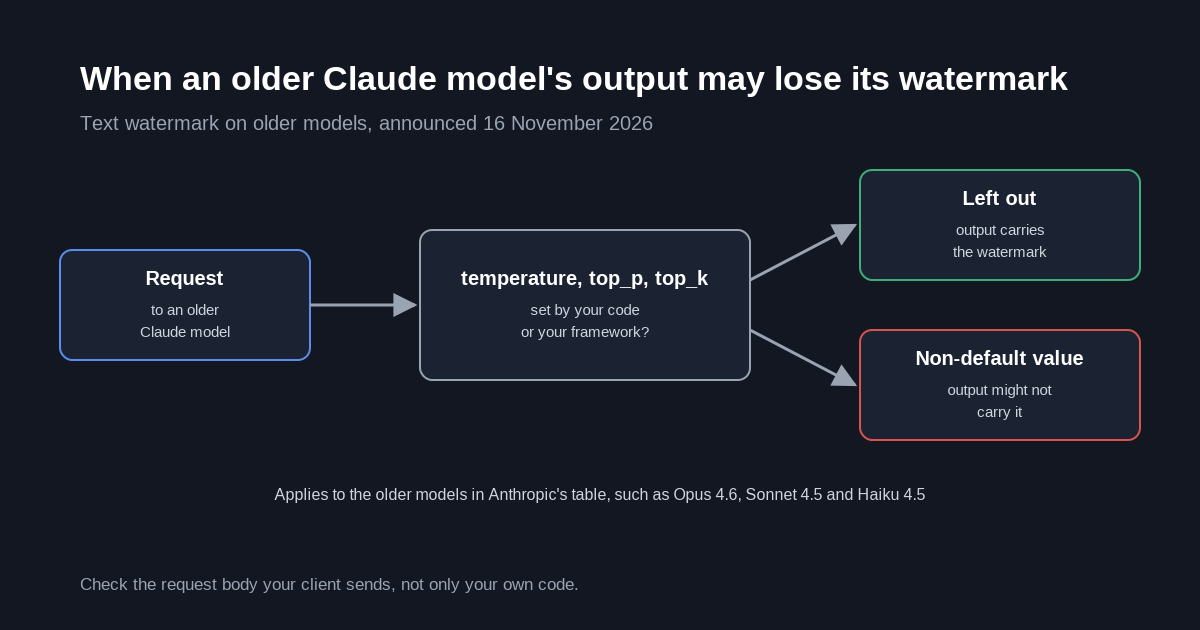
On 16 November 2026 Anthropic's release notes announced that text from several older Claude models now carries its text watermark, as text from models launched since 2 August already did. There is one condition engineers need to know about: on those older models, setting temperature, top_p or top_k to a non-default value can leave the output unmarked. If your product depends on the mark, or your compliance team assumes it is there, check what your client libraries send.
What changed
Anthropic is marking Claude's output to meet the EU AI Act's Article 50(2), which requires providers of generative AI systems to mark synthetic content in a machine-readable, detectable way. Anthropic's help article says it has signed the EU Code of Practice on Transparency of AI-Generated Content, that models launched in the EU on or after 2 August 2026 support marking at launch, and that it is adding marking to earlier models within the law's transition period.
The 16 November entry lists Claude Opus 4.6, Claude Opus 4.5, Claude Sonnet 4.5 and Claude Haiku 4.5 as now carrying the watermark "on supported platforms". The sources don't all give the same list. The help article's table and the text watermark documentation also name Claude Sonnet 4.6 and Claude Opus 3 among the models where the sampling caveat applies. The help article adds that on Amazon Bedrock the rollout for some of these models "may take a few additional days". Use the help article's table as the current list, since Anthropic points to it from both the release notes and the docs.
How the watermark works
Anthropic's explainer, published in August, describes a version of the SynthID-Text method that Google DeepMind published in 2024. When several next words would be equally good, the model normally picks one at random. With watermarking, a secret key and the preceding words decide that choice instead. A reader sees no difference, but someone holding the key can test whether a passage is consistent with Claude's choices.
The documentation is specific about what the watermark doesn't do. It "adds no tokens or hidden characters", doesn't change meaning or quality, and "carries no information about you or your organization". There's nothing to strip with a regular expression, and nothing that identifies a user. Anthropic also says it applies the watermark globally, not only in the EU, because it doesn't yet have a durable way to scope it by region.
The sampling settings
The watermark lives in the randomness of word choice, so it is sensitive to settings that change that randomness. For the older models listed, the documentation's advice is direct: if you need the watermark, omit temperature, top_p and top_k. If a request sets any of them to a non-default value, "the output might not carry the watermark". Newer models, such as Claude Sonnet 5.5 and Claude Opus 5.5, carry no such caveat in the table.
The documentation also warns that your framework or client library might set these parameters for you, and tells you to check both its settings and the request body it sends. Code that never mentions temperature can still send one. On the older models, such a default is enough to put the mark in doubt.
What a mark can and can't tell you
The help article and the explainer are candid about limits:
- A mark means Claude was involved, not that Claude wrote it. Proofreading, translation and summaries can carry a mark even when the ideas came from elsewhere, and light proofreading leaves very little for the mark to attach to.
- No mark doesn't mean no AI. Heavy editing, paraphrasing, very short passages, unsupported platforms or models, and the sampling settings above can all leave Claude's text unmarked. Another vendor's model would use a different key, or a different method.
- Code carries less. Where only one token is correct, the watermark has nothing to act on. Anthropic says code "has generally less watermarking than some other forms of text", although comments can carry it.
- Detection is restricted. The detection API is in private preview for eligible organisations, such as regulators, researchers and media, and for "select enterprises" that must verify marks for their own compliance. Files are different: Claude-generated files carry signed Content Credentials (C2PA), which anyone can check.
What it means for engineering and security leaders
There are two audiences inside most companies for this change.
The first is teams that build products on Claude. The help article tells them to assess Article 50 for their own products independently. If you provide a generative system to people in the EU and are relying on the model's mark for part of your marking duty, the sampling caveat is a configuration risk on older models: a single default in a wrapper can undo it. Moving to a model launched after 2 August, or removing the three parameters, closes the gap.
The second is anyone tempted to use the watermark as a policy tool, for example to check whether code or documents were AI-written. The sources argue against it. Code carries little of the mark, short or edited passages are unreliable, the detector isn't generally available, and a negative result proves nothing. Policies on AI use are better enforced where the tools run, through configuration, logs and review, than inferred afterwards from the text.
For privacy reviews, the documentation's statement that the mark carries no information about the user or organisation is the relevant line. It identifies the model family's involvement, not who used it.
Practical takeaways
- Check which models you call. Compare your traffic with the help article's table; note any of the older models with the sampling caveat.
- Inspect request bodies, not code. Log or capture the JSON your framework actually sends and look for
temperature,top_pandtop_k. - Remove the three parameters where the mark matters, or move that traffic to a newer model, which the table lists without the caveat.
- Don't build enforcement on detection. Treat a detected mark as a signal of Claude's involvement and an absent one as no information.
- Tell your compliance team the limits before they write a policy that assumes every AI-written paragraph is detectable.