
EU Article 50 guidelines: what they ask of coding agents and other AI agents
The Commission's Article 50 guidelines, now in the Official Journal, cover agents that deal with people and leave source code out of marking. What applies when.
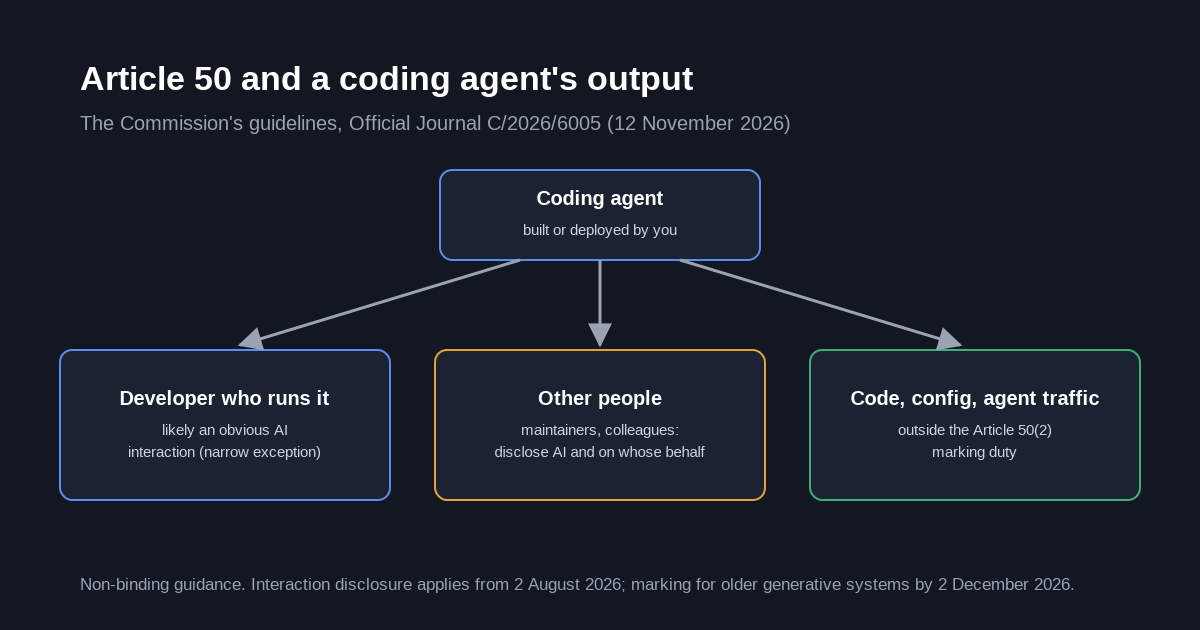
The European Commission's guidelines on Article 50 of the AI Act, the transparency rules, appeared in the Official Journal on 12 November 2026 as C/2026/6005. They are the Commission's reading of two duties that matter to engineering teams: telling people when they are dealing with an AI system, and marking AI-generated content. They name coding agents explicitly, and they leave source code out of the marking duty. For anyone building or running agents that talk to people, they are worth an hour.
What the guidelines are, and when they apply
The Commission first published the guidelines on 20 July 2026, ahead of Article 50 applying on 2 August 2026. The Official Journal version is the formal publication. The text states that the guidelines are non-binding and that only the Court of Justice of the EU can give an authoritative interpretation of the Act.
Article 50 holds four duties. Two fall on providers: design systems that interact directly with people so that those people are told they are dealing with AI (Article 50(1)), and mark synthetic image, video, audio and text output in a machine-readable, detectable way (Article 50(2)). Two fall on deployers: inform people exposed to emotion recognition or biometric categorisation, and disclose deep fakes and AI-generated text published on matters of public interest.
Being a provider isn't only for model vendors. The guidelines' examples include a company that develops an interactive AI system in-house and puts it into service for its own use under its own name. A platform team that builds an internal agent on top of a vendor's model could fit that description.
On timing, the guidelines say the AI Omnibus, the recent amendment to the Act, gives generative systems placed on the market before 2 August 2026 a transitional period for the marking duty only, until 2 December 2026. The duty to disclose AI interaction has applied since 2 August 2026, including for systems that are partly interactive and partly generative.
What they say about agents
The guidelines set four conditions for Article 50(1): an AI system, intended to interact, directly, with natural persons. Agents are covered "if they are capable of interacting with the persons instructing them or with other natural persons in the execution of the tasks", such as managing correspondence or concluding contracts. The list of in-scope examples includes "coding agents and other AI agents capable of directly interacting with natural persons".
Two requirements stand out for agent builders:
- Disclose the agent and its principal. Agents must be designed to disclose "both their artificial nature and the person on whose behalf they are acting". This applies in multi-agent setups too, where one agent works through others that reach people.
- Disclose by design when you can't predict contact. If a provider can't tell in advance whether an agent will meet a person, the agent should be designed "at the architecture level, and instructed" to disclose itself wherever contact is reasonably likely. Agents should also disclose themselves to the people instructing them at key steps, such as authorisation, reporting and validation.
The guidelines also mark out what isn't covered. Backend calls between AI systems, agents included, whose output isn't meant to reach a person are out of scope. So are "text and code auto-completion techniques", where the user only sees output and doesn't interact with the system.
The professional developer exception
Article 50(1) doesn't apply where it is obvious to a reasonably well-informed person that they are dealing with AI. The guidelines say this exception should be read restrictively, and limited to cases with "almost no doubt left". Their examples of obvious cases include code assistance and code review chatbots "available only to professional developers", and internal assistants for trained staff who know they are using AI.
So a developer running a coding agent in their own terminal is likely the obvious case. The harder cases are the people on the other end of the agent's work.
Source code is out of the marking duty
The marking duty in Article 50(2) targets content people perceive and might be deceived by. The guidelines list content outside its scope, and source code is on the list, defined broadly: programming, scripting, markup, query and configuration languages, including comments that form an integral part of the code. SDKs, SQL, infrastructure as code, YAML, JSON, configuration schemas, scripts, machine-readable specifications and APIs are excluded too, as are outputs exchanged only between machines, such as agent-to-agent communication.
That doesn't mean the code an agent writes never carries a mark. Some model providers apply text watermarks at the model level, so code can carry one too, although Anthropic, for one, says code generally carries less of its watermark than prose. It means the Act, as the Commission reads it, doesn't require marking for code. The prose an agent writes around that code, such as a pull request description or a reply in an issue, is ordinary text.
What it means for engineering and security leaders
Our reading, not legal advice: the practical exposure for most engineering organisations is less about the code and more about the conversations.
A coding agent that opens pull requests in other organisations' repositories, answers issues, comments on reviews or messages colleagues in chat is interacting with people who didn't start it. The guidelines' wording on agents and "other natural persons" fits that situation, and an open-source maintainer reading a pull request has no reason to assume an agent wrote it. Labelling such contributions, and saying whose agent it is, is a small change that matches the text.
The guidelines also align with good security practice. An agent that states whose authority it acts on, and announces itself at authorisation and validation steps, is easier to audit. The same record that answers "was this an AI?" answers "who was responsible?".
For teams that build agents for customers, the provider duties apply to their system as placed on the market, regardless of which model sits underneath. The Code of Practice on Transparency of AI-generated Content is the Commission's recognised route for the marking and labelling duties; it doesn't cover interaction disclosure under Article 50(1).
Practical takeaways
- List where your agents reach people. Pull requests, issue comments, review replies, chat messages, emails and tickets, inside and outside the company.
- Label outbound agent contributions. State that an AI agent produced them and on whose behalf, in a consistent form: a pull request template line, a bot account name, a footer.
- Decide who the provider is. For agents you build in-house and put into service under your name, the guidelines' example suggests you are.
- Mark the 2 December date if you provide a generative system placed on the market before 2 August 2026: that is when its transitional period for marking ends.
- Don't spend effort marking code. The guidelines exclude it; spend the effort on the human-facing text instead.
- Ask counsel about edge cases. The guidelines are non-binding, and the obviousness exception is narrow by design.
Sources
- Commission Guidelines on the transparency obligations under Article 50 of the AI Act (C/2026/6005), Official Journal, 12 November 2026
- European Commission: Commission publishes guidelines on transparency obligations for providers and deployers of certain AI systems (20 July 2026)
- European Commission: Code of Practice on Transparency of AI-generated Content
- Anthropic: How Claude's text watermark works