
Privacy regulators' agentic AI resolution: what it asks of engineering teams
Data protection authorities adopted a resolution on agentic AI in November. It isn't law, but its list of measures reads like an engineering checklist.
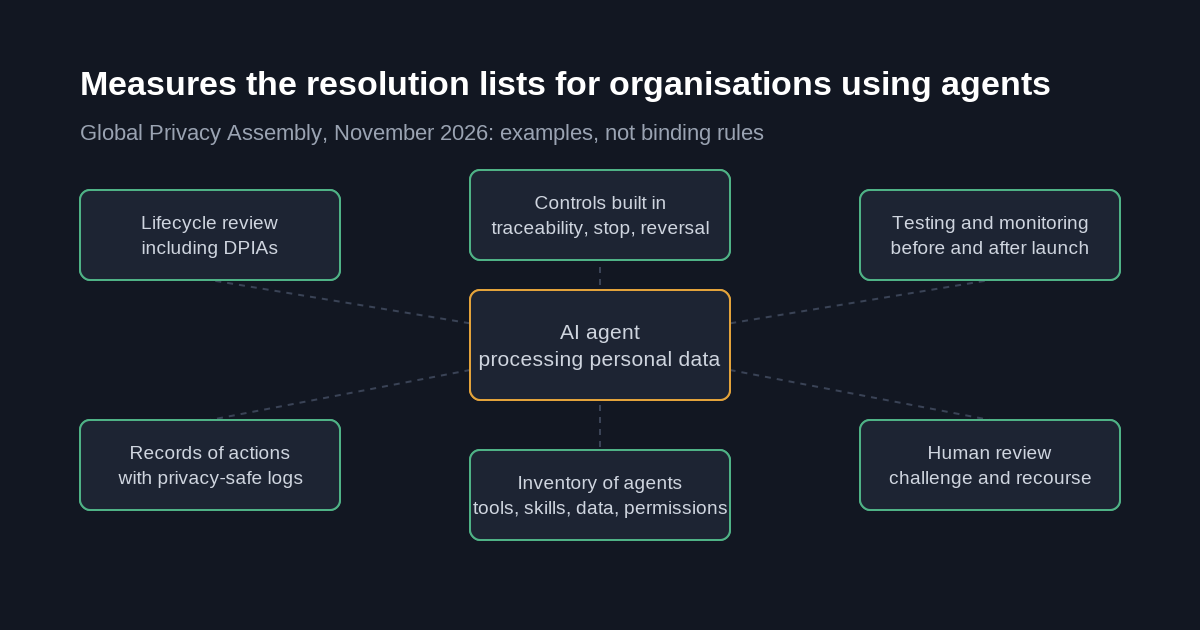
The Global Privacy Assembly, the international body of data protection authorities, adopted a Resolution on Privacy-protective Agentic AI at its annual meeting in Brussels this month. A resolution is not a law, and it binds nobody. It does show what a large group of regulators will ask when they look at an organisation that lets AI agents touch personal data, and several of its measures are things engineering teams build. The UK regulator's post of 24 November gives it a UK context.
What it is, and when it was adopted
The Assembly's press release of 18 November says the closed session took place on 16 and 17 November and adopted the resolution. The sponsors include the Canadian federal privacy commissioner, the Hong Kong, Korean, Spanish, Swiss and UK authorities and the Catalan authority. The text records that the US Federal Trade Commission abstained. The resolution's own text is dated only "November 2026". The ICO's post says the resolution was adopted "this week", which, on a 24 November post, doesn't match the closed-session dates above. Treat the Assembly's own dates as the authority.
The scope is narrower than the headline. It covers systems that process personal data, including when they make or support decisions about people. It covers use, deployment and distribution of agents by public and private organisations, and leaves out individuals using agents in a personal capacity.
What it says about the risks
The resolution names six areas where agents create or sharpen privacy problems. They are the ones engineers will recognise:
- Dynamic tool use. The tools, skills, plugins and other components an agent calls may come from different organisations with different practices, so nobody knows in advance how personal data will flow between parties.
- Memory. An agent's working memory can hold personal data longer than needed, and an agent shared across users raises the risk of one person's data surfacing for another.
- Data access and delegated authority. Agents may reach more data than a task needs, and it can be hard to tell an action a user took from one the agent took on its own.
- Security. Content or tool output that enters the context creates room for poisoning and prompt injection, and a compromised agent with privileges can widen a breach quickly.
- Human oversight. Cutting the number of approvals to gain efficiency can weaken meaningful oversight and people's ability to ask for review.
- Unauthorised or ungoverned deployment. Because agents can be configured to connect to organisational data, people may adopt them without approval, bypassing policies, data inventories, access controls and incident response.
It adds a line that is easy to skim past: organisations "should not assume" that agent systems will recognise or comply with organisational rules.
The measures it lists
The resolution gives examples of risk-based measures. As examples, they are optional in form. They are also the clearest statement yet of what a supervisor might look for:
- Lifecycle review, from preparation to decommissioning, which could include data protection impact assessments.
- Controls built in: end-to-end traceability of tool calls, inputs and outputs, memory separated across users or switched off where appropriate, defined points where an agent must ask a human, ways for operators to pause or stop it and, where feasible, to reverse actions.
- Testing and monitoring: functional and adversarial testing before deployment, and monitoring for unexpected behaviour after.
- Records of decisions, actions, tool calls, inputs, outputs and human interventions. The text adds that the logs must themselves follow data protection principles such as data minimisation, access control and retention limits, because logs may hold prompts and personal data.
- Governance: named accountable parties, and an up-to-date inventory of approved systems with their purposes, models, tools, skills, data sources, connections and permissions, plus a way to identify unauthorised or materially changed deployments.
- Challenge and review for decisions with a significant effect on a person, role-based AI training, and clear notice to affected people.
What the UK regulator adds
The ICO says it co-sponsored the resolution, that its call for evidence on agentic AI closed the week before its post, and that guidance is due in spring 2027. It says the Digital Regulation Cooperation Forum has written to ministers urging organisations to engage regulators early, before launch. Its own post is aimed at consumer-facing agents, and it warns that where it sees organisations rush to market without user controls, it will act. The earlier article on the ICO's call for evidence covers the questions it asked.
What it means for engineering and security leaders
Two things make the resolution useful even though it isn't binding. It turns a vague worry, "AI agents and personal data", into a list a regulator can ask you to show. And it puts the inventory, the audit trail and the stop button on the same list, which are the controls teams tend to postpone because they feel like overhead.
The tension to plan for is in the records measure. An agent audit trail is valuable, and it is also a new store of prompts and personal data. Decide what each log keeps, who can read it and how long it lives before you turn it on.
Practical takeaways
- Build an inventory of the agents, tools, skills, models and data connections in use, including the ones nobody approved. Compare it with what is actually running.
- Decide what a record of an agent action must contain, and keep the personal data in it to a minimum.
- Write down, per agent, the points where it must stop and ask a person, and test that the stop works.
- Check whether any agent keeps memory across users or tasks, and what it keeps.
- Include prompt injection and tool output in your threat model for any agent that can read personal data.
- If you serve UK users with agent features, watch for the ICO's guidance in spring 2027, and talk to the regulator before launch, as the DRCF letter urges.
How SpanDock fits
One of those measures, the inventory, is something SpanDock documents. Its process inventory shows which AI tools run on your team's computers, including ones that send no telemetry. While it is on, each computer reports a list of its running processes every few minutes. A snapshot holds the program's name and path, process IDs, the operating system account, start time, CPU and memory use and the AI tool it belongs to, and never command-line arguments, environment variables, window titles or open files. Snapshots stay on your server for as long as you set. The feature is off by default, and it is on the Enterprise plan and in the 30-day trial.
Sources
- Global Privacy Assembly: Resolution on Privacy-protective Agentic AI (48th Closed Session, November 2026)
- Global Privacy Assembly: International authorities gather at the 48th Global Privacy Assembly annual conference (18 November 2026)
- ICO: Developers creating agentic AI services for consumers reminded to meet their data protection responsibilities (24 November 2026)