
Copilot CLI 1.0.115: assisted permissions now switch off only by managed policy
Copilot CLI 1.0.115 removes the AUTO_APPROVAL flag and adds confirmation for SSH key and sudoers changes. What platform teams should check this week.
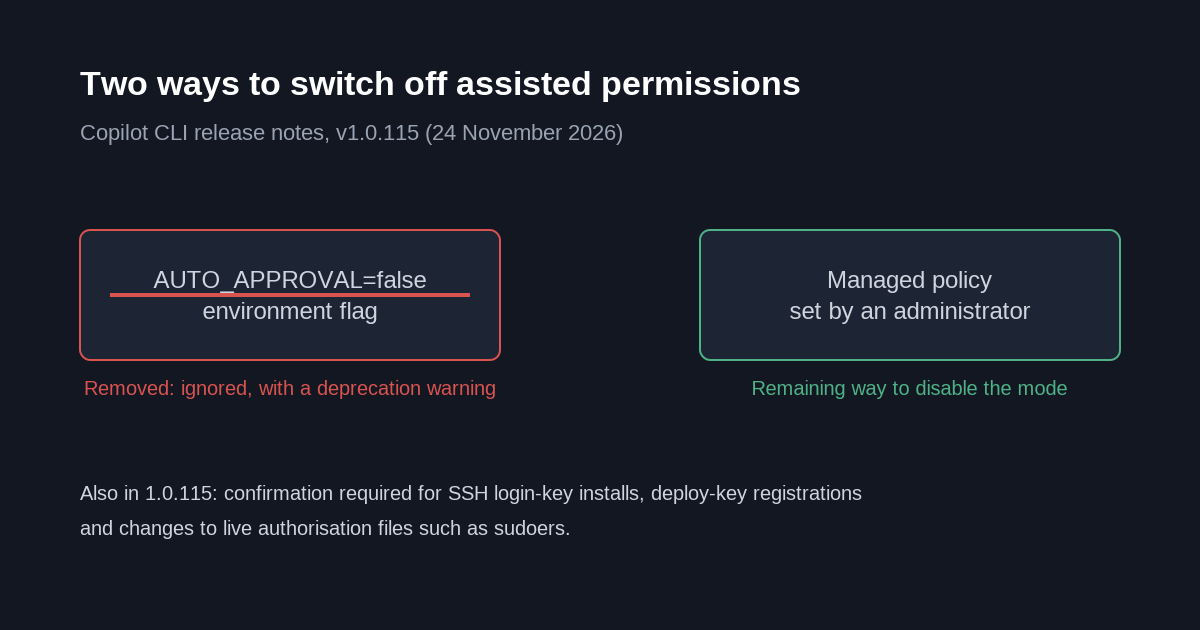
GitHub shipped Copilot CLI 1.0.115 on 24 November. Most of its release notes are the usual run of fixes. One line changes who controls a security setting. It says the AUTO_APPROVAL feature flag is removed, and that "only managed policy can disable Assisted Permissions". If your developers or your own scripts relied on that flag, it no longer does anything. Several other changes in the same release touch what the CLI asks before it acts.
Background: what assisted permissions do
Assisted permissions went generally available on 26 October, as the GitHub changelog records. When Copilot asks to run a command, reach a path or open a URL, a large language model evaluates the request. Requests it classifies as clearly safe go ahead, and the rest come to the user. The rollout questions at launch are covered in what a model-judged approval does and doesn't do.
The GitHub docs add that existing permissions and enterprise rules still apply. A user enters /permissions assisted to turn the mode on, and /permissions manual to go back. In a non-interactive run, such as a pipeline, the option is --assisted-approval. The October changelog also says enterprise administrators can block Allow All while keeping Assisted available, disable Assisted separately, and choose the default mode for new sessions.
What changed in 1.0.115
The flag is gone. The release notes say a leftover AUTO_APPROVAL=false is "ignored with a deprecation warning". The same line first appears in the pre-release 1.0.115-2 on 20 November. The notes don't explain why. A reasonable reading is that a personal environment variable was an unmanaged route around an organisation's approach, and removing it leaves one managed route. That is an interpretation, not a GitHub statement. People can still pick a mode in a session, as the docs describe; what is removed is the flag.
Some actions always ask. In assisted mode, the CLI now requires confirmation for detected SSH login-key installations, deploy-key registrations, and changes to live authorisation files such as sudoers. The notes list these as a requirement for confirmation, which suggests the model's verdict doesn't decide them alone, but the notes don't say how detection works or how complete it is.
Fewer repeat prompts. The notes describe four changes that reduce re-asking. The reviewer keeps reviewing later requests after a message or an answer of up to 128,000 characters. It can try another review model when the first stalls or fails. It can reuse a one-time approval for an identical request in the same session. And approving a custom tool or memory request for the session clears queued prompts that it covers. Each lowers friction, and each also widens what a single approval covers, which is worth a line in your guidance to developers.
The failure case is visible. Prompts now say why automatic review failed, including model errors and guidance when no review model is available.
Sandbox and policy details. The release also:
- shows the GitHub account that sandboxed
ghcommands use, under/sandbox policy; - allows specific macOS Mach service lookups in sandboxed commands through
sandbox.userPolicy.seatbelt.extraMachLookups, without enabling Keychain access; - turns on Windows sandbox package queries by default, with
sandbox.userPolicy.capabilitiesset to[]to opt out; - refuses to start a sandboxed command when a denied-path glob matches more than 100 paths, and names the glob;
- says in the
disableAllHooksdescription that hooks from managed policy keep running when it is on; - makes tool calls return a policy denial, rather than hang on a named pipe, when organisation content-exclusion rules apply;
- shows Allow All as disabled, with a reason, in the
/permissionspicker when settings or administrator policy prohibit it.
What the notes leave open
The release notes are terse and the docs lag. The GitHub docs page on allowing tools doesn't mention AUTO_APPROVAL, so the removal is documented only in the release notes. The notes also don't say which policy key disables Assisted Permissions or what the CLI does when that policy is set and a user passes --assisted-approval. The earlier 1.0.111 notes say the autopilot confirmation hides Assisted Permissions when administrator policy disables them. Pre-release builds of 1.0.116 already list more assisted-permissions changes, so expect the behaviour to keep moving.
What it means for engineering and security leaders
If you have not set a managed policy for Copilot CLI, the default is now the only route, plus whatever each developer picks in a session. That is a decision to make deliberately: allow assisted mode, make it the default, or disable it. For regulated teams the question is whether a model-judged approval is acceptable for any action class at all, and the answer should be written into the managed settings and not left to habit.
Practical takeaways
- Search shell profiles, dev-container definitions and CI configuration for
AUTO_APPROVAL. Remove it, and don't assume it still switches anything off. - Decide your organisation's position on assisted mode, set it in managed policy, and test with a developer's CLI that the picker shows the state you expect.
- Brief developers that a single approval can now cover repeated and queued requests in a session.
- Treat the SSH key, deploy key and
sudoersconfirmations as a floor, not a guarantee, and keep production credentials out of reach of the CLI in the first place. - If you use the sandbox, review
sandbox.userPolicyentries after upgrading, in particular the Windows default for package queries. - Pin and test CLI versions in managed fleets: this release changed behaviour in a point release.