
NIST's draft attack taxonomy adds agents: what coding teams should read
NIST SP 2400-102e2026, open for comment until 18 December, names seven agent attack classes, from malicious skills to decomposition attacks.
NIST has published a draft 2026 edition of its adversarial machine learning taxonomy, and it now includes a dedicated taxonomy of attacks on AI agents. The initial public draft of SP 2400-102e2026, announced on 9 November 2026, lists seven agent-specific attack classes, including malicious tools, malicious skills and decomposition attacks. It is open for comment until 18 December 2026. For teams running coding agents, it is a shared vocabulary for threats they already face, and a short list of the mitigations NIST considers credible.
What the document is
The 158-page draft is a taxonomy and glossary, not a standard or a set of controls. NIST says it is meant to inform other standards and future practice guides by establishing a common language. It sorts attacks by system type, life cycle stage, attacker goals, capabilities and knowledge, and it describes mitigations together with their limits.
Two scope points matter. The report covers attacks that exploit the statistical, data-driven nature of models; attacks on the platforms they run on are left to traditional cybersecurity taxonomies. And design or implementation flaws that cause failures without an adversary, such as plain inaccuracy, are out of scope. The draft also makes no recommendation on how much risk an organisation should accept.
A note on wording: the draft uses "super intelligence (SI)" throughout, with predictive, generative and agentic SI systems where readers may expect "AI". The terms map one to one, and this article uses "AI" and "agents".
The agent loop as an attack surface
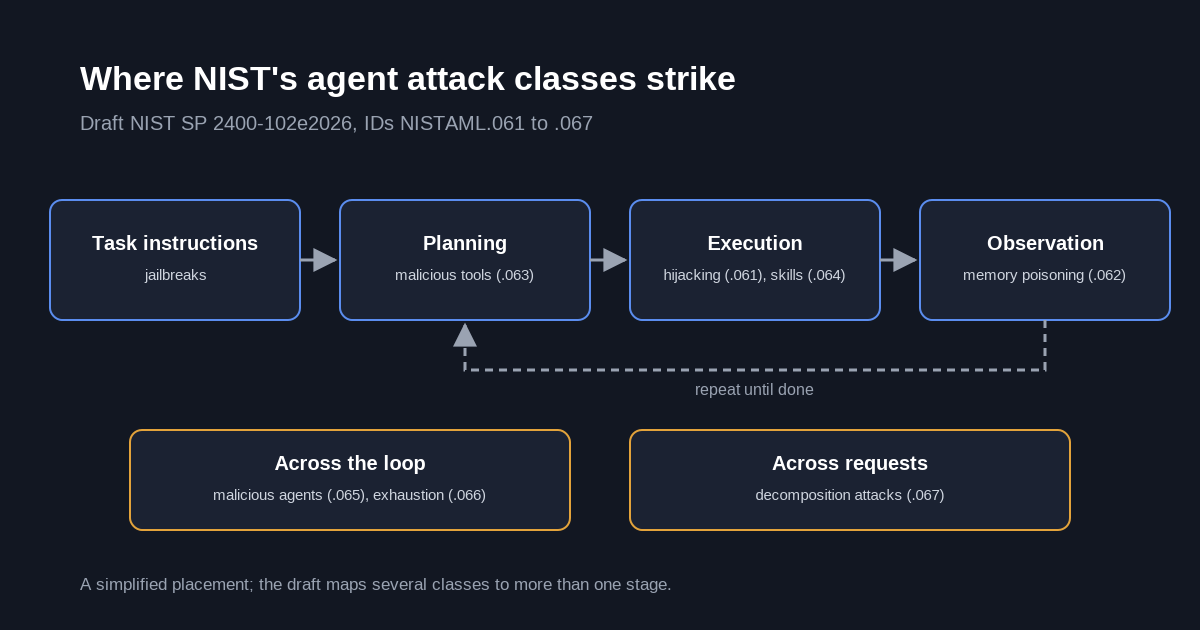
The new section describes an agent as working in four stages: it receives task instructions, plans subgoals and tool calls, executes tools, and observes results before planning again. Each stage is a place to attack. Jailbreaks target instructions; corrupted reasoning and tool selection target planning; injected content in files, web pages or tool results hijacks execution; and poisoned observations steer what comes next.
Seven agent attack classes
The draft gives each class an identifier, which makes it easy to reference in threat models and tickets:
| ID | Class | In short |
|---|---|---|
| NISTAML.061 | Agent hijacking | Injected content redirects the agent to an attacker's task |
| NISTAML.062 | Memory poisoning | Bad data in an agent's memory or retrieved knowledge |
| NISTAML.063 | Malicious tools | Tool descriptions or results that steer, leak or stall the agent |
| NISTAML.064 | Malicious skills | Skill instructions or scripts that carry attacks |
| NISTAML.065 | Malicious agents | A compromised agent in a multi-agent system |
| NISTAML.066 | Resource exhaustion | Loops, unbounded tool calls or long reasoning that deny service |
| NISTAML.067 | Decomposition attacks | A harmful task split into subtasks that each look benign |
Several of these will be familiar to anyone following MCP security. Under malicious tools, the draft describes tool poisoning, where a tool's description is attacker-controlled text placed straight into the agent's context, and notes that the attack works before the tool is ever called. It describes rogue MCP servers in public registries and the rug pull, where a server changes its tool descriptions after installation without asking for new approval.
The skills entry draws a distinction worth repeating. A tool's description and results enter the context as data; a skill is loaded and followed as trusted guidance and may persist across sessions once installed. NIST notes that public skill registries do little review, which makes them a supply chain surface comparable to package ecosystems.
On decomposition, the draft says that because each step can look benign alone, defences may need to reason over sequences of interactions rather than single requests.
What it says about coding agents
Coding agents get a paragraph of their own. They read and write code, run terminal commands and act on development platforms, often with the user's credentials. The draft lists repository content of every kind, including source files, documentation, issues, dependencies and configuration, as possible injection channels. Its examples include shared rule files that tell agents to swap legitimate dependencies for attacker-controlled packages, and a malicious issue in a public repository that led an agent to leak data from its user's private repositories.
Mitigations, and their limits
The draft is candid that defences are immature.
Model-level defences, which train a model to separate instructions from data, help in some cases but don't create a strict boundary. The draft cites work in which adaptive attacks bypassed twelve recent defences, most of which had reported near-zero attack success.
System-level defences constrain the agent's architecture instead, so that untrusted content can't drive actions even when the model is fooled. The draft groups information-flow control approaches, which label and track data through an agent's operations, and design patterns such as plan-then-execute and dual-model setups. It notes that these usually cost some generality and usefulness.
For tools, it lists signing tool definitions with immutable version identifiers, planning without access to tool metadata, and sandboxing tool execution so a malicious tool can't affect the rest of the system.
For long-running agents, it is plain that robust mitigations are still an open research problem: human review is hard to apply at the speed agents work, and state that builds up over weeks may not roll back cleanly.
What it means for engineering and security leaders
This is a draft taxonomy, so it creates no obligation. Its practical value is vocabulary and coverage. If your threat model for coding agents has entries for prompt injection and secret leakage but nothing for rug pulls, persistent skills or decomposed tasks, the table above is a checklist of gaps. The mitigations section is also a fair summary of where the field stands: system-level limits on what an agent can do are more dependable than hoping the model notices an attack.
Practical takeaways
- Map your agent threat model to the seven IDs, and note which ones you have no control for.
- Pin and review tool definitions, and treat a changed tool description as a change that needs approval.
- Treat skills as code: review them before install and know which ones persist.
- Check repository inputs your agents read, including issues and rule files, as untrusted.
- Prefer architectural limits, such as sandboxing and restricted tools, to model-level defences alone.
- Send comments to NIST before 18 December if your experience with coding agents isn't reflected.
SpanDock's MCP gateway gives every computer's AI tools one governed MCP server in front of your organisation's connectors. Set to Enforced, it also reports, or moves aside, the tools' other MCP servers. Connectors start read-only for everyone, and destructive tools need approval even after write access is granted. The MCP gateway is on the Premium and Enterprise plans.
For NIST's earlier work on agent security, see What NIST is saying about AI agent security.