
UK financial regulators on AI and cyber resilience: what engineering should note
The PRA, FCA and Bank of England published AI cyber effective practices on 19 November. What they say about agents, AI-written code, logs and kill switches.
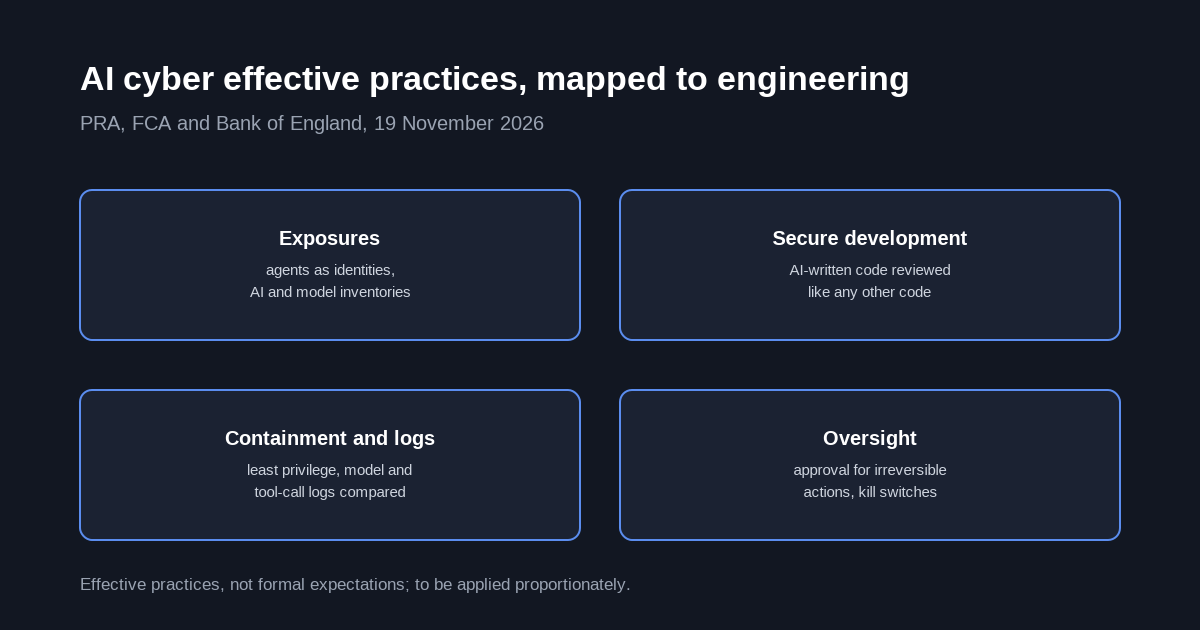
On 19 November 2026 the Prudential Regulation Authority, the Financial Conduct Authority and the Bank of England published a joint set of effective practices for managing cyber risk and resilience relating to AI. Most of it is about vulnerability management at machine speed, but a good part touches engineering teams directly: AI agents as identities, AI-generated code, logs of tool calls, and the ability to stop an autonomous system. If you build or run software for a UK bank, insurer or market infrastructure, it is a useful list of what supervisors now consider good practice.
What the publication is, and what it isn't
The document is issued by the three regulators together and applies to firms in the sense of their supervisory statement and final guidance on cyber risk and resilience management (a footnote says that guidance is itself now subject to consultation). The effective practices complement it but sit apart from it. In the regulators' words: "They are, however, not part of the regulators' formal expectations."
They are also meant to be used proportionately. Firms are invited to weigh how much they rely on AI for important business services, and how autonomous an AI system is, how much access it has to the firm's assets and how far it can act on the outside world. The text uses the OECD definition of an AI system and avoids the term "frontier AI", while noting that the practices matter most for highly autonomous, capable systems.
So this is not a new rule. It is a statement of what the regulators have seen work, which in practice tends to shape supervisory conversations.
The parts that land on engineering teams
Agents are identities, and connectors are exposures
The central idea is a move from periodic vulnerability management to continuous "exposure management". The list of places exposures can arise includes external connectors, meaning the components that link an AI system to outside data, tools or APIs, and identities, both human and non-human, with AI agents given as the example. Firms are encouraged to use AI and model inventories, alongside third-party registers and software bills of materials, to find them, and to treat unauthorised applications, including those built with AI, as a significant source of risk.
Continuous monitoring is meant to include AI-specific attack surfaces, which the text names as embeddings, memory modules and tool chains. For a team running coding agents, that reads naturally as: know which agents run where, which tools and connectors they can reach, and which credentials they hold.
Chained weaknesses count
On prioritisation, the publication asks firms to look beyond single scores and consider attack paths across connected assets and the combined impact of several low-severity vulnerabilities being exploited together, for instance if AI systems chain them. That is a direct challenge to triage that only looks at the highest individual severity.
AI-written code gets the same scrutiny
The secure development section lists practices most teams will recognise, with a few AI-specific additions: threat modelling that includes adversarial prompts and jailbreaking, scrutinising AI-generated code as well as code written by people, using AI code review tools, continuously scanning source code, infrastructure-as-code and pipelines, and protecting the confidentiality of source code. None of these is new on its own. Listed together, they say that AI-assisted development doesn't change the bar; it adds review volume.
Harnesses, not just models
A section on "harness engineering" describes the tools, workflows, controls, data and environments around an AI system used for cyber defence. Its point is that results depend as much on the harness as on the model: controlled access to tools, validation steps, integration with existing platforms and meaningful human review. It also warns against measuring success by the number of vulnerabilities found rather than the number disclosed, mitigated or fixed in ways that reduced risk.
Containment, logs and recovery
For containment, the list includes least privilege, just-in-time privileged access with continuous monitoring of privileged actions, real-time monitoring with centralised logging, and predefined emergency containment pathways. For detection, the regulators suggest that comparing logs from LLM APIs, tool executions and chat sessions can be an effective way to spot AI-specific incidents. Recovery may involve rolling back agent states or redacting unsafe memory or embeddings.
Oversight that can actually stop things
The human oversight section is the most concrete for teams deploying agents. It suggests human-in-the-loop approval where errors could be serious or irreversible, lighter monitoring for lower-risk work, and kill switches that let a system be paused, constrained or shut down safely. It asks firms to keep logs of actions and intermediate decisions, track human overrides and watch for automation bias in reviewers. For highly autonomous systems it names deterministic technical controls: least-privilege access, limits on tools and external connections, staged increases in autonomy, prohibited actions and controls at each step of a task.
How it fits with the NCSC's advice
The publication cites the National Cyber Security Centre's August 2026 blog, Managing the cyber risk of agentic AI, which the NCSC describes as interim advice ahead of formal guidance. The two line up closely: the NCSC's headings include setting the right level of oversight, sandboxing the agent's environment, logging and monitoring agent activity as part of security operations, making AI activity easy to attribute, and keeping the ability to "pull the plug". The financial regulators add the supervisory framing: board reporting, remediation speed treated as an operational risk, and third-party contracts that disclose embedded AI.
What is useful, and what to keep in proportion
The useful part is the specificity. Comparing logs from model APIs, tool executions and chat sessions, or limiting an agent's tools and external connections, are things an engineering team can check this month.
Two cautions. First, these are effective practices, not requirements, and the underlying supervisory statement is still under consultation; avoid presenting them internally as rules with deadlines. Second, many items assume capabilities a firm may not yet have, such as an inventory of agents or per-call logs. Proportionality cuts both ways: a firm with a handful of developers using assistants has less to do than one running autonomous agents against production.
What it means for engineering and security leaders
Expect questions in these areas: which AI tools and agents run on which machines, what each can reach, how AI-generated code is reviewed, where tool-call logs live and how long they are kept, and how an agent is stopped. If the honest answer to any of them is "we don't know", that is the gap to close first.
Practical takeaways
- Build an inventory of AI tools and agents per machine, including ones that send no telemetry.
- List connectors and credentials each agent can use, and remove standing access that isn't needed.
- Keep per-call logs of model calls and tool executions in one place, so they can be compared during an incident.
- Write the stop procedure down: who can pause or disable an agent, and how quickly.
- Review AI-generated code to the same standard as human code, and measure fixes, not findings.
- Check third-party contracts for disclosure of embedded AI and notification of changes to it.
If you need the inventory, SpanDock's process inventory shows which AI tools run on your team's computers, including the ones that send no telemetry. It records program names and paths but never command-line arguments, environment variables, window titles or open files. It is on the Enterprise plan and off by default.
For background on the earlier Financial Policy Committee record, see What the Bank of England told firms about autonomous AI risk.