
ENISA's frontier AI code review experiment: 220 findings and a triage queue
ENISA and CERT-EU ran frontier models over 27 EU codebases. What they found, what review confirmed, what it cost, and lessons for AI code review.
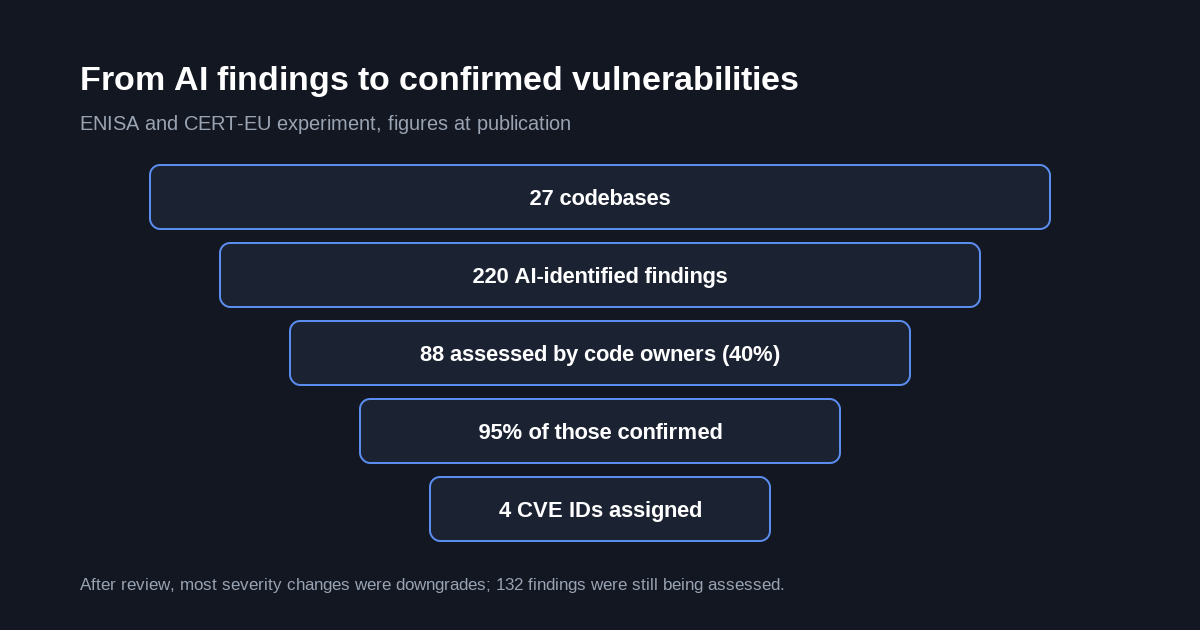
The EU's cybersecurity agency has published one of the clearer public accounts of what happens when frontier AI models are pointed at real code. In a joint advisory dated 12 November 2026, ENISA and CERT-EU describe running several models and harnesses over 27 codebases maintained by EU institutions. The models raised 220 potential issues. The headline accuracy is high, but the more useful lesson is about the queue those findings created for the people who had to check them.
What ENISA and CERT-EU did
The experiment was part of the EU action plan on cybersecurity and AI. ENISA selected open-source software that EU institutions, bodies and agencies maintain and rely on, agreed the selection with the code owners, and added critical internet-facing projects that some of those bodies submitted. According to the full report, 27 codebases were analysed: 25 already open source and 2 about to be.
The reviews used source code only. The models were given no information about production deployments, such as configuration or infrastructure, and no live application was tested.
ENISA had access to several models with advanced cybersecurity capabilities through the providers' structured access programmes. The report names OpenAI's GPT-5.5 Cyber, GPT-5.6 Cyber and GPT-6 Astra, and Anthropic's Mythos 5. They ran in various combinations of tools:
- general-purpose coding agents (OpenAI's Codex client, with its Codex Security plug-in, and the OpenCode client) with security skills;
- two skills ENISA wrote, Code Auditor, which walks an agent through a structured audit and records evidence for each finding, and Findings Browser Report, which turns results into a static HTML report;
- Vigilo, a specialised harness built by CERT-EU.
Vigilo is open source. Its repository describes specialised agents that reconnoitre, exploit and adversarially verify web application vulnerabilities, then produce evidence-backed reports and a fix branch per finding. The report adds that each agent focuses on one class of vulnerability, and that a critique step challenges each finding's severity and merges duplicates before the final report.
Everything ran in an isolated container, separated from the host, so the agents couldn't reach systems or data outside the experiment.
What the numbers say
| Measure | Figure in the report |
|---|---|
| Codebases | 27 |
| AI-identified findings | 220 |
| Assessed by code owners at publication | 88 (40%) |
| Confirmed as true positives, of those assessed | 95% |
| New CVE IDs assigned | 4 |
| Estimated total cost | about EUR 6,648.90 |
| Average cost per 10,000 lines of code | about EUR 132.27 |
Three details matter for reading this table.
The 95% applies to the 88 assessed findings, not to all 220. The other 132 were still being assessed when the report was published, three months after they were shared in August. The report itself frames the result carefully: a high true-positive rate "for the limited subset of AI-identified issues on which code owners gave feedback".
Severity was usually overstated. After review, the acknowledged findings were rated 26% high, 34% medium, 29% low and 11% informational, with none left as critical. Most changes were downgrades. The report puts this down to missing context: without knowing what is reachable, with which privileges and behind which controls, a model can't judge how serious a flaw is in practice.
The costs are indicative. ENISA had free access to the models under the access programmes, so the euro figures are estimates of what the scans would have cost. The aggregate table gives the token total as 611,486,042, about 611 million; the column header says "(M)", which doesn't match a number written out in full, so we read it as a plain count.
Specialised harness or general agent
The comparison between tool types is the most practical part of the report. General-purpose coding agents with a security skill or plug-in were usually faster and cheaper. Vigilo took longer and cost more, as expected, because it runs extra steps such as adversarial validation and patch generation. In return, code owners kept Vigilo's severity rating in 74% of confirmed findings, against 60% for the general-purpose agents.
ENISA's conclusion is that the two complement each other: a specialised harness for an in-depth audit of a repository, and a general-purpose agent with a security skill as a baseline for routine changes, such as when a pull request is opened.
The bottleneck moved to people
The report is direct about the limit. AI found weaknesses quickly; validating, prioritising and fixing them "still requires time and expert effort and cannot currently be accelerated to the same extent". It asks researchers to deduplicate and, as far as they can, verify AI output before reporting it, to say clearly when full verification needs deployment context only the owner has, and to report through the proper coordinated vulnerability disclosure channel. Code owners, in turn, need time and resources to assess what arrives.
That matches what CERT-EU wrote in April: AI is changing the economics of vulnerability discovery, and triage capacity is under strain. CERT-EU cited bug bounty programmes that paused or closed after floods of AI-generated reports, both genuine and low quality.
ENISA also warns that the environment matters. Modern AI security tools can read repositories, create files, run commands, install dependencies and call remote services, so the report calls for network segmentation, clear trust boundaries, access control and monitoring, and notes that setting this up takes considerable time.
What it means for engineering and security leaders
If you plan to run AI-assisted security review over your own code, this report gives you a realistic shape for the project. Expect real findings and inflated severities. Budget reviewer time before model time: a 220-finding backlog with 40% assessed after three months is the likely outcome without it. Give the tools deployment context where it is safe to do so, or accept that a person will have to add it later. And keep the reviews in an isolated environment, because the agents doing the review can run code.
Practical takeaways
- Pilot on one codebase you own, with its maintainers committed to triage, before scaling out.
- Run review agents in an isolated environment with no route to production systems or credentials.
- Treat AI severity ratings as a first guess. Have a person with deployment context confirm each one.
- Deduplicate and verify before filing, and route external findings through the project's disclosure policy.
- Use a light setup for pull requests and a heavier one for audits, as the report suggests.
- Track findings fixed, not findings raised, as the measure of whether the programme reduces risk.
For a related study on how coding agents treat existing flaws, see coding agents copying existing vulnerabilities.
Sources
- Joint Advisory on the Use of Frontier AI Models for Code Review (ENISA and CERT-EU, 12 November 2026)
- Joint Advisory on the Use of Frontier AI Models for Code Review (full report, PDF)
- Vigilo: AI-powered penetration-testing pipeline (CERT-EU, GitHub)
- AI is changing the economics of vulnerability discovery. Defenders should adapt now (CERT-EU, 21 April 2026)