
Claude Fable 5.2 in Copilot: the data retention switch behind the model policy
Claude Fable 5.2 is generally available in GitHub Copilot, but turning it on accepts 30-day retention of prompts and outputs. What admins should decide first.
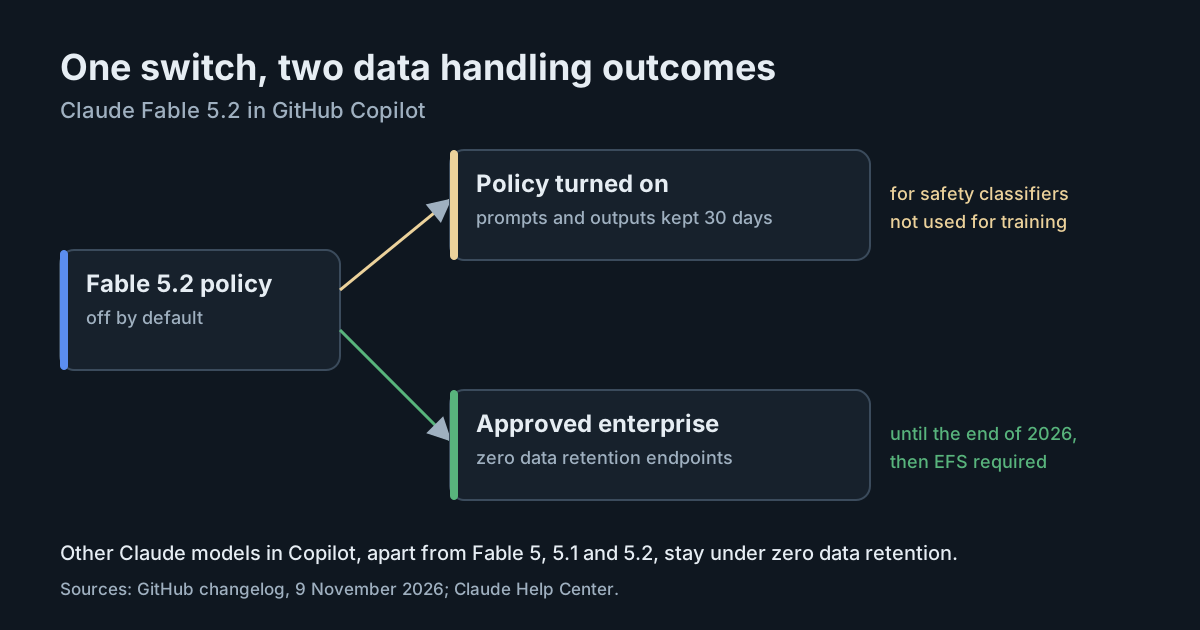
Claude Fable 5.2 became generally available in GitHub Copilot on 9 November 2026, and for Copilot Business and Enterprise it comes with a decision that is easy to make by accident. The model's policy is off by default, and switching it on is not only a model choice: GitHub says that enabling the policy "constitutes acknowledgment" that Anthropic retains prompts and outputs to run its safety classifiers. Other Claude models in Copilot stay under zero data retention. For organisations that chose Copilot partly because of that guarantee, this is a data handling change hidden inside a model picker.
What GitHub announced
The changelog entry describes Fable 5.2 as Anthropic's newest Fable model, for complex, multistep coding tasks across large codebases. It is available to Copilot Pro+, Max, Business and Enterprise users across the usual surfaces, including VS Code, Visual Studio, Copilot CLI, the Copilot coding agent, the Copilot app, github.com, JetBrains IDEs, Xcode and Eclipse. The rollout is gradual.
Three details matter for administrators:
- The policy is off by default for Copilot Business and Enterprise, and an administrator has to enable it in Copilot settings. Leaving it off keeps the model unavailable to the organisation.
- Retention applies when the model is used. GitHub writes that Anthropic retains data, including prompts and outputs, to operate safety classifiers that detect harmful use, and that retained data is not used to train Anthropic's models. Every other Claude model in Copilot, except Fable 5, Fable 5.1 and Fable 5.2, continues to operate under zero data retention.
- A time-bound exemption exists for some enterprises. Eligible customers can use the three Fable models with zero data retention through the end of the calendar year while Anthropic rolls out what it calls Enterprise Frontier Safeguards. After that, continued use requires those safeguards. Eligibility is decided through the GitHub account team, not GitHub Support, and approval does not enable the model by itself: an administrator still has to switch the policy on.
What "retention" means here
The changelog links to Anthropic's help article on covered models, which sets out the terms. Prompts and outputs of covered models are retained for 30 days, on every platform where these models are offered, and the policy has applied since 9 June 2026. Anthropic says Fable 5.2, 5.1 and 5 share the same underlying model as the corresponding Mythos models, with additional safeguards, particularly in the cyber and bio domains.
The stated reason is that some misuse only shows up across many requests, such as repeated jailbreak attempts or larger campaigns, so the classifiers need to look at requests together. Anthropic says that by default no staff can read retained conversations; human review can happen only through a controlled path, for example when content is flagged by automated systems, every access is recorded in a log reviewers cannot change, and data is deleted automatically after 30 days unless flagged or legally required.
These are reasonable controls, but they are still retention. For a coding assistant, prompts routinely contain source code, file paths, error output, and sometimes configuration that should not have been pasted. An organisation whose data classification or customer contracts assume zero retention by the model provider needs to treat the Fable policy as a change to that assumption, not as a routine model addition.
Pricing, for completeness
Fable 5.2 is billed at provider list prices under usage-based billing. The Copilot models and pricing page lists it, per million tokens, at $8.00 input, $0.20 cached input, $10.00 cache write and $40.00 output. That is lower than Fable 5.1 on the same page ($10.00, $0.25, $12.50 and $50.00), but still well above the mid-tier Claude models listed there, such as Sonnet 5.5 at $2.00 input and $10.00 output. Teams that enable it should expect it to be chosen for hard tasks and should watch where it gets used.
What it means for engineering and security leaders
The governance question is not whether Fable 5.2 is a good model. It is who in the organisation is allowed to accept a change in data handling, and whether the Copilot model policy is controlled by that person.
In many companies, the Copilot administrator is a platform or developer experience engineer who enables new models as they arrive because developers ask for them. Before this change, that was mostly a cost and quality decision. With Fable, it is also a privacy and contractual decision, and the acknowledgement is made by flipping the switch. That calls for a short review step: privacy or legal confirms whether 30-day retention is acceptable for the code and data that will flow through Copilot, and the decision is written down.
There is also a consistency point. The same model family is offered through other channels, and Anthropic's article explains that retention settings are configured per workspace, cloud subscription or organisation depending on how Claude is reached. A company that blocks Fable in Copilot but allows it through a direct API workspace with retention enabled has not made one decision; it has made two.
Practical takeaways
- Leave the policy off until someone accountable for data protection signs off. Record who approved it and why.
- Ask the account team about the exemption if zero data retention is a requirement, and plan for what happens after the end of 2026, when the exemption ends.
- Check other channels. List every way your developers can reach Fable models (Copilot, direct API workspaces, cloud platforms) and make the retention decision once for all of them.
- Update internal guidance so developers know which Copilot models are under zero retention and which are not, and what not to paste.
- Watch usage and cost after enabling it, since it is priced well above mid-tier models.
If your developers also reach Claude models through your own API keys, a gateway can keep that path consistent with the Copilot decision. In SpanDock's model proxy, a rule for a plain name such as prod-chat is an alias that sends calls to a real model, and a key can be limited to some models by name, alias or pattern and is refused any other. Routing rules and service keys are on the Premium plan and up. For how retention has come up with other Claude features, see our article on Claude message threads and data handling.