
Copilot code review: from 30 December, unset billing goes to the organisation
GitHub will bill licensed members' Copilot code reviews to the organisation from 30 December 2026 unless an owner picks Member. What changes and what to decide.
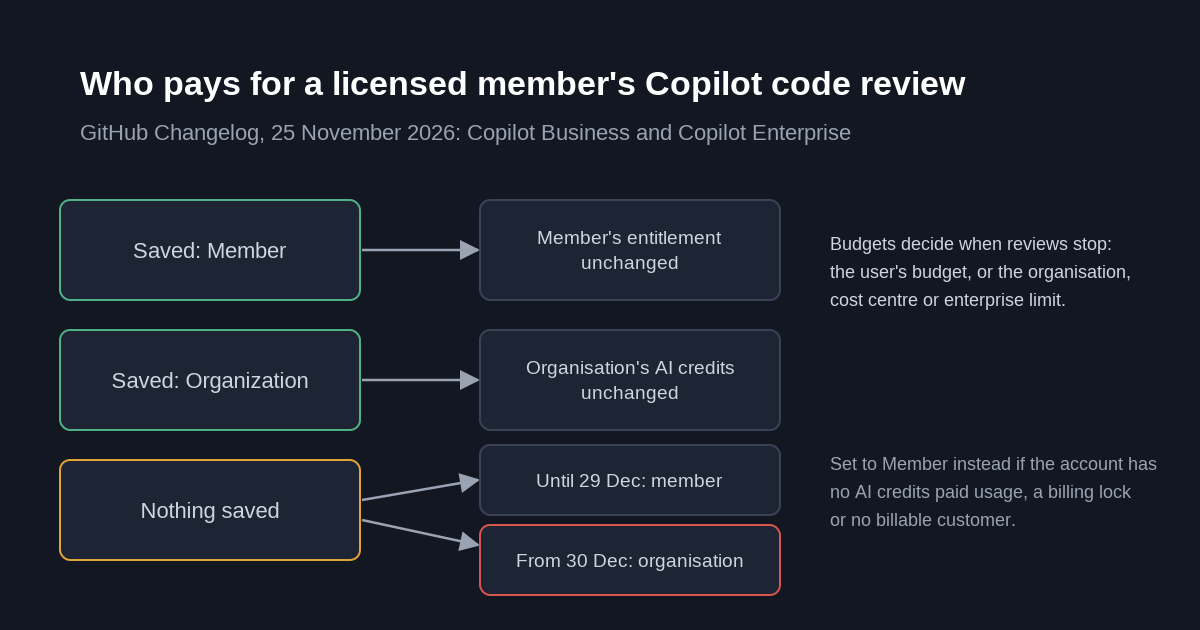
A default is about to move a cost line. On 25 November 2026 GitHub announced that, from 30 December 2026, Copilot code reviews by members who hold a paid Copilot license will be billed to the organisation that owns the repository, whenever nobody has saved a billing choice. Today those reviews draw on the member's own Copilot entitlement. For Copilot Business and Copilot Enterprise customers that haven't touched the setting, this is a decision to make before 30 December, not after the bill arrives.
What changes, and for whom
The change applies to organisations and enterprises on Copilot Business or Copilot Enterprise. According to the changelog:
- Today, when no billing choice is saved, reviews by licensed members use the member's Copilot entitlement. Unset settings show "Default (Member)" with a notice about the change.
- From 30 December 2026, those reviews are billed to the organisation that owns the repository.
- Exceptions: accounts that don't have AI Credits paid usage enabled, have a billing lock, or have no billable customer are set to Member instead.
- Saved choices stay. If an owner already chose Member or Organization, nothing changes.
- Members without a license are covered by a separate setting, which doesn't change.
If an enterprise manages the setting, only an enterprise owner can make the choice. GitHub's own warning is plain: organisation billing "requires AI Credits paid usage and can increase your organization's spending."
Context: what a review costs, and who is charged
GitHub's code review documentation explains that each review has two cost components: AI credits for the model interaction, and GitHub Actions minutes for the agentic part, such as gathering context and using tools. It also publishes estimated AI credits consumption per review, which GitHub calls estimates only:
| Review effort level | Typical range per review | Approximate average |
|---|---|---|
| Lite | $0.05 to $1 | $0.25 |
| Balanced (the default) | $0.25 to $5 | $1.50 |
| Max | $1.50 to $25 | $10 |
Those figures exclude Actions minutes, and GitHub says consumption generally rises with pull request size and repository custom instructions.
Attribution rules decide whose budget a review hits. When a repository automatically requests a review billed to a member, consumption goes to the pull request author; a manual request is charged to the person who asked. Pull requests from Copilot cloud agent are attributed first to the human co-author, then to the organisation if that person can't be billed. Reviews of pull requests from other bots, or requested by bots, are already billed to the organisation.
Budgets then decide what happens at the limit. If usage is billed to a user, reviews are blocked when that user's budget runs out. If billed to the organisation, they are blocked when the organisation budget, cost centre budget or enterprise spending limit is exhausted, together with other features that use AI credits.
Analysis: the documentation already describes the new default
There is a small but useful inconsistency to know about. Both the code review concepts page and the configuration guide, as we read them on 26 November, describe the Default option as billing "the organization that owns the repository". The changelog says that behaviour starts on 30 December, and that until then an unset setting shows "Default (Member)". We follow the changelog for the date and read the documentation as already written for the new default. Either way, a saved choice removes the ambiguity.
The more important point is what each choice optimises for:
- Member billing keeps reviews inside each person's included entitlement. When a member's quota is exhausted, the guide says, the code review fails. That is predictable for finance and unpredictable for developers: reviews stop for heavy users at the busiest times.
- Organisation billing keeps reviews running and moves the variable cost to the organisation's AI credits, with budgets as the control. Setting a budget is optional, which means an organisation can end up with uncapped review spending simply by not acting.
Neither is wrong. What is risky is drifting into one of them without choosing. Automatic reviews on every pull request at the default Balanced level, multiplied across busy repositories, can add up to a material monthly figure, and it lands on a different budget from 30 December.
The configuration guide also notes that billing, maximum review effort and approvals settings are not available through the API. Organisations that manage Copilot settings as code will need to make this choice in the web interface.
What it means for engineering and security leaders
For platform and developer experience teams, this is a policy decision with a deadline. Write down who pays for code review, check that the setting matches, and make sure the budget that will absorb the cost exists before 30 December. For finance partners, the change means review spending may move from members' included entitlements to metered organisation usage from 30 December.
It is also a good moment to look at the effort level. If most of your reviews run at Balanced because it is the default, decide whether Lite is enough for routine changes, and whether the public preview Adaptive mode with a lower maximum fits your repositories.
Practical takeaways
- Check the setting now under your enterprise or organisation Copilot policy: "Choose how members with a Copilot license are billed".
- Save an explicit choice, Member or Organization, so the 30 December default doesn't apply to you.
- If you choose Organization, confirm AI Credits paid usage is on and set an organisation or cost centre budget.
- Review the default effort level and the maximum for automatic reviews, using GitHub's per-review estimates as a starting point.
- Tell developers what happens when a budget or quota runs out, so a failed review isn't mistaken for an outage.
For more on how review effort and approvals settings work, see our earlier article on Copilot code review billing, effort and approvals.