
LLMjacking: what Google found when stolen AI keys met a resale gateway
Google's threat team describes attackers hijacking enterprise LLM access and reselling it: how they got in, how fast bills grew, and the controls it names.
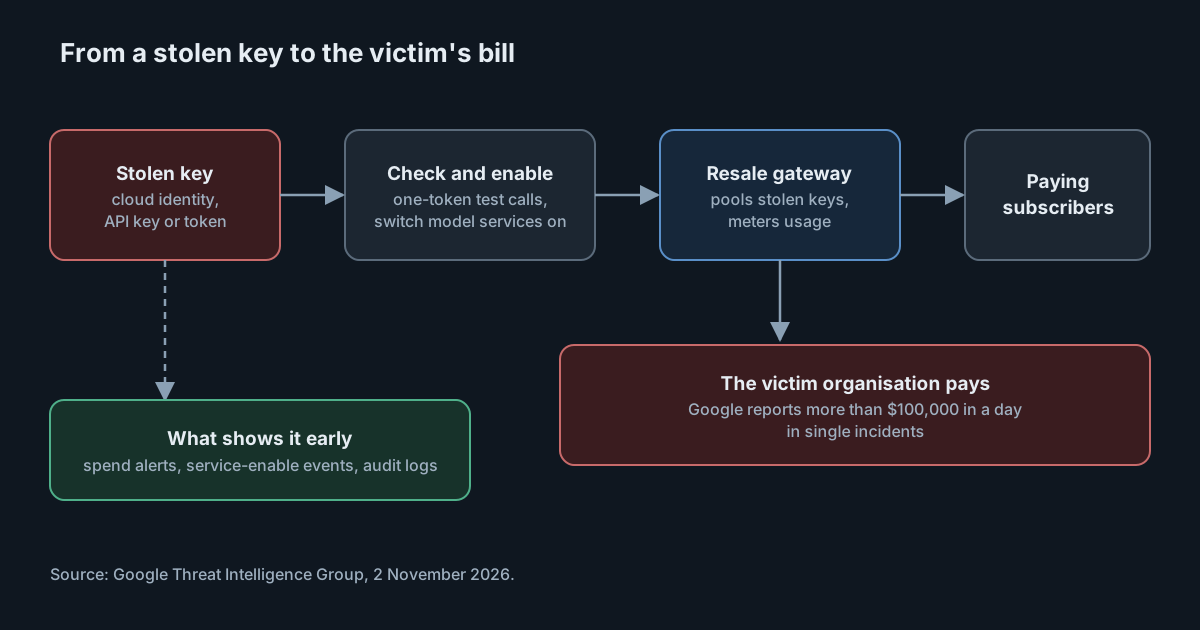
On 2 November 2026 Google's Threat Intelligence Group (GTIG) published a report on what it calls LLMjacking: attackers taking over an organisation's access to hosted language models and using or reselling it. The report draws on Mandiant incident response in 2026 across financial services, retail, technology and transportation. Its central point for anyone paying for AI usage is the speed. GTIG says fraudulent charges exceeded $100,000 in a single day in individual incidents, and reached $1 million cumulatively at some organisations before access was revoked.
What GTIG reports
GTIG contrasts LLMjacking with cryptojacking. Mining coins consumes resources gradually. Model access can be turned into a very large bill within hours, and it can be sold on straight away. GTIG expects attackers to prioritise it over cryptojacking.
The report describes a division of labour. One group gets in. Another runs what GTIG calls "LLM Mixers": gateways that proxy, aggregate and resell unauthorised model access to underground subscribers. In one investigation GTIG saw two clusters cooperating, with the first passing validated keys to the second.
How attackers got in
GTIG says the dominant route was not an exposed model endpoint but exposed or stolen cloud identity credentials: IAM credentials, service account keys, GitHub personal access tokens and active session tokens. Its examples include a misconfigured service account key, a stolen personal access token combined with a suspected web application flaw in a container, and compromised IAM credentials used with federation tokens to mint fresh access keys around multi-factor authentication.
Direct LLM credentials were also targeted. One actor harvested corporate LLM API keys exposed in public GitHub repositories, then checked them with requests that asked for a single token (max_tokens=1). GTIG notes that such tiny calls let the actor confirm a key works without tripping volume-based alerts in endpoint or SIEM tools. Other actors scanned for publicly exposed Ollama endpoints and tried to register their own models there.
What happened next
After the first foothold, attackers looked for more credentials, created extra accounts and added SSH keys to compute instances. GTIG also describes an attack on the victim's own model gateway. A follow-on cluster, holding keys the first group had validated, used a user ID rebind flaw in the /key/regenerate endpoint of a LiteLLM proxy to turn ordinary virtual keys into full proxy administrator credentials. GTIG's advice includes patching model gateways quickly for that reason.
One detail in that passage does not match the public records. GTIG ties the flaw to CVE-2026-40217. The GitHub advisory for that CVE describes a different LiteLLM bug, a sandbox escape in the custom-code guardrail endpoint. The /key/regenerate problem is described in LiteLLM's own fix, pull request 27793, merged on 13 May 2026: a non-admin caller could change the owner of their own key and be treated as a proxy administrator. The pull request does not give a CVE number. Whichever identifier is right, both flaws have public fixes, and the point GTIG makes stands.
In several incidents the model services were not enabled when the intruders arrived. They used stolen access keys to switch the services on, then called them. One actor subscribed victim accounts to pay-as-you-go plans for premium models and created and deleted short-lived service accounts to get around rate limits, a pattern GTIG calls "burn and rotate".
Reading the numbers carefully
Headlines have compressed two separate GTIG statements into one. The report says one actor made more than 500,000 LLM API calls in less than eight hours using stolen third-party keys to run a token routing service called Jet Night, and that Jet Night "passed nearly one million dollars in token costs" to the victim organisation. Separately, it says cumulative charges at some organisations reached $1 million before access was revoked. It does not say in one sentence that a single victim lost close to $1 million in eight hours, so quote the two figures as GTIG gives them.
The price story is also GTIG's inference rather than a measurement. Jet Night advertised an unlimited plan for about $60 a month, against what GTIG says a comparable consumer service would cost: $100 to $250 a month. GTIG believes the service relies on stolen keys to stay profitable, and reads outages announced on its public channel as keys being revoked after victims noticed. That is a reasoned judgement. It is not proof about any specific key.
What it means for engineering and security leaders
GTIG does not single out coding tools, and this report is not about them. But the credentials it lists are the ones developers hold: cloud keys, repository tokens and provider API keys, often in shell profiles, environment files and agent configuration. Earlier articles on this blog on infostealers collecting AI coding assistant credentials and on secret scanning that now blocks AI provider keys describe how those keys leave the laptop. The GTIG report describes what happens to a key once it has left, and how quickly the bill follows.
Three points stand out.
First, spend is a security signal. A cost alert that fires after a day, or at the end of a month, is too slow for a bill that grows by $100,000 a day.
Second, enabling a model service should be an event someone sees. GTIG says to treat unauthorised enablement of an LLM service as a critical security event, because in several incidents that was the first visible step.
Third, logging has gaps by default. For Google Cloud, GTIG notes that inference activity sits in Data Access audit logs, which are off by default because of volume and cost. If you have never turned them on, you could not reconstruct what was called.
Practical takeaways
GTIG's mitigation list is long. These are the items a team can start on this week:
- Scope keys narrowly. Separate keys by environment and by model, so a leaked key for a small utility model cannot call the most expensive model in the account.
- Set quotas and spending caps on each provider account, and add alerts that fire within hours, not at the end of the billing period.
- Scan code and history for provider keys, and rotate any that were ever committed.
- Alert on enabling an LLM service, on new service accounts and access keys, and on changes to logging configuration.
- Turn on the audit logs that record model calls in each cloud you use, and check that you can query them.
- Look for one-token calls. Repeated requests with
max_tokens=1from an unfamiliar client or address are the validation sweeps GTIG describes. - Patch model gateways like any internet-facing service. The LiteLLM case is a reminder that the proxy itself holds powerful keys.
- Require phishing-resistant multi-factor authentication on cloud consoles and developer platforms, since stolen session tokens were part of the picture.
Where a model proxy fits
The SpanDock model proxy and budgets documentation says calls use the server's provider keys, which stay on the server in the operating system credential store, while tools on each computer authenticate only with a local proxy key. It also says budgets are per person, with a day, week or month period, and that over the limit the administrator chooses whether calls are blocked, sent to the cheapest model or only flagged. Budgets are on the Standard plan and up, and limits on a service key's models and budget need service keys, which are on Premium and up. These limits apply to spend that goes through the proxy. They don't cover a provider key that is also held somewhere else.
Sources
- Google Threat Intelligence Group: The Rise of LLMJacking, how threat actors monetize compromised cloud and model resources (2 November 2026)
- LiteLLM pull request 27793: close the /key/regenerate ownership rebind (merged 13 May 2026)
- GitHub Advisory Database: GHSA-wxxx-gvqv-xp7p (CVE-2026-40217), LiteLLM custom-code guardrail sandbox escape