
Mistral Vibe ran repository Git settings before its trust prompt: three CVEs
Three CVEs let a crafted repository run code in Mistral Vibe at session start, before the trust prompt. Which versions fix what, and how to check a folder.
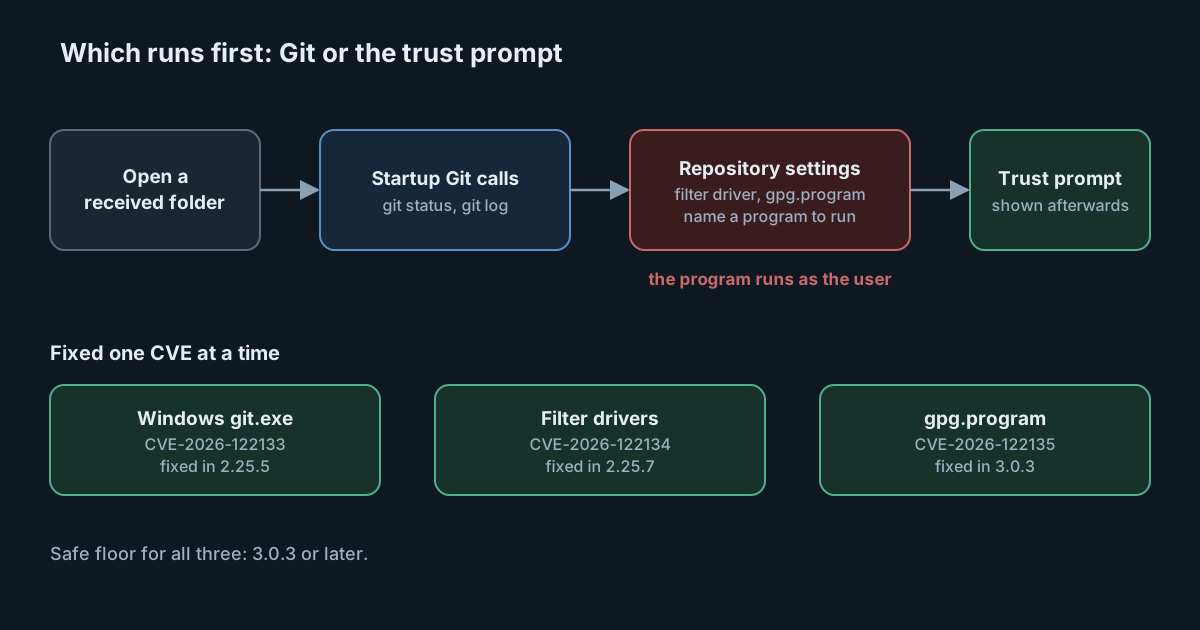
On 4 November 2026 the CVE record for Mistral Vibe, Mistral's open-source command-line coding agent, gained three entries. Each describes the same outcome: a crafted repository makes Vibe run an attacker's command at session start, with the user's privileges, before the trust prompt appears. All three are fixed, and the advisory for the last one lists every release before 3.0.3 as affected, so 3.0.3 is the safe floor. The detail worth reading is the order of events. A trust prompt protects you only from what happens after it.
What was reported
The research is credited to Francisco Rosales of Manifold Security. VulnCheck, which acted as the CVE numbering authority, published the records. The advisory for CVE-2026-122135 describes the newest one, and the advisory for CVE-2026-122134 the second. The first, CVE-2026-122133, is described in its NVD record.
| CVE | What the repository does | Affected | Fixed in |
|---|---|---|---|
| CVE-2026-122133 | Contains a git.exe in its root; on Windows Vibe runs it as if it were Git | Windows, before 2.25.5 | 2.25.5 |
| CVE-2026-122134 | Defines Git clean or process filter drivers; Vibe's startup git status invokes them | Before 2.25.7 | 2.25.7 |
| CVE-2026-122135 | Sets gpg.program and log.showSignature and holds a signed commit; Vibe's git log runs the program | Before 3.0.3 | 3.0.3 |
The fix versions come from the Vibe changelog. Version 2.25.5, dated 18 September, says Vibe "no longer runs a project-local Git executable during automatic repository inspection". Version 2.25.7, dated 22 September, says automatic project context "no longer runs repository-configured Git clean or process filters". Version 3.0.3, dated 26 October, says it "no longer runs repository-configured Git signature verification programs".
All three records are rated high. VulnCheck scores each 8.8 under CVSS 3.1 and 8.6 under CVSS 4.0. NVD lists them as received, which means NIST has not yet added its own analysis. The vectors use a network attack path with user interaction. In practice the user has to open a folder they received, which is a narrower story than "network" suggests.
Why Git settings are a code-execution path
A coding agent has to learn where it is. Vibe does that by asking Git for repository status and recent history when a session starts. Git reads its configuration from the repository itself, and several settings name a program that Git runs as part of an ordinary command:
- a filter driver defined in the repository's Git configuration and selected by
.gitattributesruns whengit statustouches the files it applies to; gpg.program, withlog.showSignatureturned on, runs the named program whengit logchecks a signed commit;- on Windows, an executable called
git.exein the working directory can be found before the real one.
None of this is a bug in Git. The bug is that the agent's startup code ran those commands in a folder it had not yet decided to trust. Manifold's earlier GitSpawn write-up found the same pattern in several other agents using a different setting, core.fsmonitor. It names Claude Code and goose among them, and describes the cause as context-gathering calls that run without stripping the repository's own Git configuration. An earlier article covers the same mechanism, a filter driver, in a different agent.
How a repository arrives matters
Manifold makes a point that applies here too. Cloning a hostile URL does not copy the sender's .git/config, because Git does not transfer local configuration. The risky route is anything that moves a whole directory with its .git folder inside: a zipped project, a shared drive, a sync folder. Consultants and colleagues pass projects around that way every day. A repository you cloned yourself from a hosting service carries much less of this risk than one you unpacked from an archive.
An open question about worktrees
A fourth report is worth knowing about, although it is not one of the three CVEs. In issue 997, a researcher reported that creating a worktree with the --worktree option ran filter drivers defined in a repository. A Mistral engineer replied that 3.0.2 only fixed the hooks route, and that 3.0.3 disables the repository's filter drivers for a folder the user has not trusted. The reply tracks it as CVE-2026-116843.
The same reply gave a caveat: the filter runs if the folder is already trusted when the worktree is created, and headless mode (vibe -p --worktree) grants session trust for the working directory automatically. The reporter said the problem still reproduced on 3.0.3 when running vibe --worktree from a malicious repository. The thread does not show how that was settled. If you run Vibe headless in automation, treat the folder's contents as trusted by definition, and only point it at code you control.
What it means for engineering and security leaders
The trust prompt is the control most teams point to when asked how an agent handles an untrusted repository. These advisories show why it needs a second question: what does the agent do before it asks? Startup work, such as reading Git state, indexing files or loading project settings, runs with full user privileges, and a prompt placed after it adds nothing for those steps.
Two practical consequences follow. Version floors are not obvious. Mistral shipped a fix for each CVE separately, so 2.25.7 closes the filter case but not the gpg.program case. The advisory for the last CVE lists everything before 3.0.3 as affected, so 3.0.3 is the safe floor. And any pipeline that opens received archives with an agent attached, such as a contractor handover or a customer reproduction, deserves the same care as opening an unknown executable.
Practical takeaways
-
Update Mistral Vibe to 3.0.3 or later. Run
vibe --versionon developer machines and in any container image or CI job that includes it. -
Look before you open. For a project that arrived as files, check the repository's own settings first. This lists the common command-running keys:
git config --local --get-regexp '^(gpg\.program|log\.showsignature|core\.fsmonitor|filter\..*)$'Also read
.gitattributes. Any setting that names a program can run it. -
Unpack archives into a scratch folder and inspect them there, not in the folder an agent is already watching.
-
Keep agents out of unreviewed code in headless runs. Automatic trust for a working directory is only safe when you wrote or reviewed what is inside it.
-
Ask each agent vendor the same question: which commands run before the trust decision, and are they started with the repository's Git configuration ignored?
Sources
- VulnCheck advisory: Mistral Vibe before 3.0.3, RCE via repository-configured gpg.program (CVE-2026-122135)
- VulnCheck advisory: Mistral Vibe before 2.25.7, code execution via Git filter drivers (CVE-2026-122134)
- NVD record for CVE-2026-122133 (Mistral Vibe on Windows, planted git.exe)
- Mistral Vibe changelog at v3.0.3
- Manifold Security: GitSpawn, a single flaw lets untrusted repos run code in coding agents (1 September 2026)
- Mistral Vibe issue 997: worktree creation runs git attribute filters