
Dependabot alerts will pause on inactive repositories from 8 December
GitHub will switch off Dependabot alerts on most repositories inactive for a year. What is exempt, why coding agents raise the stakes, and what to check.
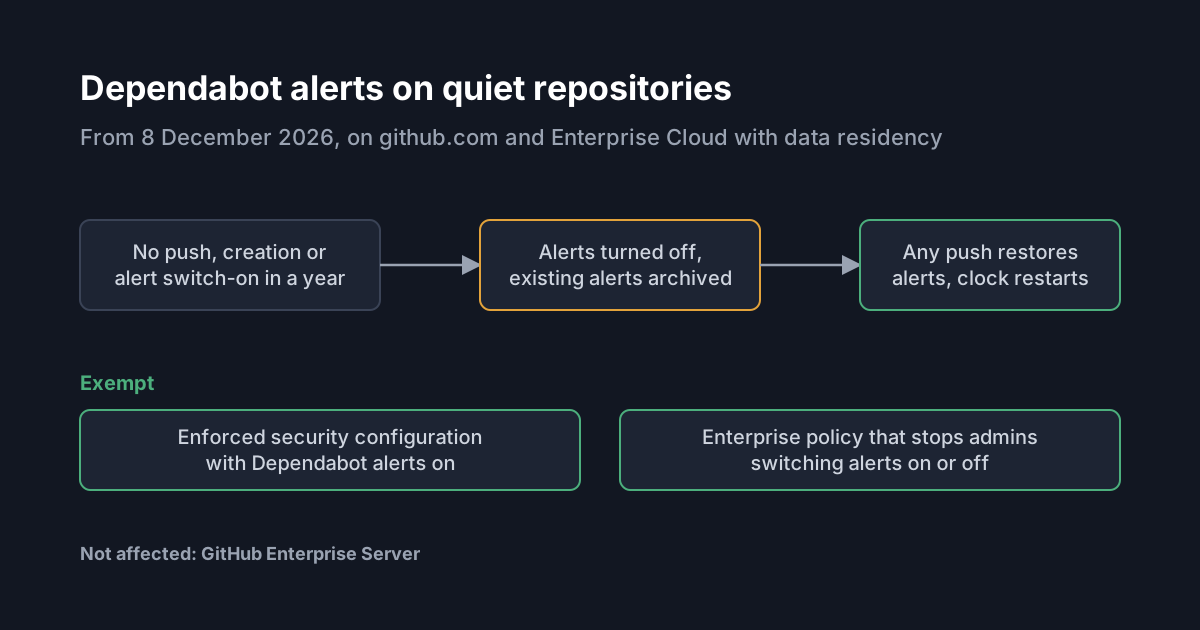
From 8 December 2026, GitHub will turn off Dependabot alerts on most repositories that have had no activity in the past year. Existing alerts will be archived, not deleted, and come back as soon as someone pushes. GitHub says the change keeps Dependabot "fast and reliable" as vulnerability discovery and alert volume grow. For most teams it removes noise. For teams whose AI coding agents read, copy from and quietly depend on old repositories, it can also remove a warning they were relying on without knowing it. The exemption that matters is an enforced security configuration, and it is worth checking before the date.
What changes on 8 December
According to GitHub's changelog of 10 November, three things count as activity:
- pushing to any branch or tag;
- creating the repository;
- turning on Dependabot alerts.
A repository with none of these in the past year has its alerts turned off and its existing alerts archived. Any push turns alerts back on automatically, and so does switching them on in the repository's settings. Either way, GitHub restores the archived alerts and the one-year clock starts again.
Two kinds of repository are skipped:
- repositories with an enforced security configuration that enables Dependabot alerts;
- repositories in enterprises whose Dependabot alerts policy doesn't let repository administrators turn alerts on or off.
The change applies to every plan on github.com and to GitHub Enterprise Cloud with data residency, where archived alerts stay in the enterprise's region. It does not apply to GitHub Enterprise Server.
Why activity is a weak signal of risk
Pushes measure whether people are changing a repository, not whether anyone depends on it. Plenty of repositories that nobody pushes to are still in use: a shared internal library pinned by other services, a template new projects are created from, a deployment script that runs every night, a sample app a team still clones, or a fork kept to carry one patch. A new vulnerability in their dependencies is as real as in an active repository. After 8 December, by default, nobody will be told about it.
GitHub's choice is understandable. Alert volume is growing and alerts on abandoned code mostly go unread. The default is reasonable for personal and experimental repositories. For an organisation, the question is which of its quiet repositories are quiet because they are finished, and which are quiet because they are dead.
Where AI coding agents come in
Two developments make the quiet repositories more important than they were.
First, coding agents reuse old code readily. An agent asked to "set up a service like the billing one" will read an existing repository, copy its patterns and often its dependency versions. Old internal repositories are exactly what agents reach for when they look for examples, and a dependency pinned in 2025 can travel into a project created this week.
Second, alerts are becoming the input to automated fixes. GitHub's documentation on Dependabot alerts now describes assigning an alert to an AI agent, GitHub's Copilot or a third-party agent such as Codex or Claude when enabled in the repository settings. The agent starts a session and opens a draft pull request with a proposed fix. Assigning alerts needs a GitHub Code Security or GitHub Advanced Security license. If the alert is archived, that pipeline has nothing to act on.
Neither point is a reason to object to the change. They are reasons to decide deliberately which repositories should keep alerts on regardless of activity.
How to keep alerts on where you need them
The mechanism GitHub names is a security configuration. As the documentation on enabling security features at scale explains, a security configuration is a set of enablement settings for GitHub's security features that you apply to repositories across an organisation, and each repository then enters a managed relationship with it. Enforcing a configuration that turns on Dependabot alerts is what exempts a repository from the pause.
The alternative, an enterprise-level Dependabot alerts policy that stops repository administrators from switching alerts on or off, also exempts repositories, but it is a broader decision and will need your enterprise owners.
Avoid the tempting workaround of pushing an empty commit to old repositories once a year. It works, but it hides the decision in a script, makes the commit history noisier, and stops working the day the script does.
What it means for engineering and security leaders
For most organisations the right outcome is a short list. Identify the inactive repositories that are still depended on, put them under an enforced configuration with alerts on, and let the rest pause. Archive repositories that are truly dead, so neither people nor agents treat them as examples.
It is also a reminder that hosted alerting only covers what is hosted and, now, active. Code also lives in clones on developer computers, in vendored copies inside other repositories, and in whatever an agent pasted into a new project last month.
Where SpanDock fits
SpanDock's repository security scans the git repositories on your team's computers for vulnerable dependencies and leaked secrets, under one policy you set on the server, with git hooks and CI enforcing it and a report for every repository on the server. Source code and secret values never leave the computer. Repository security is on the Enterprise plan.
Practical takeaways
- List repositories with no push since December 2025, before 8 December 2026, and mark which are still depended on.
- Apply an enforced security configuration with Dependabot alerts on to the ones that matter, rather than relying on activity.
- Archive dead repositories so they stop being cloned, forked or used as examples by people and agents.
- Tell agents where to look. Point agent instructions and shared skills at maintained templates, not at whatever repository looks similar.
- Check that new projects don't inherit old pins. Review the dependency versions in any project an agent scaffolded from existing code. Our article on package firewalls for coding agents covers related controls.
- If you run GitHub Enterprise Server, nothing changes for you on 8 December.