
MiniMax M3.1 Flash weights: a 428B coding model with a non-commercial default
MiniMax published weights for M3.1 Flash, a mixture-of-experts model for coding agents. Its size on disk, its self-reported benchmarks and the license terms.
MiniMax launched M3.1 Flash on 19 October 2026 as a fast, inexpensive model for agentic work, coding, computer use and security tasks, available first through its API, its M Plan subscription and its MiniMax Code app. The weights followed: the Hugging Face repository was first published on 23 October. For teams looking at models they can run on their own hardware, it is a notable release: a large mixture-of-experts model with a one-million-token context and a checkpoint that was quantised during training to reduce its memory footprint. Its license, though, is not an open-source license, and it changes the calculation for most company use.
What was released
The model card describes a natively multimodal mixture-of-experts model that takes text, images and video and produces text:
- Size. About 428 billion parameters in total, with 23 billion active per token.
- Context. Up to 1,000,000 tokens, with the caveat that usable context and throughput depend on GPU memory and serving configuration.
- Architecture changes from M3. Sparse attention throughout the model, quantisation-aware training, and a speculative decoding draft head (MiniMax calls it DSpark) shipped with the weights.
- Serving. MiniMax recommends SGLang, vLLM or TokenSpeed, and lists Transformers and several other integrations as in progress.
- Settings. Recommended sampling is temperature 1.0 and top-p 0.95, and reasoning effort is set in the chat template, from
lowtomax.
The checkpoint's configuration shows what quantisation-aware training means in practice: the routed expert weights are stored in NVFP4, a 4-bit format, and most other quantised layers in an 8-bit format. MiniMax notes that its results are for these official weights and that third-party quantisations may differ. The files in the repository total about 252 GB. That explains a discrepancy you'll notice on the model page: Hugging Face's parameter counter shows about 220B, because it counts packed 4-bit values as single bytes. Our arithmetic from the published tensor counts comes to roughly MiniMax's 428B; MiniMax doesn't comment on the difference.
The weights also explain hardware choices. 4-bit floating-point formats such as NVFP4 have native support on recent NVIDIA GPUs; on older hardware, serving engines may need to convert or emulate them, at a cost in speed. Check your engine's support for your GPUs before planning a deployment, and remember that a long context needs memory for the attention cache on top of the weights.
What the benchmarks show
MiniMax's table compares M3.1 Flash with two DeepSeek V4.1 Flash variants, Kimi K3, GLM-5.3 and two closed frontier models. All numbers are self-reported, many cells are empty, and each benchmark ran in a different agent harness, which the model card lists. A few rows:
| Benchmark | M3.1 Flash | Best other open model in the table |
|---|---|---|
| DeepSWE v1.1 | 73.7 | 77.0 (DeepSeek V4.1 Flash-1017) |
| Terminal Bench 4.0 | 38.1 | 42.3 (DeepSeek V4.1 Flash-1017) |
| NL2Repo-Bench | 61.2 | 68.2 (DeepSeek V4.1 Flash-1017) |
| SWE Refactor Bench | 23.0 | 19.5 (Kimi K3) |
| Automation-Bench v1.0.6 | 62.8 | 60.5 (DeepSeek V4.1 Flash-1017) |
| CyberGym | 82.2 | 84.5 (GLM-5.3) |
On MiniMax's own numbers, it is competitive rather than leading on the pure coding rows, and stronger on the automation and tool-use rows. The announcement's emphasis is cost: MiniMax claims roughly three times faster inference and 70% lower usage cost than its predecessor, and lists API prices of $0.15 per million input tokens, $0.60 per million output tokens and $0.015 per million cached input tokens. Those are prices for MiniMax's hosted API. Self-hosting costs are your hardware and operations, which no benchmark table captures.
The usual caution applies. Benchmarks run in particular harness versions with particular context sizes tell you what to shortlist, not what to deploy. Run the model on your own repositories and tasks, in the agent your developers use, before concluding anything.
The license
The license is the MiniMax Community License. It is short and worth reading in full, because its default is the reverse of most permissive licenses:
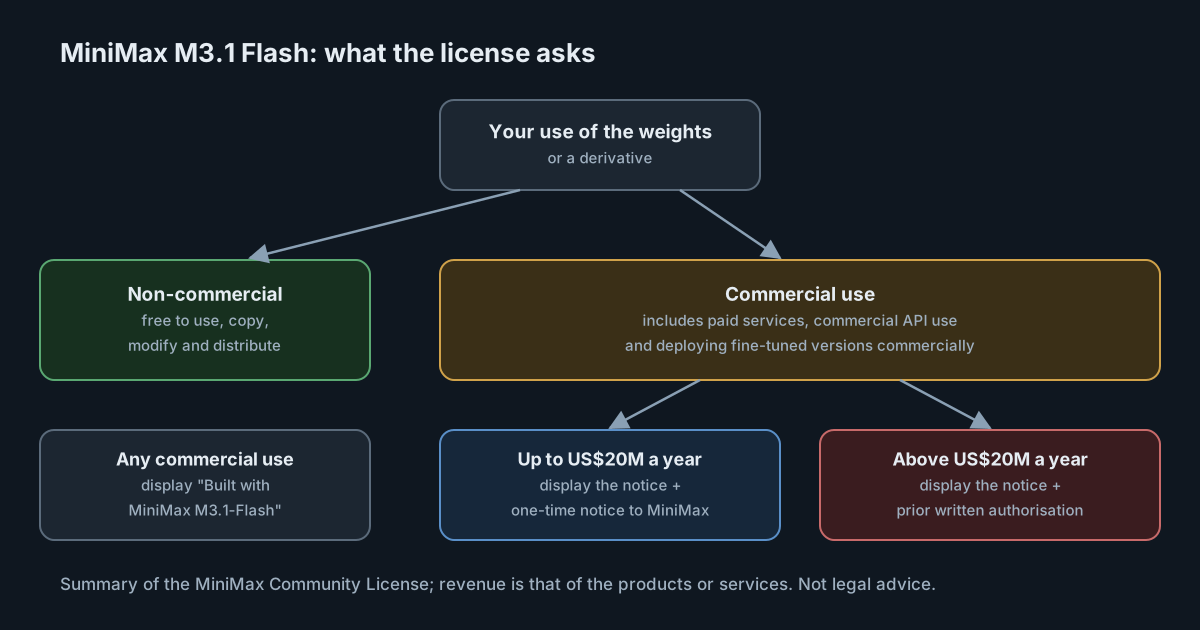
- Non-commercial use is granted freely, with the usual rights to use, copy, modify and distribute.
- Commercial use carries conditions. You must display "Built with MiniMax M3.1-Flash" on a related website, interface, blog post, about page or product documentation. If the products or services involved earn more than 20 million US dollars a year, you need MiniMax's prior written authorisation; below that, a one-time notice to MiniMax is enough.
- "Commercial use" is defined broadly. It covers any use "primarily intended for commercial advantage or monetary compensation", including offering paid products or services that rely on the model, commercial use of APIs serving it, and deploying a fine-tuned or otherwise modified version for any commercial purpose.
- Prohibited uses are listed in an appendix, including any military purpose.
For a company, an internal coding agent that helps engineers build the product is hard to argue is not "primarily intended for commercial advantage". Read that way, most corporate deployments are commercial use, which means the attribution requirement, a notice to MiniMax, and, for companies above the revenue threshold, a negotiation before use. The license ties the threshold to the revenue of the products or services, not the company, which leaves room for interpretation. That is a question for your legal team, before a pilot rather than after.
What it means for engineering and security leaders
Open weights are attractive for reasons that don't depend on benchmark leadership: data stays on your infrastructure, costs scale with hardware rather than tokens, and a model version can't be retired under you. M3.1 Flash is a credible candidate on those grounds, and its 4-bit checkpoint makes it more practical to host than its parameter count suggests.
The license is the main constraint. A model that is free for research but needs notice or permission for commercial use belongs in a different procurement category from one under a permissive license, and your model inventory should record which is which. Hosting it yourself also makes you responsible for the serving stack's security, updates and capacity.
Practical takeaways
- Classify the license before the pilot. Record it as source-available with commercial conditions, and decide with legal whether your use is commercial.
- Size for the real checkpoint. About 252 GB of weights, plus the attention cache for the context you plan to allow.
- Check the serving path. Confirm that your engine and GPUs support the checkpoint's 4-bit expert format at acceptable speed.
- Evaluate in your own harness. The published scores come from several different agent harnesses and versions; yours will differ.
- Keep model access behind a stable name, so that switching between a hosted and a self-hosted model doesn't mean reconfiguring every tool.
For comparison with other recent releases, see our notes on Muse Spark Open and on small open-weight models for coding sub-agents.
In SpanDock's model proxy, a rule for a plain name such as prod-chat works as an alias that apps ask for and the server sends to a real model, and a rule can allow translation so that Claude Code runs on any OpenAI-compatible model. Routing rules are on the Premium plan and up.