
Agent Skills, Open Responses and OpenSandbox join the Agentic AI Foundation
Four vendor-built agent projects moved to neutral governance at AGNTCon in October. What each one covers, and how to weigh them when picking standards.
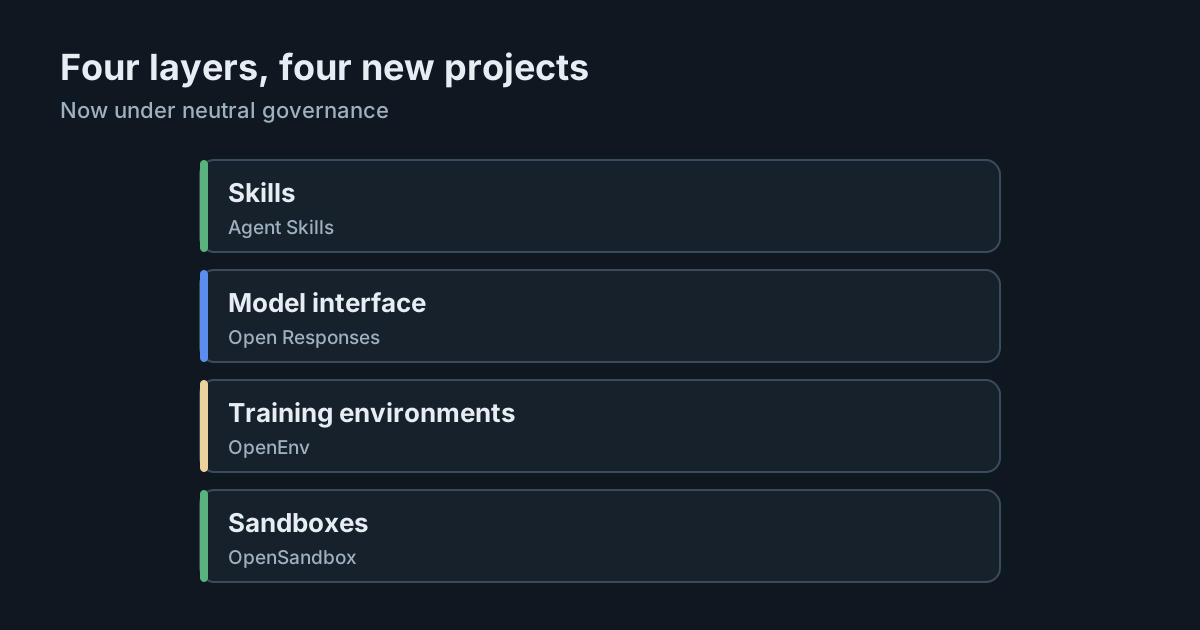
On 22 October 2026, at AGNTCon + MCPCon North America in San Jose, the Agentic AI Foundation (AAIF) announced four new projects, each contributed by a different company: Agent Skills from Anthropic, Open Responses from OpenAI, OpenEnv from Hugging Face and OpenSandbox from Alibaba. The foundation now hosts ten projects, up from the three it launched with in December 2025. For teams deciding which agent formats and interfaces to build on, the move changes one input to that decision, who controls the specification, without settling the others.
The four projects
The AAIF announcement places them at four layers of an agent system:
- Agent Skills is an open format for giving agents capabilities and domain knowledge. A skill packages instructions, scripts and resources that an agent loads when it needs them. Anthropic launched the format a year earlier and has now handed it to the foundation. The format is documented at agentskills.io.
- Open Responses is an open specification, based on the OpenAI Responses API, for calling language models across providers with one shared schema, consistent streaming events and extensible tooling. Its technical charter, adopted on 21 October 2026, sets it up as a series of LF Projects, LLC.
- OpenEnv is a framework and hub for reinforcement learning environments, served as containers that expose both MCP and the Gym training interface.
- OpenSandbox is a sandbox platform for AI applications, with SDKs in several languages, Docker and Kubernetes runtimes and a protocol defining lifecycle and execution APIs. Its README also describes per-sandbox egress policies and a credential vault that lets agents call external services without exposing real credentials inside the sandbox. The repository now sits under an
opensandbox-grouporganisation rather than Alibaba's own.
They join the six existing projects: the Agent2Agent protocol, Agent Router, agentgateway, AGENTS.md, goose and the Model Context Protocol.
What neutral governance does and doesn't change
A foundation home means that changes to a specification go through a published process rather than one company's product roadmap, and that the project is held by a neutral body rather than by the company that contributed it. That matters for anything you plan to build on for years: a skill library, an internal model gateway, a sandbox layer.
It doesn't make the projects equally mature or equally adopted. Each was built inside one company to match that company's products, and the foundation's announcement contains statements of intent rather than adoption figures. Open Responses is a clear example. It is based on one provider's API, and providers that publish their own native APIs are under no obligation to adopt it. A common schema helps most when the providers you use support it directly, or when a translation layer you trust sits in between.
Governance also doesn't do your security review. OpenSandbox's isolation, Agent Skills' trust model and Open Responses' tool calling all need the same scrutiny as before. A skill from a public catalogue is still code and instructions from a stranger, as our look at skills pointing at bad domains showed.
What it means for engineering and security leaders
- Fewer single-vendor bets. If you have avoided a format because one vendor controlled it, that objection is weaker for these four. Check each project's governance documents rather than assuming they are identical.
- Interfaces are converging, slowly. Open Responses and MCP together cover a large part of how agents call models and tools. Code written against them should be easier to move between providers, but only as far as each provider actually implements them.
- Sandboxes are becoming shared infrastructure. An open sandbox protocol makes it more realistic to run agents on your own infrastructure with egress rules you set, rather than inside each tool's built-in sandbox. Our guide to what built-in sandboxes cover explains the gaps an external layer can fill.
- Skills need a supply chain. As Agent Skills becomes a shared format, the same skill can run in many tools. Decide who in your organisation may publish skills, how they are reviewed and how they are withdrawn.
Practical takeaways
- List the agent formats and interfaces your teams already depend on, and note which now sit under foundation governance and which remain vendor-controlled.
- For Open Responses, check which of your model providers implement it natively before planning a migration around it.
- If you evaluate OpenSandbox, test its egress policies and credential vault against your own threat model rather than relying on the feature list.
- Keep an internal, reviewed catalogue of skills instead of letting each developer install skills from public sources.
- Watch the projects' changelogs and governance pages rather than conference announcements, since that is where commitments become concrete.
If you use SpanDock, its skills feature uses the same folder-with-a-SKILL.md layout: an administrator turns a skill on once, every computer receives it and keeps it up to date, and turning it off removes it at the next check-in. Published skills keep versions and can be rolled back. Starter skills are in every plan; publishing your own is on the Premium and Enterprise plans. Skills are in beta.