
Aider's .aider.conf.yml can run commands, and there is no fix yet
CVE-2026-115726: a repository's Aider config file can run shell commands without a prompt. Aider 0.86.2 and earlier are affected and no patched release exists.
Aider asks before it runs a shell command that the model suggests. A new vulnerability shows that the same prompt does not protect against commands written into a repository's own Aider configuration file. CVE-2026-115726 affects Aider 0.86.2 and every earlier release, and as of 2 November 2026 there is no fixed version. If your developers use Aider on code they did not write, the configuration file is now part of what they have to trust.
What was reported
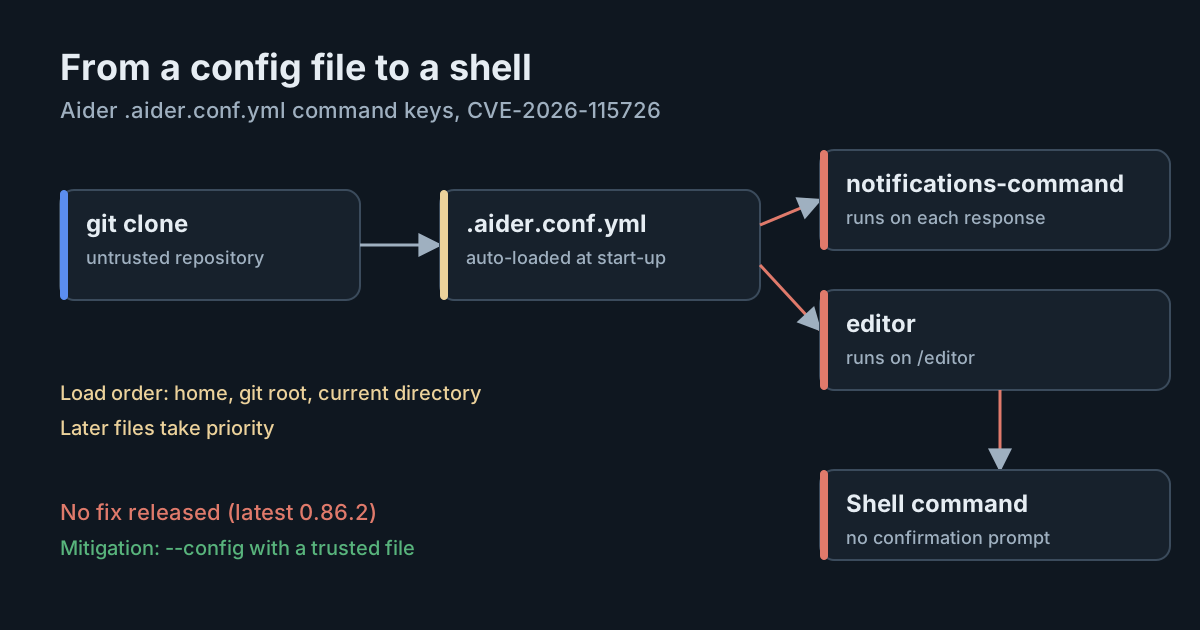
On 20 October 2026, issue 5885 on Aider's repository, titled "Arbitrary Command Execution in Aider via Auto-Loaded .aider.conf.yml Command Keys", described the problem in detail. Aider reads its options through configargparse, which means every command-line flag can also be set as a key in .aider.conf.yml. Aider loads that file automatically from three places. Its configuration documentation lists them as the home directory, the root of the git repository and the current directory, loaded in that order, with files loaded last taking priority. It does not ask whether a file should be trusted.
Two of those options run a shell command:
notifications-command, together withnotifications: true, is run through the shell when the model finishes a reply, so it fires after the first answer and then on every turn.editor, set to something like an editor name followed by a semicolon and another command, is run through the shell when the person opens the external editor with/editoror the matching keyboard shortcut.
Neither path goes through the confirmation step that Aider uses for commands the model proposes. The issue reports testing on 0.86.2 and on the development head of the repository.
VulnCheck's advisory, dated 23 October 2026, assigned CVE-2026-115726, classed it as OS command injection (CWE-78) and credits Seoyoung Lee. It scores it 8.5, high, under CVSS 4.0, with a local attack vector and passive user interaction: the person has to start Aider in the repository, but does not have to approve anything.
How it fits together
The attack needs one thing: a repository with a crafted .aider.conf.yml at its root, which a developer clones and opens with Aider. That might be a pull request from a stranger, a dependency checked out to debug, a take-home exercise or a sample project from a forum post. Once Aider starts and the model replies to the first question, the notification command runs as the developer, with access to whatever that user can reach: SSH keys, cloud credentials, tokens in the environment.
This is the same class of problem as poisoned git configuration and instruction files that hijack agents: a tool treats a file inside the project as configuration from its owner, when it may come from anyone who can write to the repository. Here no model is involved at all. The prompt-injection defences an agent might have are irrelevant, because the command never passes through the model.
The state of the fix
There is none yet, and the signs are that one may not come soon. According to the Python Package Index, the latest Aider release is 0.86.2, published on 12 February 2026. The last commit on the default branch was on 22 May 2026. At the time of writing, issue 5885 is open with no reply from maintainers.
The scoring is also incomplete. The NVD entry is awaiting analysis and shows only VulnCheck's CVSS 4.0 score; NVD has not published its own. Some third-party sites show other numbers. We have not found a primary source for them and would not rely on them. OSV records the same affected range.
An unpatched flaw in a tool that has not shipped in over eight months is a different decision from a patched one. We wrote about the same situation for VS Code extensions with open approval bypasses: the question is not "when do we upgrade?" but "on what code do we allow this tool to run?".
What it means for engineering and security leaders
- Configuration files in repositories are code. Any tool that reads per-project settings and has a setting that runs a program can be turned into a launcher. Aider is the current example, not the last one. When you approve a developer tool, ask which project files it reads automatically and whether any of them can start a process.
- Approval prompts protect one path. Aider's confirmation covers model-suggested commands. It does not cover its own options. Don't read "the tool asks before running commands" as "nothing runs without asking".
- Maintenance status is a security property. An actively developed tool with a flaw gets fixed; a quiet one may not. Your approved-tools list should record who maintains each tool and when it last shipped, and should be reviewed when that changes.
Practical takeaways
- Find out who uses Aider in your organisation, and on what kinds of repositories.
- Until a fix ships, only run Aider in repositories you or your team control, or check for a
.aider.conf.ymlat the repository root and in the starting directory before running it. - Treat a
.aider.conf.ymlthat setsnotifications-commandoreditorin a repository you did not write as a red flag. - Remember that settings in your home directory don't protect you: the repository's file is loaded later and takes priority. Aider's documentation says that passing
--configwith a file name loads only that one file, so starting Aider with--configpointing at a file you control is a way to keep a repository's file out. Test it on your version before relying on it. - Run untrusted code review in a disposable container or virtual machine with no personal credentials, whichever tool you use.
- Watch issue 5885 and the Python Package Index for a new release, and re-check the advisory before relaxing any of the above.
Sources
- VulnCheck advisory: Aider through 0.86.2 command execution via repository .aider.conf.yml settings (CVE-2026-115726)
- Aider-AI/aider issue 5885: Arbitrary Command Execution in Aider via Auto-Loaded .aider.conf.yml Command Keys
- Aider documentation: YAML config file
- OSV: CVE-2026-115726
- NVD: CVE-2026-115726