
Copilot's usage API now separates BYOK and custom models: how to read it
GitHub's Copilot usage metrics now flag local BYOK and enterprise custom model use. What the new fields count, where they undercount, and how to use them.
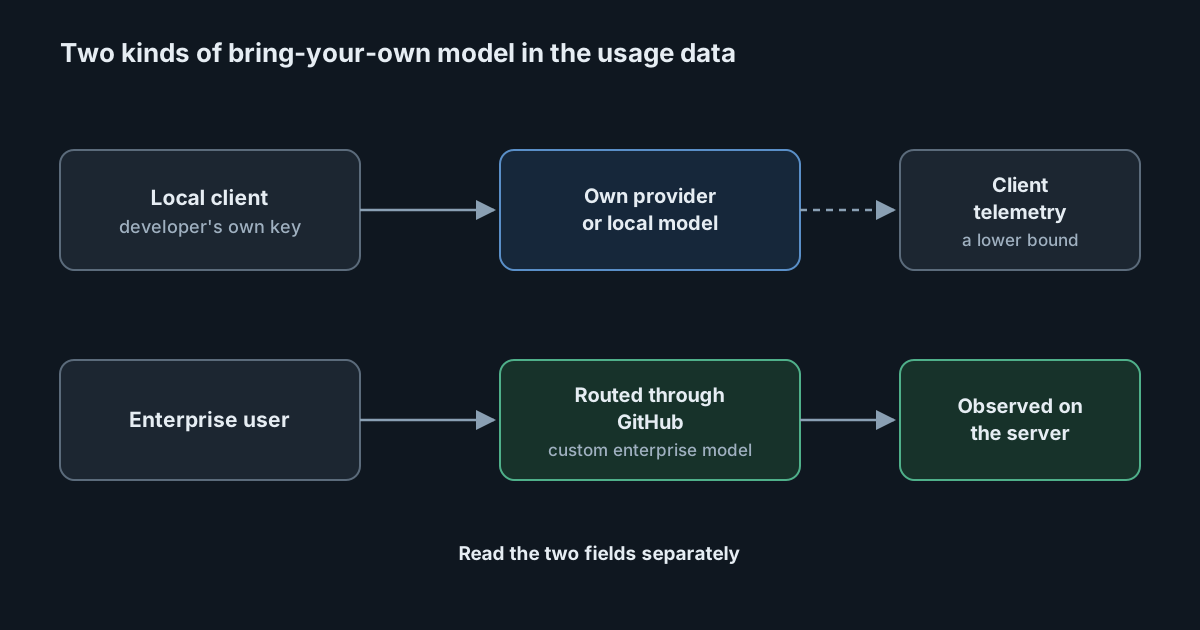
Until this week, a request that GitHub Copilot sent to a developer's own model looked much the same in the usage metrics as one served by Copilot itself. Local and custom models often share names with Copilot's hosted models, so the two blended together. On 3 November 2026 GitHub added fields to the Copilot usage metrics API that separate bring-your-own-key (BYOK) usage from hosted usage, in both enterprise and organisation reports.
This matters to anyone who has a BYOK policy, pays for model usage through more than one provider, or tries to work out what Copilot actually costs per developer. The new fields are useful, but they are not all equally reliable, and the differences are worth understanding before anyone builds a dashboard on them.
Two kinds of BYOK
The changelog distinguishes two paths, and they are measured differently.
Local BYOK is configured by developers in their own client. Requests go from Copilot CLI or the GitHub Copilot app directly to the developer's provider key or to a local model served by tools such as Ollama, Foundry Local, LM Studio or llama-server. GitHub never sees those requests; it learns about them from client telemetry. (We looked at the local-model side of this in Copilot CLI finding local Ollama models.)
Enterprise custom models are configured by administrators in GitHub settings. Requests route through GitHub to your provider, so GitHub observes them server-side, from every client, including IDEs.
The new fields
For local BYOK:
used_local_byok, in user-level reports, says whether a user made at least one local BYOK request in Copilot CLI or the Copilot app that day.totals_by_local_byok, in user-level and aggregate reports, gives session, request, prompt and token counts, broken out bybyok_kind(local_managed,local_user,local_autoorremote_user) and bysurface(copilot_cliorcopilot_app).daily_active_local_byok_users,weekly_active_local_byok_usersandmonthly_active_local_byok_users, in aggregate reports, count distinct users for the day, calendar week and calendar month.
For enterprise custom models, each entry in totals_by_client[].totals_by_model[] gains an is_custom_enterprise_model boolean. A model used both as a hosted model and as a custom model now appears as two entries, so the counts stay separate.
The fields appear in 1-day and 28-day reports. The reports themselves are reached through the existing endpoints: the REST documentation describes calls such as GET /enterprises/{enterprise}/copilot/metrics/reports/enterprise-1-day, which return signed links to download the report rather than the data itself. At the time of writing the REST reference does not yet list the new fields, so the changelog is the authoritative description for now.
What the numbers do and don't tell you
GitHub's notes contain four caveats that change how the data should be read.
- Existing totals do not change. BYOK usage was already counted. Local BYOK is a subset of
totals_by_cliandtotals_by_copilot_app, and custom model usage was already insidetotals_by_client. The new fields let you subtract; they do not add anything new to the totals. - Local BYOK is a lower bound. Because it relies on client telemetry, it undercounts when telemetry is disabled. Token counts can undercount too, because some local providers do not report token usage. Custom model counts are observed server-side and do not have this limitation.
- Local BYOK has no model breakdown. You can see how much local BYOK a person used, but not which model. Custom model names go through GitHub's existing name normalisation, so unrecognised names appear as
unknown. - No history. Report days before the release do not include
is_custom_enterprise_model, so trends start from 3 November.
Access is limited to enterprise owners, enterprise billing managers, organisation owners and custom roles with the View Copilot Metrics permission, and the Copilot usage metrics policy must be enabled.
What it means for engineering and security leaders
The governance use is the most direct. If your policy allows custom models configured by administrators but not personal provider keys, used_local_byok gives you a list of people to talk to, and the byok_kind breakdown narrows down how they are doing it. The changelog does not define each kind, so confirm what each value covers before you act on it. Treat it as a starting point rather than proof: someone with telemetry turned off will not appear at all, so an empty list does not mean nobody is doing it.
The cost use needs more care. Subtracting BYOK from the totals gives a better picture of what Copilot itself serves, and so a fairer cost per user. But the BYOK spend still happens somewhere, on a provider invoice or on a developer's own machine, and these fields only tell you that it happened, not what it cost.
The efficiency comparison GitHub suggests, grouping users by BYOK or custom model use and comparing them with other metrics, is reasonable once a few weeks of data exist. It sits naturally alongside the custom skill names and client counts GitHub added in October.
If you want a view of local tool sessions that does not depend on Copilot's own reports, SpanDock can receive the OpenTelemetry that AI coding tools export. GitHub Copilot CLI is one of the tools for which it shows the exact lines to add, and its dashboard lists each session with its tokens, cost and models, as described in getting started. The same caveat applies: it sees only what the tool reports.
Practical takeaways
- Pull a 1-day report now and check that the new fields are present for your enterprise or organisation.
- Decide what your BYOK policy is before reading the numbers, so that each
byok_kindvalue and enterprise custom models map to "allowed", "allowed with conditions" or "not allowed". - Report local BYOK as "at least". Label it as a lower bound in any dashboard, and do not compare its token counts directly with server-side figures.
- Keep custom and hosted entries apart when you calculate cost per model; the same name can now appear twice.
- Start trend lines on 3 November, since earlier days lack the custom model flag.
- Check who has
View Copilot Metrics. The data now says more about individual choices, which is a reason to review who can read it.