
GitHub Agentic Workflows is generally available: reading its security model
Agentic Workflows reached general availability on 28 October. What its layered safeguards do by default, where the docs add caveats, and how to set it up.
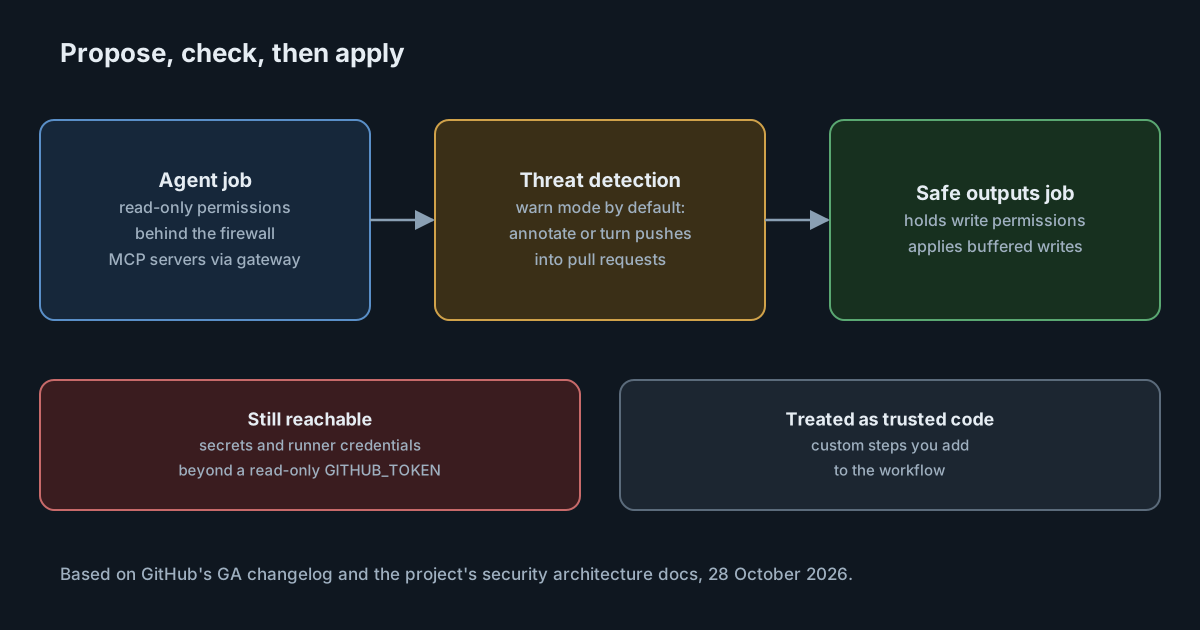
Running a coding agent inside CI is different from running one on a laptop. Nobody watches each step, the runner may hold tokens a developer never sees, and the agent's input can include issues and pull requests written by anyone. On 28 October 2026 GitHub made Agentic Workflows generally available: natural-language Markdown files that compile to ordinary GitHub Actions workflows and run a coding agent for tasks such as issue triage, CI failure analysis, documentation updates and test writing.
Its security model is more thought through than most. It is also more nuanced than the announcement's summary, and the defaults matter. This article walks through the layers using the project's security architecture documentation.
What became generally available
Agentic Workflows is an open source project from GitHub Next. It works on github.com for GitHub Free, Team and Enterprise; using the default Copilot CLI engine needs a Copilot license, and other coding agents can be used instead. Because workflows compile to Actions YAML, they use your existing runner groups and policies.
Since the public preview, the changelog lists support for self-hosted Actions Runner Controller runners with Docker-in-Docker, new models and per-workflow model providers, a model router, and gh aw forecast, which is no longer experimental and now includes threat detection credits and monthly ranges in its AI credit estimate.
The changelog also includes a customer quote with large productivity figures. Those are one customer's own numbers, not measurements GitHub publishes, and we don't repeat them as findings.
The layers
The documentation organises the defences into three layers of trust:
- Substrate: the runner, containers and network controls that hold even if everything above them misbehaves.
- Configuration: what the compiled workflow declares, such as permissions, allowed tools and allowed network destinations.
- Plan: the staged execution in which the agent proposes and separate jobs decide what happens.
Within those, the main mechanisms are:
- A read-only agent job. The agent runs with read-only permissions. It can't write to the repository directly.
- Safe outputs. The agent's intended writes, such as comments, labels or pull requests, are buffered and applied by a separate job that holds the write permissions.
- Threat detection. A dedicated job reviews proposed outputs before the safe outputs job acts.
- The Agent Workflow Firewall. Network access goes through a proxy with a domain allowlist.
- An MCP gateway. MCP servers run in containers behind a gateway rather than directly beside the agent.
- Integrity filtering. The MCP gateway removes content below a configured trust level, based on its author and merge status, before the agent sees it. On public repositories
min-integrity: approvedis applied automatically, which restricts content to owners, members and collaborators. - Secret redaction. Logs and artefacts are scrubbed in a step that runs whatever the outcome.
- Compile-time checks. Compilation runs workflow linters and security scanners and pins actions to commit SHAs.
Where the documentation adds caveats
The changelog says a threat detection job "scans all proposed changes before they are applied." That is accurate, but the documentation explains what happens next, and it depends on the mode.
By default, threat detection runs in warn mode. The detection step is allowed to fail without stopping the run. In this mode, outputs that a person will review anyway, such as comments, are published with an annotation, and a direct branch push becomes a pull request for review. Outputs that can't be reviewed that way are aborted. In strict mode, flagged outputs are blocked. The documentation also notes that if the detector itself fails, the result is no verdict, not a clean one.
That is a reasonable default for adoption, because people still see what was flagged. But it means "scanned before being applied" does not, by default, mean "blocked if suspicious". For workflows that write to protected branches or touch release automation, decide whether strict mode is the right setting.
The second caveat is about isolation. The changelog lists running agents in a Cloud Hypervisor or NVX micro-VM as an improvement for general availability. The architecture documentation labels the Cloud Hypervisor option as preview. Treat micro-VM isolation as not yet generally available until the documentation says otherwise.
The third is about tokens. The documentation states that a read-only GITHUB_TOKEN does not remove other credentials the job can reach. Secrets passed to the workflow, cloud credentials on a self-hosted runner and anything in the environment are still there. And custom steps you add to a workflow are treated as trusted code: they run outside the agent's sandbox and with whatever permissions you give them.
What it means for platform and security leaders
The design separates proposing from doing, which is the right shape for unattended agents. An agent that can only suggest a change, reviewed by a separate job and applied by a third, is much easier to reason about than one holding a write token.
The weak points are the ones the documentation points to: secrets that live outside the token model, self-hosted runners that hold more than they should, custom steps that bypass the agent's sandbox, and a default threat detection mode that annotates rather than blocks. None of these is a flaw in the product. They are the places where your configuration decides the outcome.
Practical takeaways
- Start with read-heavy workflows, such as triage and CI failure analysis, before ones that open pull requests.
- Set threat detection to strict mode for any workflow whose outputs can reach protected branches or releases.
- Keep integrity filtering on for public repositories, and think before lowering it.
- Review which secrets and credentials each workflow's jobs can reach, beyond
GITHUB_TOKEN. - Treat custom steps as ordinary privileged CI code and review them as such.
- Keep network allowlists short, and add domains only when a workflow needs them.
- Use
gh aw forecastbefore enabling a workflow broadly, andgh aw logsandgh aw auditto review runs afterwards. - Don't plan on micro-VM isolation until it is documented as generally available.