
MCP moves to March and September releases: what SEP-3398 means for your planning
The Model Context Protocol now plans releases on a fixed six-month calendar, and the December 2026 release moves to March 2027. The dates that matter.
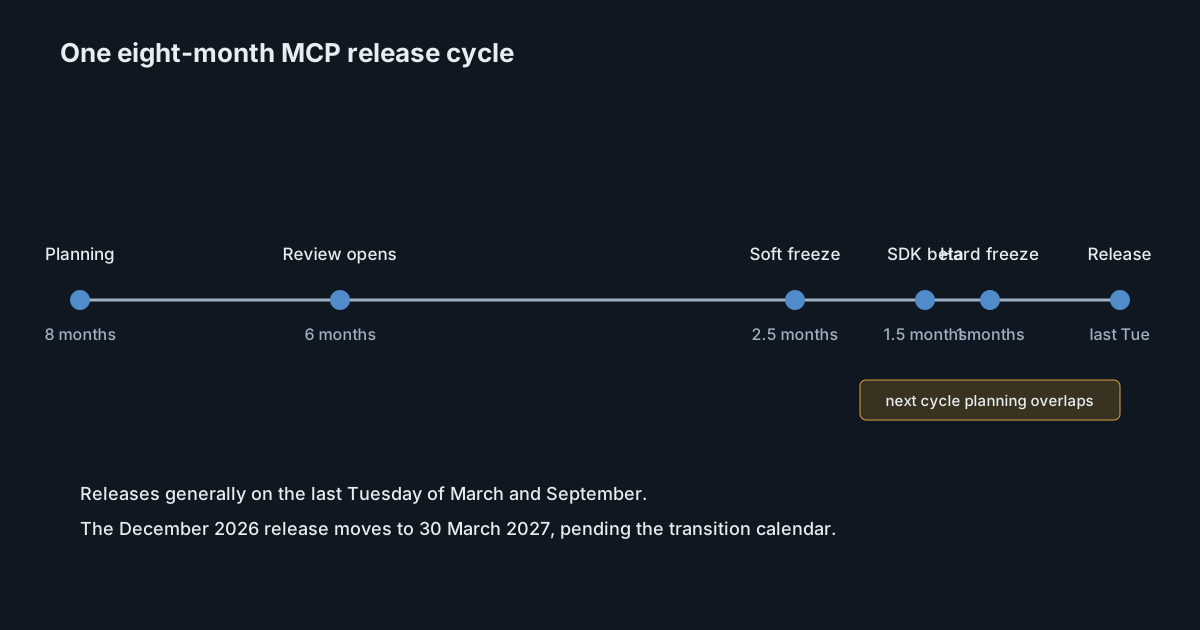
If your team builds MCP servers, ships an MCP client or sets policy for the AI tools that use them, the hardest question has been when the next specification will land. The answer was set release by release. A process proposal accepted by the Model Context Protocol's Core Maintainers on 14 October 2026 replaces that with a fixed calendar: specification releases every six months, generally on the last Tuesday of March and September. The first consequence is concrete. The release that had been expected in December 2026 moves to 30 March 2027, subject to a transition calendar that has not been published yet.
What SEP-3398 says
SEP-3398 is a Process proposal by Kurtis Van Gent, sponsored on behalf of the Core Maintainers. It was created on 17 September 2026 and accepted on 14 October 2026. It changes how the specification is planned and released, not what the protocol does. In its own words, it "introduces no protocol messages, schema changes, version-negotiation changes, or new requirements for deployed clients and servers." Protocol versions keep their date-based format, and existing versions stay valid.
Each release gets an eight-month cycle. The first two months are planning, and the last two overlap the planning of the next release, so there is always one release stabilising while the next is being shaped.
The milestones
The proposal expresses every milestone as calendar months before release. Release managers publish exact dates for each cycle.
- 8 months: planning begins. Core Maintainers propose a roadmap and gather feedback from maintainers and Working Groups.
- 6 months: Core Maintainer review opens. Scheduled reviews of proposals take place in this window.
- 2.5 months: soft freeze. Every proposal in the release must be Final and merged, including specification text, schema changes, a reference implementation and any required conformance tests. "Acceptance alone does not meet the cutoff." After this point, only bug fixes, polish and clarifications within the frozen scope.
- 2 months: next-cycle planning begins.
- 1.5 months: SDK beta. Tier 1 SDKs publish betas supporting the frozen scope.
- 1 month: hard freeze. Changes are limited to critical security vulnerabilities and release-blocking correctness or interoperability defects, and each needs a full Core Maintainer vote passed by more than half of all eligible members.
- Release. The dated specification, release notes, migration guidance and an SDK readiness summary are published.
Other process changes
Every proposal now needs a sponsor, either a Working Group or the Core Maintainer group, before formal review. Each release has a primary and a secondary release manager, and the secondary leads the following cycle. Proposals that miss the soft freeze "move to a later cycle without moving the release date." A missed SDK milestone is disclosed in the release guidance, but "does not postpone specification publication or automatically change that SDK's tier."
The transition
The last specification release was 28 July 2026, which we covered in MCP's 2026-07-28 specification: what changes for operators. SEP-3398 moves the next one to 30 March 2027, "subject to confirmation in the transition calendar". Within two weeks of adoption, Core Maintainers are to choose the first release managers, who then publish exact freeze, beta and release deadlines.
Applying the milestone offsets to 30 March 2027 puts the soft freeze in mid-January 2027, Tier 1 SDK betas in mid-February and the hard freeze at the end of February. That is our arithmetic, not a published date. Treat the transition calendar as the authority once it appears.
After March, the next release would follow on the last Tuesday of September 2027, with its planning starting in late January 2027.
How the SDK tiers fit in
The proposal ties its beta milestone to the existing SDK tiering system. That page sets out what each tier commits to:
- Tier 1 SDKs pass all conformance tests, support new protocol features before the new specification is released, and resolve critical bugs within seven days.
- Tier 2 SDKs pass at least 80% of conformance tests and support new features within six months.
So for a Tier 1 SDK, the calendar now gives a target: a beta about six weeks before release. SEP-3398 is also clear about scope: the beta milestone covers features the tiering policy requires and "does not make experimental features or extensions mandatory for Tier 1."
Why this matters
Until now, an MCP release could arrive with little notice, and SDK support might trail it by weeks or months. That made it hard for platform teams to plan upgrades of the clients and servers they approve, and for vendors to promise support dates.
A fixed calendar helps in three ways.
Scope is known early. At soft freeze, the content of the next release is final and merged. That gives you two and a half months to read what is coming before it ships.
SDK readiness is visible. Release managers maintain a public readiness summary with SDK versions, conformance results, gaps and expected resolution dates.
The release doesn't wait. A feature that isn't ready moves to the next cycle. That makes dates dependable, at the cost of features sometimes slipping by six months.
There is one thing it doesn't do. It doesn't change how fast clients adopt a new version. Hosts and servers still negotiate versions, and many deployed tools will run older versions for a long time. Extensions such as Skills over MCP also follow their own track.
What it means for engineering leaders
If MCP is part of your AI tool estate, you can now put two dates a year in your planning calendar and work back from them. The soft freeze is the useful one for review: from that point, the specification text for the next release is settled.
The December 2026 release that some roadmaps assumed is not coming. Anything you were waiting for in that release, such as a feature in an accepted proposal, now targets March 2027 at the earliest, and only if it is Final and merged by the soft freeze.
Practical takeaways
- Update roadmaps. Replace any December 2026 MCP release assumption with 30 March 2027, pending the transition calendar.
- Watch for the transition calendar. It will set the exact soft freeze, beta and hard freeze dates.
- Read the frozen scope at soft freeze. Use the two and a half months before release to assess security and compatibility impact.
- Test against Tier 1 betas. If you build on an SDK, plan a test window about six weeks before each release.
- Check your SDK's tier. A Tier 2 SDK may take up to six months to support new features, which can be a full release cycle.
- Don't confuse spec dates with client dates. Plan upgrades of approved clients and servers separately from the specification calendar.
If your team's AI tools reach business systems through MCP, the SpanDock MCP gateway gives every computer one MCP server, keeps connector credentials on your server and never sends them to computers, and checks each call against your rules. It is on the Premium and Enterprise plans.