
GitHub's harness comparison: how to read one vendor's benchmark of rival agents
GitHub's benchmarks site now compares Copilot CLI with Claude Code and Codex CLI on the same models. What the method controls, what it can't, and how to use it.
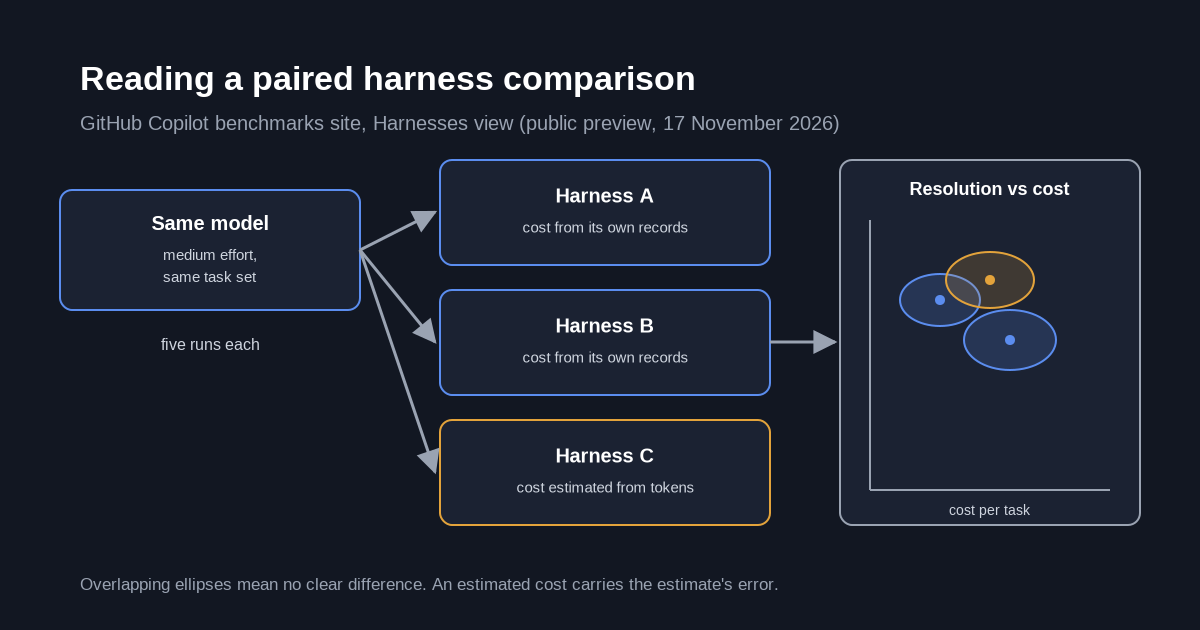
On 17 November 2026 GitHub added a Harnesses view to its Copilot benchmarks site. It puts GitHub Copilot CLI next to Claude Code and Codex CLI, running the same model at the same reasoning effort on the same tasks, and plots how often each solves a task against what each task costs. It is in public preview. For anyone choosing an agent, or trying to explain why the same model costs different amounts in different tools, it is useful data. It is also a vendor measuring its competitors, which calls for a careful reading.
What GitHub published
The changelog entry describes two additions. The site now includes Terminal-Bench-Science 0.1, which tests agents on research workflows written and reviewed by domain experts. And the new view compares harnesses, the software around a model that manages tools, context and the loop of calls, rather than models.
The view has two parts:
- A scatter plot of each harness's resolution rate against its mean cost per task, with lines joining matched results and shaded ellipses showing "the run-to-run variation observed across published runs".
- Paired differences: for each matched model, Copilot CLI's resolution advantage in percentage points and its cost saving as a percentage, with approximate 95% bootstrap intervals.
GitHub limits the comparison to exact model pairs at medium reasoning effort. Copilot-only configurations, such as Copilot Fusion, and unmatched results are left out "rather than compared against a different model". The changelog is open about the motive: "Much of the work we do to make Copilot better happens at the harness-level, and this view makes those improvements visible."
The methodology notes
The benchmarks site's own methodology notes add detail the changelog doesn't. Within each benchmark, every configuration uses the same task set: 113 tasks for DeepSWE 1.1, 66 for Terminal-Bench 4.0 and 70 for Terminal-Bench-Science 0.1. Each configuration runs five times, with up to two retries per task. Results are averages, and costs count only tasks with complete cost data. The notes aren't fully consistent on run counts: benchmark descriptions elsewhere on the site say results average "the most recent runs (1 to 5)", and some harness notes say configurations include 3 to 5 runs, so not every configuration has five.
Three notes matter for interpretation:
- Codex CLI's cost is estimated. The site says Codex CLI logs token usage but not cost, so its costs are estimates from OpenAI's public API prices "at standard short-context rates, excluding context-length band increases; actual billed amounts may differ."
- Score and cost coverage differ. Coverage notes list missing cost observations per harness. For Copilot CLI on Terminal-Bench 4.0, for example, 754 of 15,180 expected attempts have no cost record. Scores use the full task count; costs use the attempts with complete data.
- Reward hacking is measured, not removed. The site reports the share of attempts an audit judged solved by reward hacking, such as reading held-out tests or altering the grader, and says scores "are not adjusted" for persistent cases.
The site also warns against mixing sources: compare results only within each benchmark, "not with results published elsewhere", because GitHub can't see other publishers' harnesses, datasets or methods.
Analysis: what the method controls and what it can't
The design choices are sound. Holding model, effort and tasks constant isolates the harness, which is the variable most comparisons ignore. Repeated runs with visible variation discourage reading a two-point gap as a win. Excluding Fusion from the paired view avoids comparing Copilot's model routing against a rival's single model. We made the same argument in why the same model costs more in some agents: the harness can change both the success rate and the bill.
What the method can't control is how each rival harness was configured. Medium effort may not be a tool's default. Each agent has its own permission settings, context handling and tool set, and the notes we read describe the model, effort, task set and run counts for Claude Code and Codex CLI, not the permission or context settings they ran with. A vendor has every reason to tune its own harness for these tasks and little reason to tune a competitor's. That is not an accusation; it is the normal limit of any self-published comparison, and why independent leaderboards with shared rules still matter.
Cost needs the most care. One harness's cost comes from its own records; another's is estimated from list prices that leave out long-context surcharges. A cost saving built on that comparison carries the estimate's error inside it. Your bill will also differ from either figure if you pay through a subscription, a negotiated rate or a gateway, or if your prompts cache differently.
Note too that GitHub's other announcement that day, for Copilot Fusion, cites a Terminal-Bench 4.1 public leaderboard result, while the benchmarks site uses Terminal-Bench 4.0. By the site's own rule, those numbers shouldn't be compared with each other.
What it means for engineering and security leaders
The view is best used as evidence that the harness matters, not as a ranking to quote. If an evaluation compares agents on the same model and finds differences in cost per solved task larger than the run-to-run variation, that is a reason to measure the agents you use on your own work. It is not, by itself, a reason to switch.
Your own numbers are what count: your repositories, your permission settings, your models and your price. Cost per completed task, not cost per token, is the figure to track.
Practical takeaways
- Read the intervals first. Treat differences inside the run-to-run ellipses or bootstrap intervals as no difference.
- Check whose cost is estimated. Discount comparisons where one side's cost is measured and the other's is inferred from list prices.
- Match settings before you compare. If you run your own trial, pin the same model, effort and permission mode in every agent, and record the versions.
- Measure cost per solved task on a sample of your own tickets, over several runs.
- Don't mix benchmark versions or sources. Terminal-Bench 4.0 and 4.1 results are different measurements.
To get those numbers from your own work, SpanDock's dashboard lists each session from Claude Code, Codex, Gemini CLI, Copilot and other tools with its calls, tokens, cost and models. When a tool reports tokens but not cost, the cost estimate comes from a price catalogue and is marked as estimated, so you can see which figures are measured.