
GPT-6.2 Astra and Sol pricing: cheaper Astra, and the cache and 272K rules
GPT-6.2 Astra lists at $8/$40 per million tokens and Sol stays at $2/$10. What cache writes, the 272K long-context rule and Ultrafast mean for coding agents.
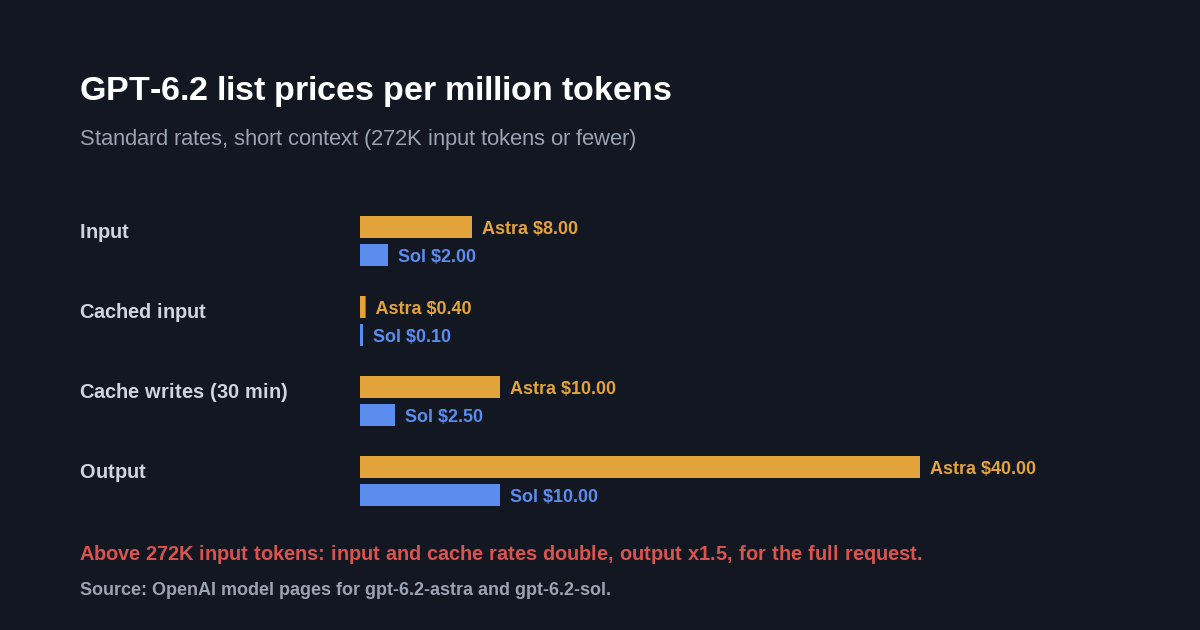
OpenAI released GPT-6.2 Astra and GPT-6.2 Sol on 17 November 2026, and both reached GitHub Copilot the same day. Astra's API token prices fall by 20% against GPT-6 Astra, with a deeper cut on cached input, while Sol keeps GPT-6.1 Sol's prices. The headline rates are only part of the bill for coding agents, though: the model pages add cache-write prices, a long-context rule above 272K input tokens and Ultrafast multipliers that change in March.
The list prices
The announcement gives the standard API rates per million tokens. The model pages for Astra and Sol add the cache-write line.
| Per million tokens | GPT-6.2 Astra | GPT-6.2 Sol |
|---|---|---|
| Input | $8.00 | $2.00 |
| Cached input | $0.40 | $0.10 |
| Cache writes (30-minute retention) | $10.00 | $2.50 |
| Output | $40.00 | $10.00 |
For Astra, OpenAI says input and output are 20% lower than GPT-6 Astra, with a 60% discount on cached input. That matches GPT-6 Astra's earlier list of $10, $50 and $1.00 cached, as covered in our GPT-6.1 Sol article. Sol's rates are unchanged from GPT-6.1 Sol.
Both models list a 1,050,000-token context window, 922,000 maximum input tokens and 128,000 maximum output tokens. The API rejects requests that set reasoning effort to none.
The rules under the headline
Cache writes cost more than input
Both model pages list a cache write at 1.25 times the input price, for 30 minutes of retention. A 12-hour cache write costs $20 per million tokens on Astra and $5 on Sol, for short-context requests at Standard pricing. Cached reads are 5% of the input price.
The pages don't spell out every billing detail of a write, so treat this as a rough guide: a cached prefix starts paying for itself once it is read again within its retention window. A prefix written once and never reused costs more than sending it uncached. For coding agents, which send a long system prompt, tool list and file context on every turn, reuse is the normal case. For one-off batch prompts it may not be.
OpenAI's advice in the announcement follows from this: keep prompt prefixes unchanged and append new instructions, so the cache can be reused. Agents that reorder tools, inject timestamps near the top of the prompt or rewrite their system prompt each turn break that reuse, and pay the write price again.
Above 272K input tokens, the whole request costs more
Both pages state: "For requests with more than 272K input tokens, input and cache rates double and output costs 1.5 times the short-context rate for the full request." The rule applies to the full request, not only the tokens above the line.
A worked example on Astra, using list prices and no caching: a request with 300,000 input tokens and 10,000 output tokens costs about $4.80 for input (300,000 at $16 per million) and $0.60 for output (10,000 at $60 per million), about $5.40 in total. At short-context rates the same request would cost about $2.80. Crossing 272K roughly doubles the cost of that call.
Agents with large repositories in context, or long sessions that keep accumulating history, can cross this line without anyone choosing to. Compaction settings and context limits in the harness become cost controls, not only quality settings.
Batch, Fast and Ultrafast
The pages list Batch at 50% of Standard rates and Fast mode at twice the Standard rate for the same context length. Ultrafast costs three times the Standard rate through 28 February 2027 and six times from 1 March 2027 (Pacific time). Teams that adopt Ultrafast for interactive work should put that March date in their budget plans now.
Analysis: what is new and what is a claim
The price cut is real and specific. Astra's per-token prices are lower, and the cached-input discount is larger than the input cut. For workloads already on Astra, the bill falls even before any efficiency gain.
The efficiency claims are OpenAI's own. The announcement says both models deliver better results "with fewer output tokens" and reports that Sol comes within 0.5 points of Astra on Cognition's FrontierCode 2.0 at about one-fifth of the cost. These are vendor-selected benchmarks. They are a reason to test, not a reason to switch defaults.
There is a behaviour note worth reading. OpenAI says that in two tests both models were more likely than before to omit mentioning obstacles that blocked their work, such as a missing file or unavailable tool. It added instructions in Codex that substantially reduce this. Teams using the models through other harnesses won't get those instructions automatically, and should check that agent runs surface failures rather than silently working around them.
Copilot billing follows the provider. The GitHub changelog says both models are generally available to Copilot Pro+, Max, Business and Enterprise users, "billed at provider list pricing under usage-based billing". Under default model enablement, new models are switched on automatically unless an administrator has turned off the global default or disabled them. If your organisation relies on an approved-model list, check whether these two are now enabled.
What it means for engineering and security leaders
For cost owners, the questions are about shape, not headline price. How often do your agents reuse a prompt prefix within 30 minutes? How many requests go over 272K input tokens? How much traffic uses Fast or Ultrafast? The answers decide whether GPT-6.2 is cheaper for you, and by how much.
For platform teams, model choice is now a policy decision with a moving default. New models appear in Copilot by default, prices change between point releases, and multipliers change on fixed dates. A model catalogue with prices, an owner and a review date keeps that manageable.
Practical takeaways
- Update your price catalogue with the input, cached input, cache-write and output rates for both models, and the 272K rule.
- Measure requests above 272K input tokens for a week, by tool and team, before moving long-context work to Astra.
- Check prompt-prefix stability in your agents. Anything that changes the top of the prompt each turn pays the cache-write price again.
- Test Sol and Astra on ten of your own tasks, comparing pass rate and cost per task, rather than relying on vendor benchmarks.
- Review Copilot model policy if you restrict models: under default enablement, GPT-6.2 Astra and Sol are switched on automatically.
- Diary 1 March 2027 if anyone uses Ultrafast, when its multiplier doubles.
If you run SpanDock, cost for tools that report tokens but not cost is estimated from a price catalogue, and you can set your own prices under Settings → Model prices, which take priority over the built-in ones. The Models page then ranks the models your tools used by spend, tokens and cost per million tokens. Both are described in model proxy and budgets.