
Gemini 4 Hydrogen pricing: flat to 1M tokens, and a Flash price rise in January
Gemini 4 Hydrogen costs $1.50 and $7.50 per million tokens across its whole context window. How that compares with 3.8 Flash before and after 1 January.
Google released Gemini 4 Hydrogen on 12 November 2026 as the fast, lower-cost member of the Gemini 4 family, aimed at "everyday coding and agentic workflows". Its headline price is simple: $1.50 per million input tokens and $7.50 per million output tokens, flat across the full 1 million-token context window. The more useful detail for budget owners is on the pricing page: the model Hydrogen replaces, Gemini 3.8 Flash, is half that price today and rises to exactly Hydrogen's price on 1 January 2027. Choosing between them is mostly a question of what you pay in the next six weeks and what happens to cached input afterwards.
What Google released
According to the developer guide, Hydrogen (gemini-4-hydrogen) shares Gemini 4's unified 1,048,576-token window, in which input, thinking and output tokens all count, and supports long outputs past 64K tokens. It has four thinking levels: low, medium, high and a new xhigh. Google recommends it as the upgrade from 3.8 Flash and as the execution model alongside Gemini 4 Carbon or Argon, which handle planning.
Google's own claims are strong: on the Artificial Analysis Intelligence Index, Hydrogen scores 51 at its default level against Argon's 50, and 54 at xhigh; against 3.8 Flash it reports finishing tasks 2.5 times faster and a Terminal-Bench 4.1 score of 57% against 18.2%. These are vendor figures, and they compare across thinking levels and harnesses that may differ from yours.
The price list
On the Gemini Developer API pricing page, paid-tier prices per million tokens are:
| Gemini 4 Hydrogen | Gemini 3.8 Flash to 31 Dec 2026 | Gemini 3.8 Flash from 1 Jan 2027 | |
|---|---|---|---|
| Input | $1.50 | $0.75 | $1.50 |
| Output, including thinking | $7.50 | $3.75 | $7.50 |
| Cached input | $0.075 | $0.075 | $0.15 |
Hydrogen's Batch and Flex tiers are listed at half the standard rate ($0.75 and $3.75), and Priority at $2.70 and $13.50. Hydrogen supports implicit caching only, with cached input discounted by 95%; explicit caching isn't supported. It is also on the free tier, rate-limited, where the pricing page notes that content is used to improve Google's products.
On Google Cloud, the Agent Platform pricing page lists the same $1.50 and $7.50 for the global endpoint, 10% more for regional ("non-global") endpoints, and a cache write price of $1.875 per million tokens "effective January 12, 2027". So the cloud price is not identical to the API price in every scope, and the cache write charge is a future change, not a current one.
Analysis: what actually moves the bill
Thinking defaults. Output pricing includes thinking tokens, and Hydrogen defaults to high, while the guide notes that Carbon and Argon default to medium. Teams that move sub-agents from Carbon or Argon to Hydrogen and expect the cheaper rate to do all the work should check how many thinking tokens the default level produces on their tasks. Google says Hydrogen often uses fewer output tokens than competitors in its class; that is worth measuring rather than assuming.
No long-context step. Some models charge more per token above a prompt-size threshold. Hydrogen doesn't, which makes cost estimates for large-repository work more predictable, though a 900K-token prompt still costs about $1.35 in input every time it isn't cached.
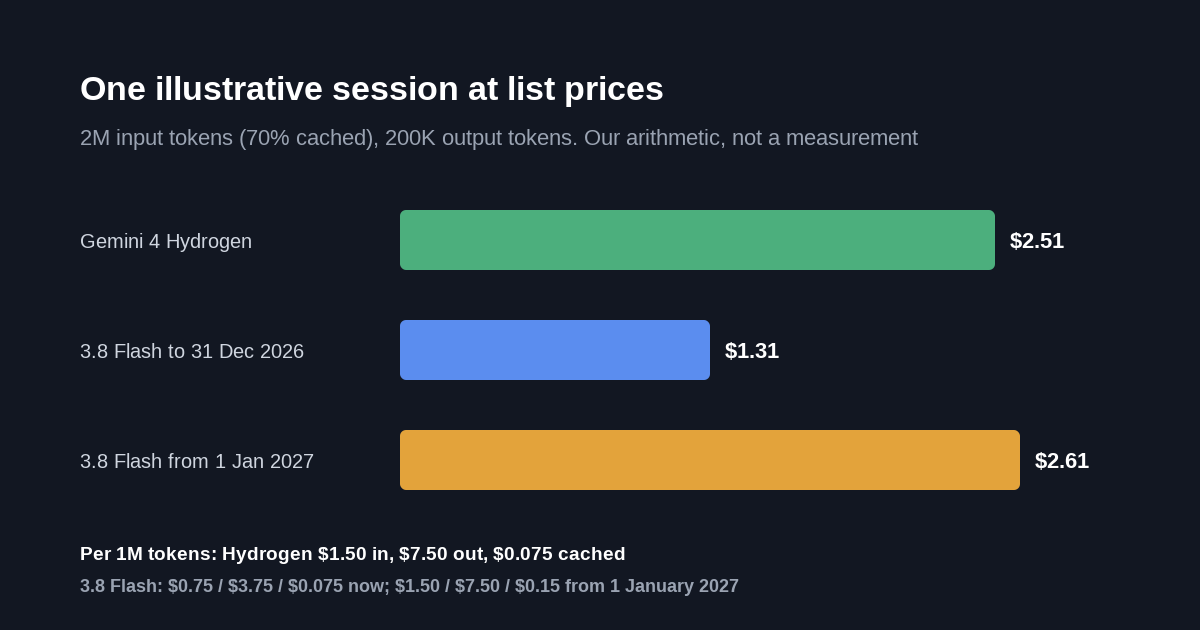
Caching after January. Our own illustration, at list prices: a coding-agent session that sends 2 million input tokens, 70% of them cache hits, and receives 200,000 output tokens costs about $2.51 on Hydrogen. On 3.8 Flash it costs about $1.31 today and about $2.61 from 1 January 2027, when the input and output prices match Hydrogen but the cached input price doubles to $0.15, twice Hydrogen's. The more an agent depends on cache hits, the more that difference matters. These are list prices for one invented session, not a measurement; your token mix will differ.
Copilot billing. In GitHub Copilot, Hydrogen is billed at provider list pricing under usage-based billing and is available on Pro, Pro+, Max, Business and Enterprise. Under default model enablement it is switched on automatically unless an administrator has turned off the global default or disabled this model.
What it means for engineering and security leaders
For the rest of 2026, 3.8 Flash is the cheaper option at list price, and Google's benchmark claims say Hydrogen does more per token. From January, the choice no longer has a price advantage on the Flash side, and cache-heavy agent workloads favour Hydrogen. That makes this a reasonable moment to test Hydrogen on real tasks and plan a switch for the new year, rather than move everything now or stay by default.
Watch the less visible changes as well: the thinking level you send, the regional premium on Google Cloud, the cache write price from 12 January, and the fact that a new model in Copilot can appear in developers' pickers without an explicit decision.
Practical takeaways
- Price 3.8 Flash workloads at January rates now, so the 1 January change doesn't arrive as a surprise in the first invoice of the year.
- Run a side-by-side test of Hydrogen and 3.8 Flash on a sample of your own agent tasks, recording output tokens per task at each thinking level, not just pass rates.
- Set
thinking_levelexplicitly in your clients and gateways instead of inheritinghigh. - Check your endpoint scope on Google Cloud: global and regional prices differ by 10%.
- Decide on Copilot model policy for Hydrogen, especially if you rely on default model enablement.
- Update price tables in your own cost tooling, including the dated 3.8 Flash and cache write changes.
If your AI tools call models through SpanDock's model proxy, every call records the requested model, the model that answered, tokens and cost, and prices you enter under Settings → Model prices take priority over the built-in catalogue when costs are estimated. Per-person budgets, on the Standard plan and up, can limit people to cheaper models near their limit. See model proxy and budgets.
For why the same model can cost more in one agent than another, see the harness sets the bill, and for the cache side, prompt caching for AI coding costs.