
Two LLM gateway flaws in request fields: LiteLLM's Azure parameters and Kong's model name
LiteLLM let callers send Azure credential fields that leaked its secrets; Kong wrote a client's model name into SQL. Fixed versions and what to check.
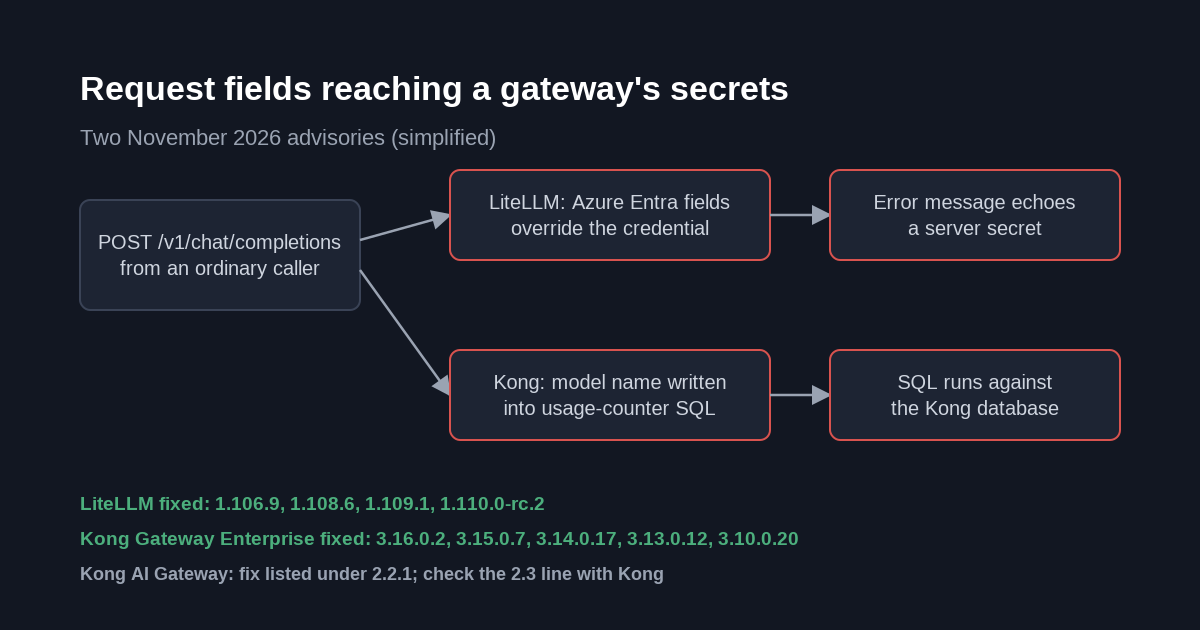
An LLM gateway sits between every AI tool in a company and the model providers, holding the provider keys and counting the spend. That position makes the request body interesting to an attacker: everything a gateway does with a caller's fields happens next to its most valuable secrets. Two advisories published between 10 and 12 November 2026 show the pattern from two directions. In LiteLLM, a caller could send Azure Entra ID credential fields that the gateway should have refused, and read back server secrets through an error message. In Kong Gateway Enterprise and Kong AI Gateway, a client-supplied model name was written into a SQL statement without escaping. Both need only an authenticated or ordinary client, and both are fixed.
LiteLLM: credential fields that weren't blocked
The LiteLLM advisory GHSA-2rwg-2wh4-7c4f, published on 12 November and rated high (CVSS 7.7), affects the proxy only under two conditions: at least one Azure OpenAI (azure/) or Azure AI (azure_ai/) model is configured, and the AZURE_API_KEY or AZURE_OPENAI_API_KEY environment variables are not set, for example where the proxy authenticates to Azure with Entra ID instead of a key.
LiteLLM keeps a blocklist of parameters callers may not set in a request body. It did not include the six Azure Entra ID credential fields: tenant_id, client_id, client_secret, azure_username, azure_password and azure_scope. A caller could send them in an ordinary POST /v1/chat/completions or POST /v1/images/generations request, and they overrode the credential the deployment would otherwise use. Setting client_id to a reference to a server-side environment variable, such as LITELLM_MASTER_KEY, made the proxy resolve it; Entra then rejected the value as an unknown application, and the proxy returned that error, value included, to the caller.
The impact, in the advisory's words: a low-privilege user with access to one Azure model "can read environment variables of the proxy process and the contents of files that an environment variable points to". That typically includes the database URL, provider API keys and the master key, which "gives full proxy admin control".
The fixed versions are 1.106.9, 1.108.6, 1.109.1 and 1.110.0-rc.2. Before upgrading, the advisory suggests blocking the six parameters at a reverse proxy in front of LiteLLM.
The client-side credentials documentation explains why such gaps are easy to create. A request body can carry api_key, which is accepted on any deployment and replaces the configured key for that request; api_base and a few provider parameters are refused unless an operator opts in; and "unmapped params, will be assumed to be provider-specific params, and will be passed through". A blocklist over a body that otherwise passes fields through has to name every dangerous field, for every provider, as providers add new authentication options.
Kong: a model name in a SQL statement
The second flaw, CVE-2026-92544, was published in the GitHub Advisory Database on 10 November and rated high there, without a CVSS score. Its description says SQL injection in the LLM usage counters of Kong Gateway Enterprise and Kong AI Gateway "may allow a client to execute arbitrary SQL against the Kong database via a crafted model name".
The Kong AI Gateway changelog describes the fix: values are now escaped before the SQL statement runs, "preventing SQL injection when a client-supplied model name is written to the license_llm_data table". The Kong Gateway changelog lists the same fix in Gateway Enterprise 3.16.0.2, 3.15.0.7, 3.14.0.17, 3.13.0.12 and 3.10.0.20, all released on 10 November.
For Kong AI Gateway, the fix appears under 2.2.1, also dated 10 November. The 2.3.0 (4 November) and 2.3.1 (10 November) entries don't mention it, so the changelog alone doesn't say whether the 2.3 line includes the fix. If you run 2.3.x, confirm with Kong rather than assume. The same releases fix a cache-key flaw in the request-callout plugin (CVE-2026-123041) that could serve one caller's cached callout response to another.
What it means for engineering and security leaders
The model field is untrusted input. It is tempting to treat model as configuration because it usually names something an administrator set up. It is a string the client controls, and gateways use it for routing, pricing, logging and usage accounting. Each of those is a place where it can be interpreted.
Error messages are an exfiltration path. The LiteLLM flaw didn't need the attacker to reach Azure or the database; it needed the gateway to resolve a reference and echo the result back. Any gateway that resolves env: or file: style references, or forwards provider errors verbatim, should be checked for the same shape.
Low privilege is enough. Both flaws are reachable by someone who already has a normal key or can send ordinary requests. In many companies that is every developer and every CI job. A gateway's master key and provider keys should be treated as reachable by anyone who can call it, until the gateway proves otherwise.
Practical takeaways
- Upgrade LiteLLM to 1.106.9, 1.108.6, 1.109.1 or later in your release line if you use Azure models without an Azure key in the environment. Until then, strip the six Entra parameters at the edge.
- Rotate the master key and provider keys if an affected LiteLLM proxy was reachable by people you don't fully trust, and check logs for requests carrying those parameters.
- Upgrade Kong Gateway Enterprise to the 10 November patch release for your line, and confirm the AI Gateway 2.3.x status with Kong.
- Allow-list request fields at the gateway edge where you can, rather than relying on the gateway's own blocklist alone.
- Check what your gateway returns on provider errors. Upstream messages that echo request values should be sanitised before they reach the caller.
- Keep gateway databases least-privileged, so an injection in a usage table can't reach configuration or credentials.
An earlier LiteLLM flaw with a similar outcome is covered in LiteLLM's Enterprise proxy unauthenticated file read, and for how stolen keys are used once they leak, see LLMjacking and LLM mixers.
Sources
- LiteLLM advisory GHSA-2rwg-2wh4-7c4f: Authenticated secret exfiltration via Azure Entra credential parameters in the request body
- LiteLLM documentation: Clientside LLM credentials
- GitHub Advisory Database: GHSA-jvch-w6fx-vccj (CVE-2026-92544), SQL injection in the LLM usage counters of Kong Gateway Enterprise and Kong AI Gateway
- Kong AI Gateway changelog
- Kong Gateway changelog