
An MCP gateway that fetched any address it was given: the registry SSRF fix
mcp-gateway-registry let users who could register a server point the gateway at internal services. What the High advisory says, and checks for any MCP gateway.
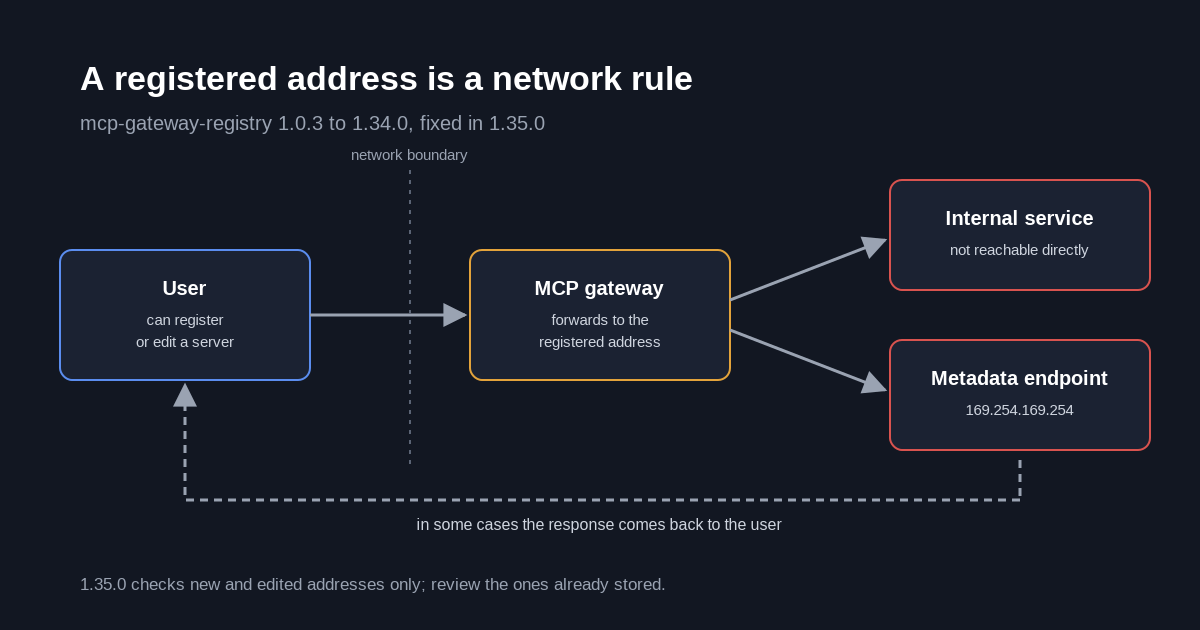
An MCP gateway sits in an unusual place: it accepts requests from people and agents outside a network boundary and makes requests to services on the inside. That makes the question "which addresses will it call?" a security control, not a configuration detail. On 11 November 2026 the maintainers of mcp-gateway-registry, an open-source MCP registry and gateway, published a High-severity advisory showing what happens when the answer is "any address a user registers".
What the advisory says
The advisory, GHSA-fc39-fwh3-wv5r, describes a server-side request forgery (CWE-918) in the registry's server registration and update API. The registry "did not validate the upstream address of a registered server". An authenticated user with permission to register or modify a server could set that address to a service on the deployment's internal network, and the gateway would then send requests there. In some cases it returned the responses to the user. Depending on the network, the advisory says, reachable services could include the cloud instance metadata service "and the credentials it provides".
Key facts, as published:
- Affected: versions 1.0.3 to 1.34.0. Fixed: 1.35.0.
- Severity: High, with the CVSS 3.1 vector
AV:N/AC:L/PR:L/UI:N/S:C/C:H/I:L/A:N: network reachable, low complexity, needing a low-privileged account, with a scope change and high confidentiality impact. - No package listed. The advisory is not tied to a package in an ecosystem, so tools that alert by matching package versions may have nothing to match. Check your deployed version by hand.
A note on timing: release 1.35.0 is dated 29 October 2026, about two weeks before the advisory, and its release notes don't describe the address check. That is a common pattern, fixing first and disclosing after, but it means "we upgraded recently" is not the same as "we read why". The current release at the time of writing is 1.38.2.
The advisory also warns about version sequencing: a separate issue in the product's external management API was fixed in 1.25.0, so a deployment on 1.25.0 or later is still affected by this one until 1.35.0.
The fix doesn't clean up what is already stored
The most important line for operators is this: 1.35.0 "validates server upstream addresses when a server is registered or modified", and "leaves server configurations stored before the upgrade unchanged". If someone registered an internal address while you ran an affected version, the upgrade does not remove it. The advisory asks operators to:
- review the upstream addresses of registered servers and correct or remove any you didn't intend;
- review application logs from the affected period for unexpected registrations and changes;
- if the registry runs with an attached cloud role and the logs can't rule out misuse, review that role's activity and rotate its credentials.
For deployments that can't upgrade yet, it suggests limiting who can register and modify servers, restricting outbound network access from the registry and auth-server components, and, on Amazon EC2, requiring IMDSv2 and giving each component's role only the permissions it needs.
Why gateways keep meeting SSRF
The MCP project's own security best practices already have a section on SSRF, written about MCP clients that follow URLs during OAuth discovery. Its advice carries over well to gateways: block private and link-local ranges, including 169.254.0.0/16 where cloud metadata lives; validate redirect targets as well as the first URL; watch for DNS rebinding, where a name resolves to a safe address at check time and an internal one at use time; and, for server-side deployments, route outbound requests through an egress proxy that enforces network policy. It also warns against hand-written IP validation, because encoding tricks such as octal, hex and IPv4-mapped IPv6 addresses get past custom parsers.
The IMDSv2 advice in the advisory is worth understanding too. AWS documents IMDSv2 as a session-oriented method: a client first makes a PUT request for a token. The EC2 user guide says those PUT requests are rejected if they carry an X-Forwarded-For header, and their response has a hop limit of 1 by default. Those properties make a forwarded request through a proxy much less likely to obtain credentials. They reduce exposure; they don't replace fixing the gateway.
What it means for engineering and security leaders
Registering an MCP server is an act of network configuration. In many organisations the permission to do it is handed out generously, because it feels like adding a bookmark. This advisory shows it can be closer to editing a firewall rule. Two questions are worth asking of any MCP gateway or registry, whatever its vendor:
- Who can add or change an upstream address, and is that permission reviewed like other network changes?
- What can the gateway itself reach? If its outbound traffic isn't limited, its permissions are effectively the network's.
It is also a reminder to keep an inventory of MCP infrastructure as well as MCP servers. Gateways, registries and their auth components are now part of the attack surface, and their advisories don't always reach the tools you use for dependencies.
Practical takeaways
- Upgrade mcp-gateway-registry to 1.35.0 or later; 1.38.2 is current. Don't stop at 1.25.0.
- Export the list of registered servers and review every upstream address, especially private, loopback and link-local ones.
- Search logs from the affected period for unexpected registrations or edits.
- Rotate the cloud role's credentials if you can't rule out misuse.
- Restrict egress from MCP gateways and registries to the destinations they need, through a proxy if you can.
- Require IMDSv2 on EC2 hosts that run MCP infrastructure, and keep instance roles minimal.
- Treat "register a server" as a privileged permission in every MCP gateway you run.
Sources
- GitHub advisory GHSA-fc39-fwh3-wv5r: Server-side request forgery in the server registration and update API in mcp-gateway-registry (11 November 2026)
- mcp-gateway-registry release 1.35.0 (29 October 2026)
- Model Context Protocol: Security best practices, Server-Side Request Forgery
- Amazon EC2 User Guide: Use the Instance Metadata Service to access instance metadata