
MAI Code 2 in Copilot: read the cost claims at the price after May 2027
MAI Code 2 and Code 2 Flash launch in Copilot at half price until 17 May 2027, and Microsoft's cost comparisons use that price. What changes when it ends.
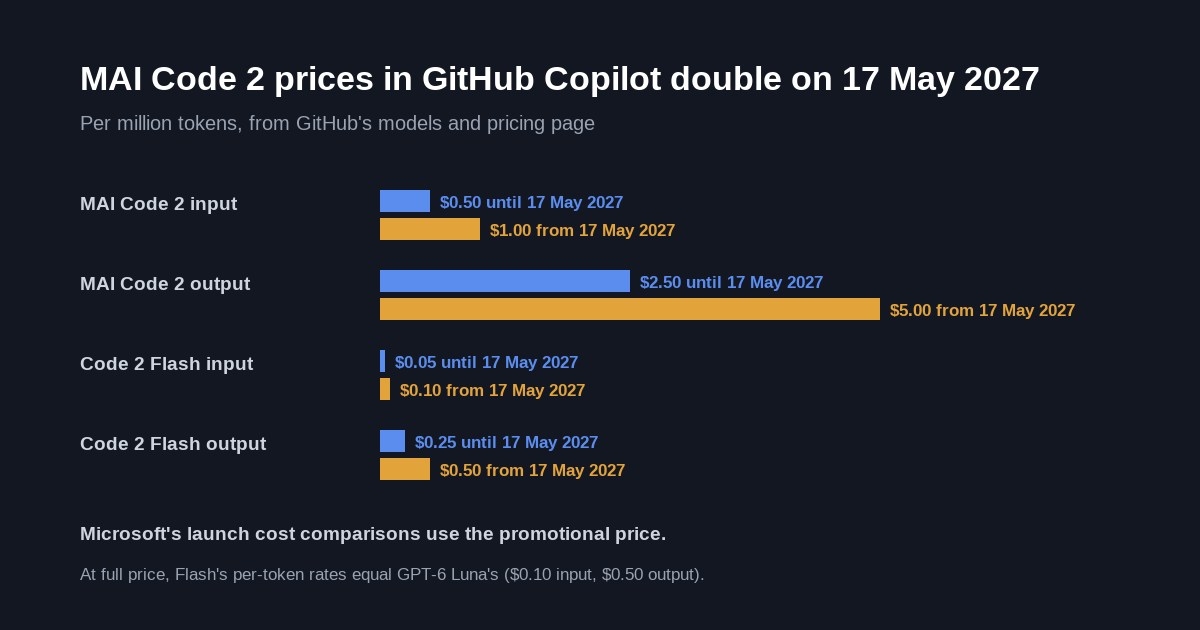
Microsoft released two coding models, MAI Code 2 and MAI Code 2 Flash, in GitHub Copilot on 17 November 2026. The launch pitch is price-performance: close to the leading models' benchmark scores at a fraction of their cost. Both models are on a 50% promotional price until 17 May 2027, and Microsoft's footnotes say its cost comparisons use that promotional price. Anyone choosing a default model for the next year should work out what those comparisons look like at the full price too.
What was released
According to Microsoft's announcement, MAI Code 2 targets everyday enterprise coding: taking code to production, debugging, multi-file changes, repository-wide reasoning and user interfaces. MAI Code 2 Flash targets high-volume work such as explanations, targeted edits and routine fixes. Microsoft is explicit about the limits: the models are "explicitly not yet tuned for harder problems, like fundamental science research and very long-horizon agentic work".
GitHub's changelog lists availability:
- MAI Code 2: Copilot Pro, Pro+, Max, Business and Enterprise.
- MAI Code 2 Flash: the same plans, plus Copilot Free and Student.
- Both appear in VS Code, Visual Studio, Copilot CLI, the cloud agent, the Copilot app, github.com, GitHub Mobile, JetBrains, Xcode and Eclipse, and are billed under usage-based billing.
Outside Copilot, Microsoft says Code 2 Flash is in limited-access preview in Microsoft Foundry and that other platforms will follow "soon". For now, Copilot is the only place to use MAI Code 2.
The prices
GitHub's models and pricing page gives the per-million-token rates, with the end date of the promotion in its footnotes:
| Per million tokens | Until 17 May 2027 | From 17 May 2027 |
|---|---|---|
| MAI Code 2, input | $0.50 | $1.00 |
| MAI Code 2, cached input | $0.025 | $0.05 |
| MAI Code 2, output | $2.50 | $5.00 |
| MAI Code 2 Flash, input | $0.05 | $0.10 |
| MAI Code 2 Flash, cached input | $0.005 | $0.01 |
| MAI Code 2 Flash, output | $0.25 | $0.50 |
For comparison, the same page lists GPT-6.1 Sol at $2 input and $10 output in its default tier, Claude Opus 5.5 at $4 and $20, and GPT-6 Luna and Claude Haiku 5.5 at $0.10 and $0.50 in their default tiers. In Copilot, usage is converted into AI credits at $0.01 each.
The claims, and the footnotes
Microsoft averages four benchmarks (DeepSWE 1.1, Terminal Bench 2.1, SWE-Atlas and FrontierCode v1.1) and reports that MAI Code 2 gives "98% of the performance of GPT-6.1 Sol at 40% of the cost, and 96% of Claude Opus 5.5's performance at just 5% of the cost". For Flash, it reports performance comparable to GPT-6 Luna and Claude Haiku 5.5 at 65% and 20% of their cost.
The footnotes add two conditions. All models were run at maximum reasoning effort, three of the benchmarks on Microsoft's internal evaluation platform using Copilot CLI. And the MAI costs are "shown at its 50% promotional price", for both models.
What the same comparisons look like at full price
From 17 May 2027, every MAI rate doubles. If token use per task stays as Microsoft measured it, the cost ratios double too. This is our arithmetic, not Microsoft's:
| Comparison | At promotional price (Microsoft) | At full price (doubled) |
|---|---|---|
| MAI Code 2 vs GPT-6.1 Sol | 40% of the cost | about 80% |
| MAI Code 2 vs Claude Opus 5.5 | 5% | about 10% |
| MAI Code 2 Flash vs GPT-6 Luna | 65% | about 130% |
| MAI Code 2 Flash vs Claude Haiku 5.5 | 20% | about 40% |
Two things stand out. MAI Code 2 stays far cheaper than Opus 5.5 at either price, and somewhat cheaper than GPT-6.1 Sol. But Flash's advantage over GPT-6 Luna reverses: at full price, the per-token rates are identical ($0.10 input, $0.50 output), and Microsoft's own token measurements imply Flash would cost about 30% more per task. The comparison prices for the other models could change before May 2027 as well, in either direction.
Benchmarks at maximum effort
Running everything at maximum reasoning effort is a fair way to compare capability, but most teams don't run their coding agents that way all day. At lower effort, both quality and token use change, and not necessarily by the same amount for every model. Microsoft's own caveat says results "vary by workload, model configuration, reasoning effort, and pricing assumptions".
What else changes
GitHub will deprecate the previous model, MAI-Code-1.1-Flash, across Copilot on 18 December 2026, with the deprecation notice suggesting the latest MAI Code Flash model instead. It notes that Copilot Enterprise administrators may need to enable the alternative through model policies. Flash's full price ($0.10 and $0.50) is lower than 1.1-Flash's current rates ($0.20 and $1.20), so moving across saves money even after the promotion.
The changelog also notes that, under default model enablement, new models are switched on automatically unless an administrator has turned off the global default or disabled the model.
What it means for engineering and security leaders
MAI Code 2 is a credible new option for routine coding work, and the promotion makes it cheap to try. The risk is anchoring: a team that sets it as the default on the strength of "40% of the cost" will see that figure become roughly 80% in May, with no change in code or behaviour. Budget for the full price from the start, and treat the promotional months as a trial period.
The model's stated limits also matter for routing. Microsoft says it isn't tuned for very long-horizon agentic work, so long autonomous tasks are a poor place to make it the default.
Practical takeaways
- Put 17 May 2027 in your cost model now, with the doubled MAI rates.
- Compare Flash and GPT-6 Luna on your own tasks if Flash is a candidate for high-volume work; at full price their per-token rates are the same.
- Test at the reasoning effort you actually use, not only at maximum.
- Move off MAI-Code-1.1-Flash before 18 December, and check model policies allow its replacement.
- Decide whether new models should be enabled by default in your Copilot organisation.
- Keep long autonomous tasks on models tuned for them, as Microsoft itself suggests.
Sources
- MAI Code 2 and Code 2 Flash: Everyday coding at scalable prices (Microsoft AI, 17 November 2026)
- MAI Code 2 and MAI Code 2 Flash in GitHub Copilot (GitHub Changelog, 17 November 2026)
- Models and pricing for GitHub Copilot (GitHub Docs)
- Upcoming deprecation of MAI-Code-1.1-Flash in December (GitHub Changelog, 17 November 2026)