
Timestream for InfluxDB MCP Server: a token sent to whatever URL a call named
CVE-2026-126681: the AWS Labs InfluxDB MCP server could send its API token to an attacker's URL. The fix shipped in July; the advisory came in November.
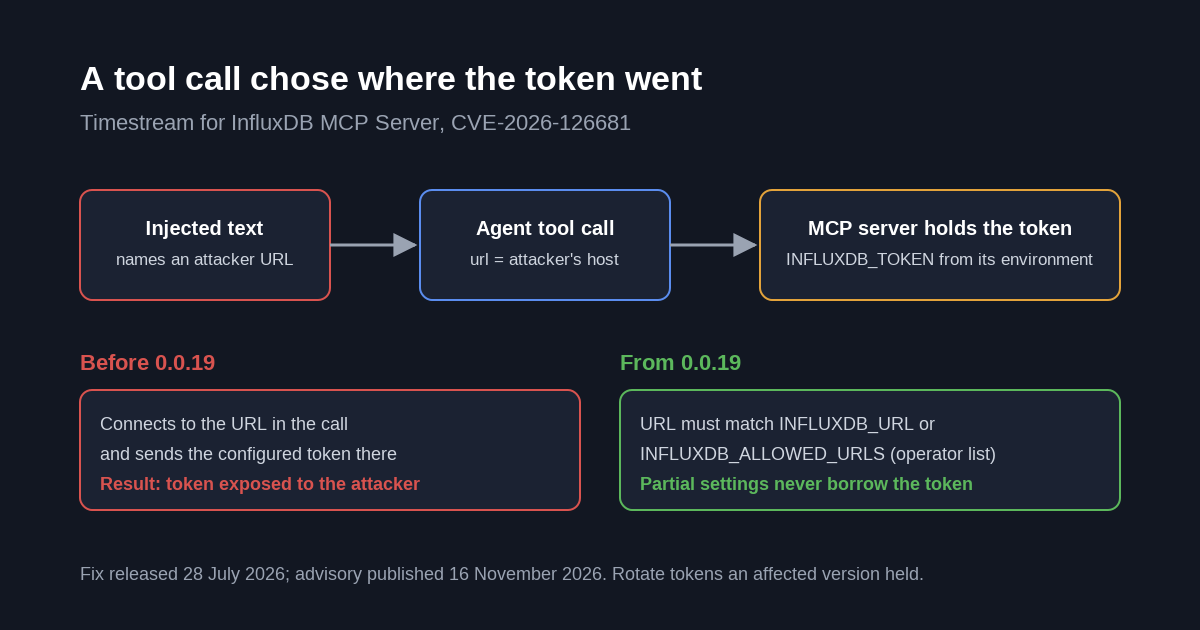
On 16 November 2026, AWS published CVE-2026-126681 for the AWS Labs Timestream for InfluxDB MCP Server. The server let a tool call name the InfluxDB endpoint to connect to, and it would send the API token configured on the server to that endpoint. If text the agent read could put an attacker's URL into a call, the token went to the attacker. The fix shipped in version 0.0.19 at the end of July; the advisory followed almost four months later. If you run this server, upgrade and rotate the token. If you write or approve MCP servers, the pattern is worth checking for everywhere.
What the advisory says
The GitHub advisory GHSA-2f9r-g4f3-wc2j and the AWS bulletin 2026-185-AWS describe the same issue. The server, awslabs.timestream-for-influxdb-mcp-server, lets MCP clients manage Amazon Timestream for InfluxDB resources and read and write InfluxDB data. Its connection handling "did not restrict which endpoints it connects to". AWS's scenario is prompt injection: an attacker introduces a crafted InfluxDB URL into the client's context, the agent passes it to a tool, and the server connects to it with the token it holds.
- Affected: versions 0.0.12 up to, but not including, 0.0.19.
- Fixed: 0.0.19. AWS recommends the latest version and asks anyone who used an affected version to rotate the InfluxDB API tokens configured for the server.
- Workaround: none that fully fixes it. AWS suggests a least-privilege token and keeping the server away from clients that process untrusted content.
- Severity: GitHub rates it moderate, CVSS 3.1 score 5.5. AWS labels the bulletin "Important (requires attention)".
Where the records disagree
Three details in the published records don't line up, and they matter if you triage from scanners.
First, both texts call the attacker "remote" and "unauthenticated", while the CVSS vector uses a local attack vector with user interaction required (AV:L/UI:R). That is a common way to score prompt-injection issues in locally run servers, but it pulls the number down. A score of 5.5 does not mean the token is hard to steal once an agent reads hostile text.
Second, the GitHub advisory's structured fields list "No package listed" and give the patched version as "<0.0.19", which reads as a range of affected versions, not a fix. The advisory's own text and the AWS bulletin both say the fix is in 0.0.19. Dependency scanners that read the structured fields may match this advisory badly, or not at all.
Third, the dates. The fix was pull request 4149, "tighten connection configuration handling", merged on 24 July 2026. PyPI's release history shows 0.0.19 uploaded on 28 July. The advisory is dated 16 November. Anyone who has upgraded at least once since August was already protected; anyone who pinned an older version had no advisory to prompt them for about sixteen weeks.
What changed in the fix
The project's README now describes connection parameters as "a single trust boundary":
- The server uses
INFLUXDB_URL,INFLUXDB_TOKENandINFLUXDB_ORGfrom its environment when a call supplies no connection parameters. - If a call supplies any connection parameter, it must supply all of them. The server's own credentials are never used to fill in a partial set.
- A URL supplied in a call must match
INFLUXDB_URLor an entry in a new, optionalINFLUXDB_ALLOWED_URLSlist.
The README calls this a breaking change for clients that sent some parameters and relied on the environment for the rest. We checked the 0.0.19 package from PyPI: it contains the allow-list setting.
A second change that got no advisory text
The server's changelog records another security fix. Writes, including creating and deleting clusters and instances and writing data points, used to be authorised by a tool_write_mode parameter on the tool call itself. In the changelog's words, that allowed "a caller (or prompt-injected agent) to self-authorize destructive operations". Pull request 4582, merged on 16 September, replaced it with an ALLOW_WRITE environment variable read when the server starts; read-only is the default. We found it in the 0.1.2 package, released on 22 September. The changelog still files the entry under "Unreleased".
The pattern behind it
This is the same mistake in two forms: the server let the request decide something only the operator should decide. In the first case it was where a credential may be sent; in the second, whether writes are allowed. An agent's tool arguments are model output. If any text the model read can shape them, they carry the same trust as that text.
We wrote about the wider family in MCP servers keep trusting the wrong URLs. The new twist here is the credential. A server that holds a token and accepts a destination from the caller is a token-forwarding service, whatever its tools are called.
What it means for engineering and security leaders
- Version pins hide fixed bugs. The fix was public for months before the advisory. Teams that install MCP servers with
@latestwere covered by accident; teams that pinned for stability were not. Pinning is still right, but it needs a review cadence that doesn't wait for a CVE. - Scanner output is not enough here. With odd structured data in the advisory, check the version by hand.
- Rotation is part of the fix. AWS asks for token rotation, because a token that left before the upgrade still works afterwards.
- Workarounds have limits. AWS says none fully fixes this. A least-privilege token only shrinks what a stolen one can do.
Practical takeaways
- Find every install of
awslabs.timestream-for-influxdb-mcp-server, includinguvxentries in developers' MCP settings, and move them to the latest release (0.1.4 at the time of writing). - Rotate any InfluxDB API token that an affected version held, and scope the new one to the buckets the agent needs.
- If people use more than one InfluxDB endpoint, list them in
INFLUXDB_ALLOWED_URLSrather than letting calls choose. - Check
ALLOW_WRITEis unset orfalsewherever the agent only needs to read. - For any MCP server you approve, ask two questions: can a tool argument choose where a credential goes, and can a tool argument turn on writes? Either "yes" is a finding.
If your MCP servers run behind SpanDock's MCP gateway (Premium and Enterprise plans), connector tokens are kept in the server's credential store and are never sent to developers' computers, so there is one place to upgrade a server and rotate its token. Each connector starts read-only for everyone, tools can be allowed or denied by name, and every call is recorded. The gateway does not change what a server you run does with its own token, so the upgrade still matters.
Sources
- GHSA-2f9r-g4f3-wc2j: Improper restriction of intended endpoints in AWS Labs Timestream for InfluxDB MCP Server (GitHub, 16 November 2026)
- CVE-2026-126681 bulletin 2026-185-AWS (AWS Security Bulletins, 16 November 2026)
- fix(influxdb): tighten connection configuration handling, awslabs/mcp pull request 4149 (merged 24 July 2026)
- awslabs.timestream-for-influxdb-mcp-server release history (PyPI)
- Timestream for InfluxDB MCP Server README: InfluxDB connection security (awslabs/mcp)